Watch the film
| Size in ft: | Width: 9'9" x Length: 13'3" |
| Size in Inch: | Width: 117" x Length: 159" |
| Size in meters: | Length: 4.04 x Width: 2.97 m |
| Colors: | Ivory, Beige, Rust, Cream, Olive Green |
| Shape: | Rectangular |
| Woven: | 100% Hand-knotted | Handmade |
| Foundation: | Cotton |
| Pile: | Wool and Silk |
| Age: | New |
| Design: | Mahi Tabriz | Herati Fish Lattice | Central Medallion |
| Origin: | Made in India |
| Condition: | Perfect | Brand New | Never used |
9'9" x 13'3" Mahi Tabriz Design Rug | Ivory Herati Fish Lattice | Wool & Silk Medallion
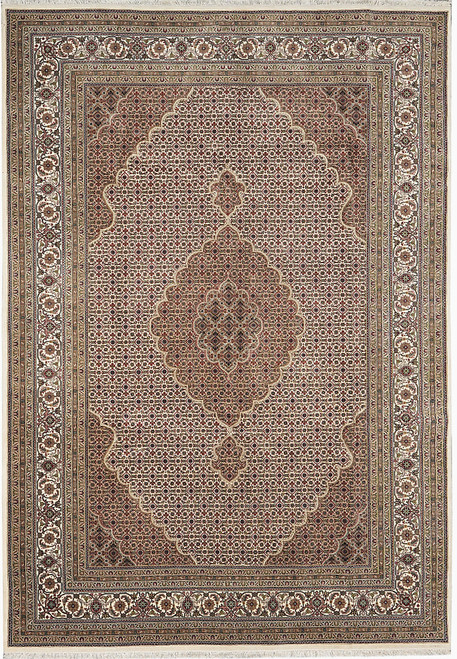
Everything about this 9'9" x 13'3" piece is built on restraint: an ivory ground, one scalloped medallion, and a Mahi Herati lattice drawn so small that from standing height the field reads like woven cloth rather than a pattern. It is hand-knotted in wool with silk accents on a cotton foundation, brand new, never laid in a home, and the pile still stands at its full original height with sharp outlines on every motif. At this footprint it holds a complete seating group or a 10 seat table with chairs pulled back, which is exactly why buyers shopping 10x13 rugs keep coming back to this drawing. Like everything we ship, it arrives with a certificate of authenticity confirming a genuine hand-knotted Oriental rug and not a power-loomed copy.
Design and Motifs
The field is a full Mahi lattice, the fish pattern, in which every diamond compartment holds a small rosette flanked by 4 curved lanceolate leaves that read as fish circling a pool. That repeat runs uninterrupted from selvage to selvage and continues straight through the medallion, which is the test of a well drawn Mahi: the lattice never breaks stride, it simply changes ground color. At center sits a multi-lobed scalloped medallion with a small quatrefoil core, ringed by a tonal halo and finished top and bottom with stepped pendants that taper into serrated finials. The 4 corners carry matching spandrels cut on the same scalloped line. The main border is an ivory band of alternating star rosettes and shield-shaped cartouches linked by broad curling acanthus leaves, and it is framed by 8 narrow guard stripes of reciprocal hooks, meandering vine and running florettes, the sort of layered framing that is far more work than a single wide border.
Ivory Ground With Beige, Rust and Olive
The ground is ivory, warm rather than stark, and because the lattice is worked in rust, beige and soft olive at very small scale the whole field settles into a golden sand tone from across the room while staying crisply legible up close. The medallion shifts to a deeper camel beige with a pale sea green core, outlined in near-black and edged with a thin line of true red that gives the shape its snap. Rust carries the rosettes and the small florettes in the guard stripes; olive green and a muted celadon fill the leaves and several of the border cartouches; cream and clear ivory keep the border open so the palmettes read individually instead of merging. Silk accents catch the light along the outlines and on the medallion tracery, so the rug changes tone as you walk around it. It is a quiet, neutral palette that sits comfortably with oak, walnut, linen and warm white walls.
Made in India in the Mahi Tabriz Tradition
This rug was made in India, and that is a recommendation rather than a caveat. India is where most of the world's good contemporary hand-knotted work is produced today, with workshops that still cartoon their designs by hand, spin and dye their own yarn, and keep experienced weavers on the same loom for the months a piece of this size demands. The Mahi Tabriz pattern is one of the hardest classical layouts to keep honest at 13 feet, because any drift in the lattice shows immediately across an open ivory field, and here the rows stay true corner to corner. The weave is tight and even, the pile is clipped low so the fine drawing stays readable, the selvages are wrapped by hand and the fringe is a continuation of the cotton warps rather than a sewn-on finish. Turn a corner over and the back shows the same clarity as the front, which is the honest measure of how much knot count actually went into it.
9'9" x 13'3" Mahi Tabriz Design Rug | Ivory Herati Fish Lattice | Wool & Silk Medallion
Ask about this rug
This piece is the only one of it, so the things worth knowing about it are particular to it. If you want to talk through the size, the colour in your own light, or the weave, speak to someone here first.