Vintage Rugs (Pre-1970)
Vintage is the trade's word for a rug woven before about 1970, which means more than half a century of being walked on. The pile is lower than it left the loom, the colours have settled, and the wool has taken a low sheen from use. None of that is wear in the sense that matters. Reading one is mostly a matter of separating what use did from what neglect did.
1970 is a convention, not a birthday
The line is trade shorthand, agreed loosely and applied loosely. Most rugs carry no date at all, though workshop pieces from Tabriz or Qom sometimes carry one knotted into a cartouche. Everything else is dated by reading the rug: the foundation, the dyes, the spin of the wool, how far the pile has come down. That gives a decade, not a year. A confident single date on an undated rug is an opinion.
Even, or local
Patina is even. The pile is lower than it was, but it is lower everywhere, and the colours have quietened together. Damage is local: a worn lane where a door swung, a pale square under where a chair stood, a corner where the foundation shows through. Look across the rug at a shallow angle from the far end, so the light rakes the pile, and both read at once. Sun fade is the third case: neither even nor local but a gradient, strongest down the side that faced the window.
The fringe is structure, not trim
Fringes are the ends of the warps the rug was woven on, left exposed. Fifty years of vacuuming shortens them, so a reduced or rewoven fringe on an old rug is housekeeping rather than injury. What matters is the finish just above it, the woven band and overcast that stop the last row of knots working loose, and the selvedges down the sides. A rug fails at its edges before it fails in the field.
Most of the fading is behind it
Dyes move fastest early. Whatever a palette was going to do in daylight, a pre-1970 rug has largely done, which is why old colour looks settled and will look much the same in another decade. That is the real argument for the band. The opposite argument belongs to the new end, where colour is at full strength with all that movement still ahead, and the 1970s to 2000s band sits between.
What the date does not promise
Vintage is not a synonym for natural dye. Synthetic dyes reached the weaving regions in the nineteenth century and were in ordinary use long before 1970, so age settles nothing about what coloured the wool. It is not a quality grade either: a coarse village runner and a fine workshop piece both turn fifty. Nor is it rarity, since a great deal was woven mid-century in every origin here.
Which old rugs to walk on
An old wool village rug is the most forgiving thing on this list. A vintage Heriz, Bijar or Hamadan has already proved it takes traffic, and a low even pile hides the next twenty years better than a full one. Tribal weaving of the same decades behaves the same way. The exception is fine silk, thin when new and thinner at sixty, which belongs where it is walked on lightly. The three age bands only make sense against each other.
-

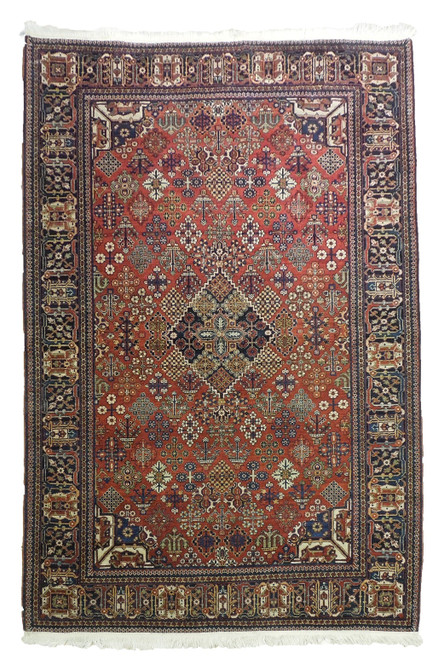
8'8" x 12'2" Persian Najafabad Rug | Red Field, Navy Border, Weeping Willow Spandrels | Vintage 1970s
Was: $3,120.00Now: $2,999.00 -

-
-

-

-
-
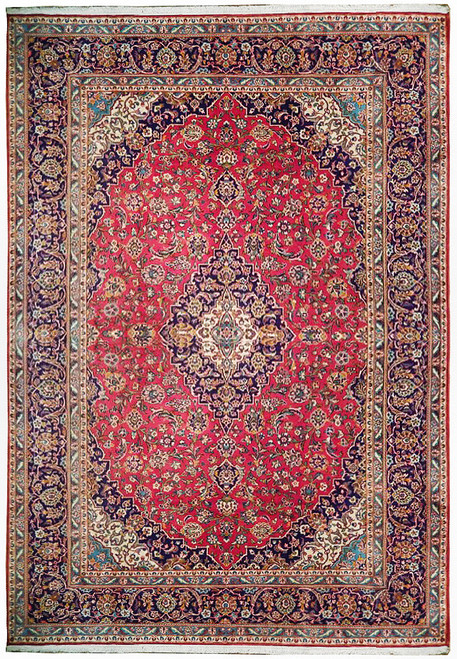
9'9" x 13'4" Persian Kashan Rug | Red Floral Field with Navy Lobed Medallion | Semi-Antique, Excellent Condition
Was: $2,930.00Now: $2,599.00 -

-

-

-

-