Gold & Yellow Rugs
Yellow came from pomegranate rind, weld, vine leaf, onion skin and larkspur, and every one of them is less lightfast than madder or indigo. Yellow is the first colour to go. That single fact explains more about how old rugs look than anything else in the dye cupboard: the golds have softened, the greens have cooled, and the whole palette has drifted toward blue and brown.
The dyestuffs, and their weakness
Pomegranate rind was the everyday yellow across Persia because the fruit was everywhere and the rind was waste. Weld, vine leaf, onion skin and the yellow larkspur the trade calls isparak fill out the rest. Saffron appears in the literature and almost never in a floor rug, for the obvious reason. All of these sit on the wool as relatively fragile compounds, and sunlight breaks them down faster than it touches indigo. A field that reads honey today may have been closer to lemon in 1920, and the sunward end of a rug left in one place for decades will be noticeably paler than the shaded end.
Gold that is not a dye at all
A good deal of what buyers call gold is sheen rather than pigment. In silk and wool and silk weaving, a pale cream or straw pile lying in one direction throws back light as gold and, seen from the other end of the room, as ivory. A fine Qom demonstrates this better than any argument. It is also why a gold rug photographs unreliably: the camera picks one of the two readings.
Regions that commit to it
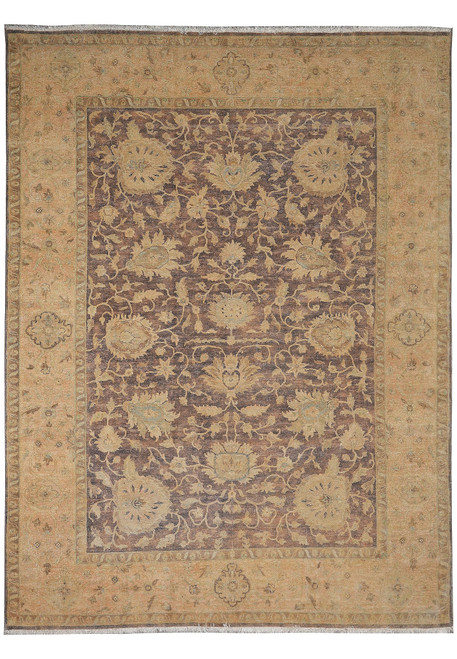
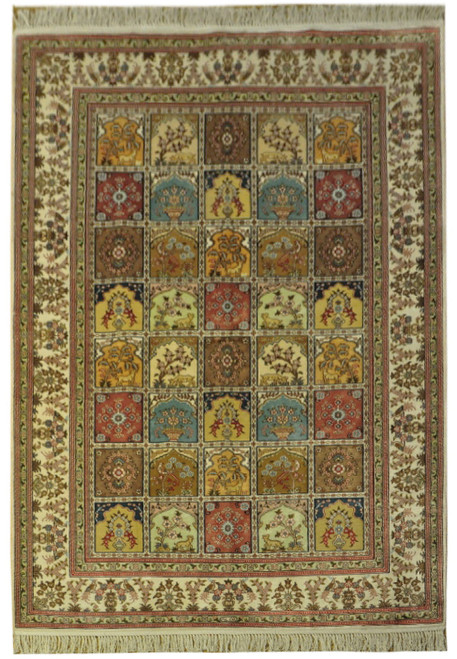
Gold grounds are a Khorasan habit above all, and both Kashmar and Moud weaving use them. Kerman uses soft yellow as a secondary in a rose or ivory field, Bakhtiari panels use it as one compartment in six, and a good deal of Chinese production is built on an even gold field with sparse drawing.
What it does to a room
A whole gold field is a commitment. Under warm lamplight it fills a room and makes the walls look further away. Under a north window it turns mustard, and against a cool grey wall it can look dirty rather than warm. Yellow used as a highlight is far easier to live with than yellow used as a ground, which is why the safer version of this taste is often a rust or ivory rug with gold drawing. For how yellow behaves once indigo is laid over it, see green.
-
-

-
-

-
-

-

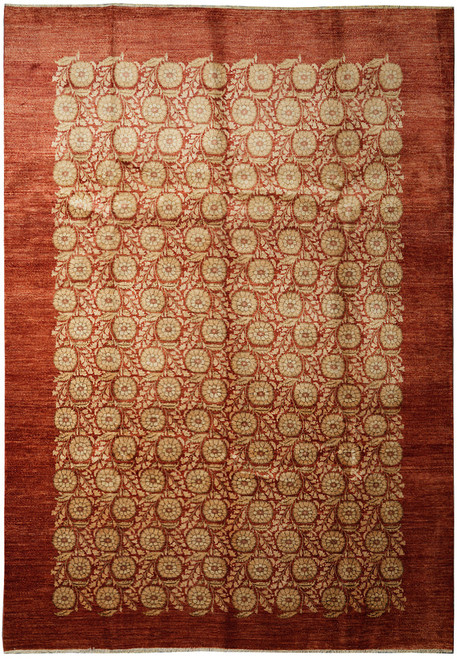
9'5" x 11'11" Ziegler Area Rug | Golden Beige Floral Motif | All-Over | Agra Design
Was: $3,900.00Now: $3,660.00 -

-

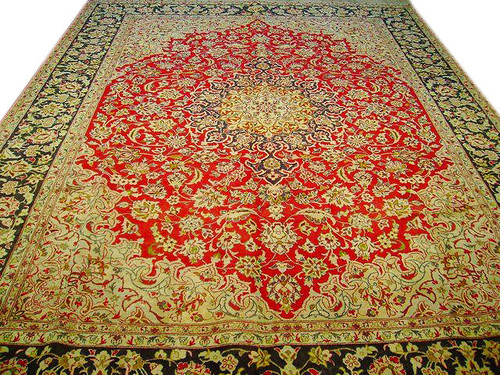
7'1" x 7'3" Round Oriental Area Rug | Fine Wool & Silk | Persian Tabriz-Inspired Star Medallion | New
Was: $5,000.00Now: $4,599.00 -
-

-
