Caucasian & Russian Rugs
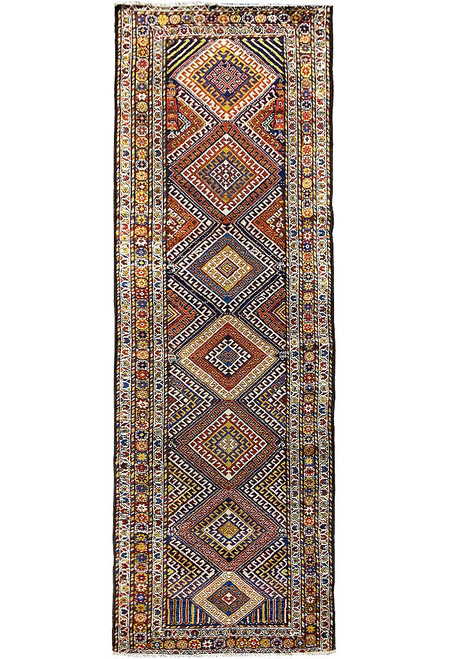
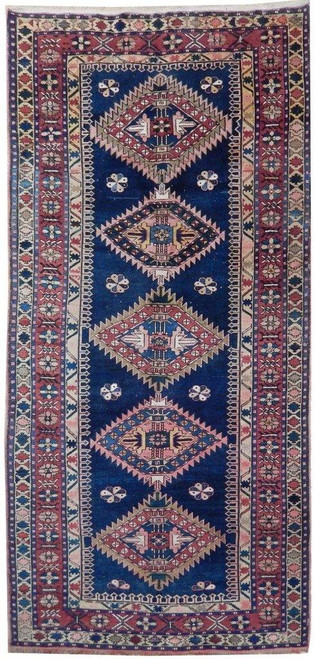
Caucasian rugs look like heraldry and very little like gardens. The fields are built from medallions, stars, hooked latch devices and stepped outlines in a small number of saturated colours, drawn with the confidence of something copied for two hundred years. If a curved Persian field feels fussy to you, this is the tradition to look at.
A region, not a country
The Caucasus is a band of mountains between the Black Sea and the Caspian, historically home to dozens of weaving groups across what is now Azerbaijan, Armenia, Georgia and the southern Russian republics. The trade still sorts the rugs by the old district names: Kazak, Shirvan, Kuba, Karabagh, Gendje. They share a symmetric knot with Turkey and a design logic with nowhere else.
The Kazak
The Kazak is the best known and the boldest: very large devices on a red or ivory ground, a long lustrous pile, a coarse knot and a short list of colours used at full strength. Nothing else in this catalogue reads as clearly from across a room. It is also the reason Caucasian design keeps being revived, most visibly in the new production coming out of Pakistan.
Why the drawing is angular
Two reasons, and both are structural rather than a matter of taste. The symmetric knot sits square and steps cleanly; and these were village and small-workshop rugs woven without a paper cartoon, from patterns held in memory. A shape you can carry in your head and reproduce exactly is a shape made of straight lines. The same logic shapes the wider tribal family.
Colour at full strength
Caucasian dyers used madder, indigo, and a strong yellow, and they did not blend. A typical field uses six or eight colours, each one clear, with white used as an outline to separate them. The effect is closer to stained glass than to painting, and it is why these rugs sit in the red, blue and ivory families rather than in any soft one.
Size, and what that means for a room
Caucasian looms were narrow, so genuine old pieces are mostly small: scatter sizes and long narrow rugs rather than room-size carpets. That makes the accent and 4x6 bands the natural place to look, and runners are common. If you need a large rug with this character, the modern reweaves are where to find it.
Condition
Most genuine Caucasian rugs are old, which means the question is condition rather than age. Look for even wear across the field rather than a worn path, and check the ends and selvedges, which is where a rug fails first. The age bands explain what to expect, and a wool pile in this construction will take a great deal more use yet.