Watch the film
| Size in ft: | Width: 5' x Length: 10'2" |
| Size in Inch: | Width: 60" x Length: 122" |
| Size in meters: | Length: 3.10 x Width: 1.52 m |
| Colors: | Soft Antique Coral Red, Blue, Gold Yellow |
| Shape: | Rectangular |
| Woven: | 100% Hand-knotted | Handmade |
| Foundation: | Wool foundation |
| Pile: | |
| Age: | 1950's |
| Design: | Kazak | Triple Linked Medallion | Geometric |
| Origin: | Caucasus | Caucasian Kazak |
| Condition: | Excellent |
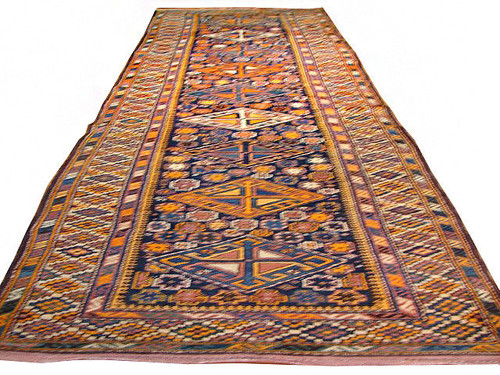
5' x 10'2" Caucasian Kazak Rug | Gallery Size Triple Medallion Geometric | 1950s Wool, Excellent Condition
This is a Caucasian Kazak woven in the 1950s, and it is the kind of piece you buy because of how it was drawn rather than how fine it is. The 5' x 10'2" format is a true gallery size, long and narrow, with three linked stepped medallions marching down a soft coral red field and a wide blue border carrying hooked keyhole panels. The wool is heavy, lustrous and full of lanolin, the handle is thick and floppy the way mountain weaving should be, and the pile has mellowed into that chalky, lived-in surface collectors look for while the knots still sit tight and even. An old warehouse tag is still stapled to the back, visible in the last photograph along with our own inventory label. Every rug we sell ships with a certificate of authenticity confirming it is hand-knotted, and this one holds up well as an honest village-woven Oriental rug rather than a workshop reproduction.
Please Note About the Photographs:
The two close-up photographs were taken in direct light, so the red field reads brighter and the yellows hotter there than in the full views. The overall shots are the better guide to how the rug looks in normal room light. The soft tonal banding across the red field is abrash, the natural variation between hand-dyed wool lots, and it is not wear, fading or damage.
Design and Motifs
The field is organised around 3 large stepped medallions joined end to end, each one outlined in reciprocal saw-tooth bands of yellow, coral and red so the whole column reads as a single linked chain. Inside the medallions the weaver set gold yellow cruciform devices with a single red bar at the center, flanked by ivory 8 point stars and small crab-like rosettes. The lower end closes with a deep arrow-shaped pendant and two large blue snowflake rosettes sitting out in the open red ground, with a pair of small ivory stars floating above them as fillers. The main border is the signature element: a mid-blue ground carrying brick red hooked keyhole panels alternating with square cartouches centered on gold or ivory blocks, a motif vocabulary that places this squarely among bold geometric rugs. Narrow yellow serrated vine bands guard it on both sides, and the outermost stripe runs a row of simple blue, green and gold rosettes. All 4 corners were resolved by eye on the loom, so the border turns are slightly improvised, which is exactly how a village weaver works from memory rather than from a cartoon.
The Color Palette
The field is a soft antique coral red, a warm brick tone that has oxidised toward terracotta at the surface and shows gentle horizontal abrash where one dye lot gave way to the next. Against it the blues do most of the work: a dusty denim blue in the border ground, a deeper indigo in the medallion panels and the outer border, and a cooler slate blue where the pile catches light. The gold yellow is the accent that makes this rug read from across a room, running through the medallion cores, the serrated guard stripes and small square blocks in the border cartouches. Secondary notes include a soft pistachio green in the rosettes and medallion outlines, ivory white in the stars and the fine pinstripes that separate the borders, a pale apricot in the medallion edging, and an almost black brown used for fine outlining. The combination is high contrast up close but surprisingly easy to live with overall, because the red has aged to a muted, chalky warmth rather than a hard primary scarlet.
Origin and Weaving Quality
Kazak weaving comes out of the southwestern Caucasus, the mountain and high-pasture country where flocks produce coarse, springy, lanolin-heavy fleece and where looms were set up in homes rather than in commercial ateliers. That is why a rug like this is knotted on a wool foundation with a longer pile and a lower knot count than a city piece: the point was never fineness, it was durability and bold, legible drawing that could be executed from memory in big, confident blocks of color. This example dates to the 1950s, late enough to still be a working village product and old enough that the dyes have settled and the surface has gained patina, and the wide gallery proportion suggests it was woven for a long living space rather than a square room. The selvedges are intact, the ends are secure, and the pile is even across the full length. If you want to understand what the tag, the wear pattern and the dye behaviour tell you about a piece like this, our guide on how to date an Oriental rug walks through the same clues we used here, and similar mountain weavings sit alongside our other tribal rugs.
5' x 10'2" Caucasian Kazak Rug | Gallery Size Triple Medallion Geometric | 1950s Wool, Excellent Condition
Ask about this rug
This piece is the only one of it, so the things worth knowing about it are particular to it. If you want to talk through the size, the colour in your own light, or the weave, speak to someone here first.