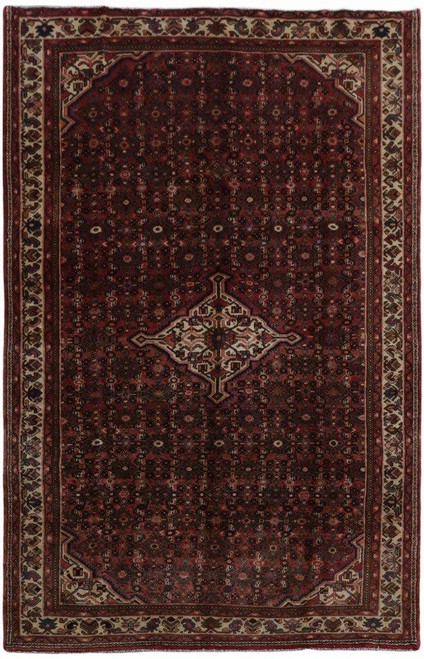
Hamadan Rugs
Hamadan is not a workshop. It is a market city in western Iran with several hundred weaving villages behind it, and the name on the label is the place the rug was sold rather than the place it was made. That is why no two Hamadans are quite alike, and why the name remains the most sensible way into hand-knotted Persian weaving.
Several hundred villages, one market name
The Hamadan district covers a very large number of separate weaving villages, and the trade knows the better ones by their own names: Malayer, Borchalou, Tuiserkan, Kabutarhang and others, each with its own habits of colour and drawing. Most rugs never get that specific, and reach the market simply as Hamadan. The practical effect is that Hamadan is a district, not a standard. Two rugs with the same label can differ in fineness, palette and wool quality more than two rugs from two different cities. This is worth knowing before comparing, and it is also why the name rewards looking at the actual rug instead of reading the ticket.
Single weft, and how to spot it
The one construction feature that ties the district together is the single weft. After each row of knots, one weft thread is passed across, not two. The back of the rug consequently shows a distinct ribbed pattern, with the warp threads visible in alternating relief, and the whole structure sits flatter and firmer than a double-wefted rug of the same fineness. Weavers here use the symmetrical knot, which the trade also calls the Turkish knot. None of this is exotic. It is simply the north-western village method, shared with Senneh and, in its own extreme form, with Bijar.
Camel, and the undyed neutrals
Hamadan rugs are one of the few Persian groups with a real tradition of leaving wool alone. Grounds and borders in natural camel tones, soft greys and warm undyed browns appear constantly, sometimes from actual camel hair and more often from the natural fleece of local sheep. Those neutrals are the reason the district sits so easily in modern rooms: a camel-ground Hamadan is a geometric Persian rug that behaves like a plain one. For the wider range of that colour family, see brown and ivory and beige, and for the material itself, wool.
Runners are the district's real speciality
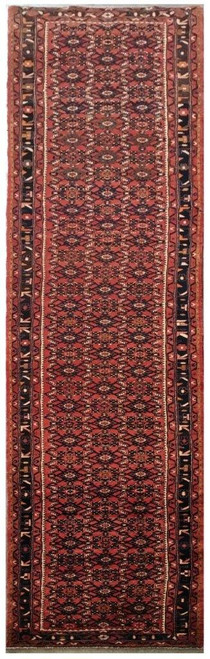
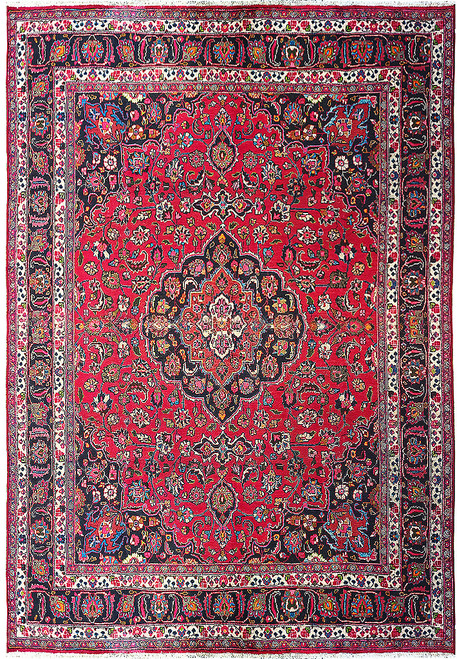
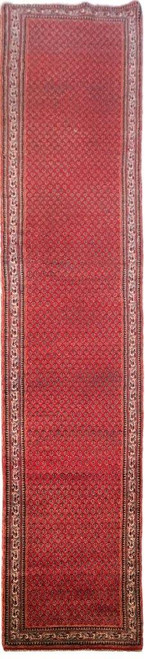
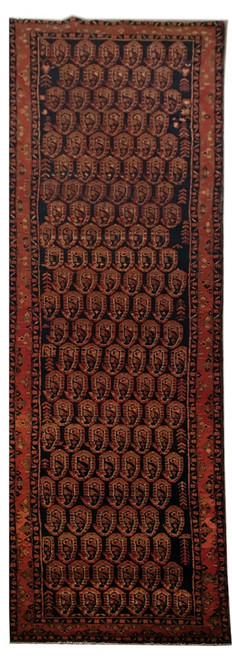
Village looms are narrow, and Hamadan has produced more good runners than anywhere else in Iran. A single-weft runner is firm, thin enough to pass under a door, and dense enough to survive a corridor, which is the whole brief. The other characteristic formats are small: the under four by six mat and the four by six to six by nine room rug. Large Hamadans exist but are less typical, and a genuinely oversized one is uncommon enough to check carefully.
Where the value is, honestly
Hamadan is the cheapest way to own a real hand-knotted Persian rug, and the reason is not inferior weaving. It is fineness. A village single-weft rug at moderate knot density takes a fraction of the loom time of a fine city rug, and time is most of what a rug costs. What that buys is the good half of the deal: genuine hand-knotting, good highland wool, natural or well-made dyes, and geometry that will not date. What it does not buy is drawn detail. Nobody should expect a Hamadan to render a curved arabesque the way a Kashan or a Nain does, because it has neither the knot count nor the intention.
How they age
A Hamadan wears evenly, which is more than can be said for finer rugs. The thick village pile gives up its tips slowly, the geometric drawing does not lose legibility as the pile shortens, and the single-weft structure keeps the rug flat long after a softer one has started to ripple. Within tribal and village weaving it is the most domestic and least decorative option, and within Persian rugs generally it is the one most often bought as a first rug and kept for thirty years. Recent production is widely available as new weaving, and the district has changed less over a century than almost any other.