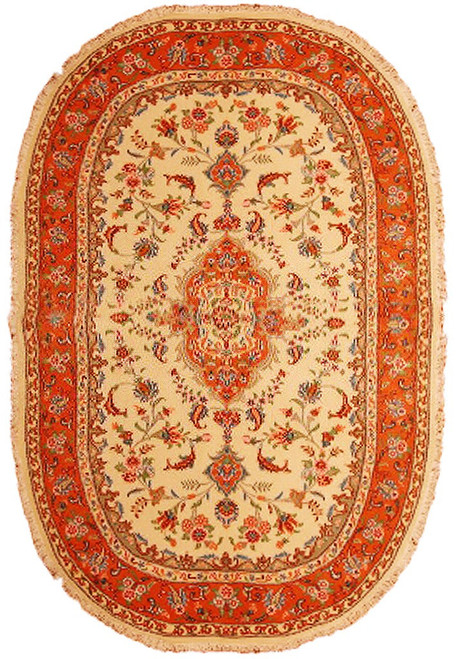
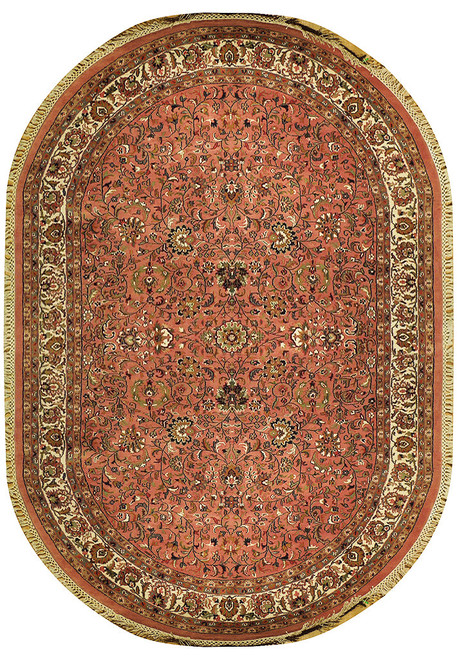
Oval Rugs
The oval is the rarest format in hand-knotted weaving and the one with the shortest history. It has a genuine tradition in French workshop weaving, where ovals were designed for particular rooms and particular ceilings. It has almost none in Persian or tribal work. So an oval rug is generally either European in origin, a modern piece woven to order, or a rectangle that has been cut and bound.
The one tradition that owns the shape
Ovals belong to the French court workshops. Aubusson and Savonnerie carpets were commissioned for named rooms, and the oval and the shaped panel were used deliberately, echoing a ceiling rose or a domed plaster centre above. Aubusson weaving is a tapestry technique, a flat weave with no pile, which makes an oval far easier to produce than it is on a knotting loom. That is the honest reason the shape is more or less confined to European weaving and its later copies.
Knotted ovals are made two ways
Either woven to the shape, which means a workshop shortening every row and building a curved edge without a selvedge, or cut from a finished rectangle and bound. The first is a special order in most traditions, priced accordingly and measured in months or years rather than weeks. The second is common, and it shows: the border is sliced where the curve crossed it, the field pattern runs off the edge mid-motif, and the perimeter is a sewn binding over raw knots rather than a woven edge. The binding is what wears out, and it takes the knots with it when it goes.
Drawing for an oval
An oval has to be designed as one. A medallion drawn for a rectangle and then cut to an oval sits wrong: the corner spandrels disappear, the border loses its corner resolutions, and the whole composition reads as a fragment. This is why the successful examples are almost all either modern designs with no medallion at all, workshop pieces drawn for the shape, or the Kerman and European-influenced patterns whose open floral fields tolerate being curved.
Practical notes
Ovals work under an oval dining table, in a long entrance, beside a bed, and in a room whose main feature is curved. They do not work laid against a straight wall, where the gap at the ends looks like an error. Braided and hooked ovals are a different craft entirely and not hand-knotted weaving. Expect most stock to be new and the sizes to be limited, with anything in the 6x9 band already unusual. The closely related format is the round rug, the easier answers are a square or a plain rectangle, and the whole set sits at rug shapes. Whatever the outline, wool decides how long it lasts.