Qashqai Rugs
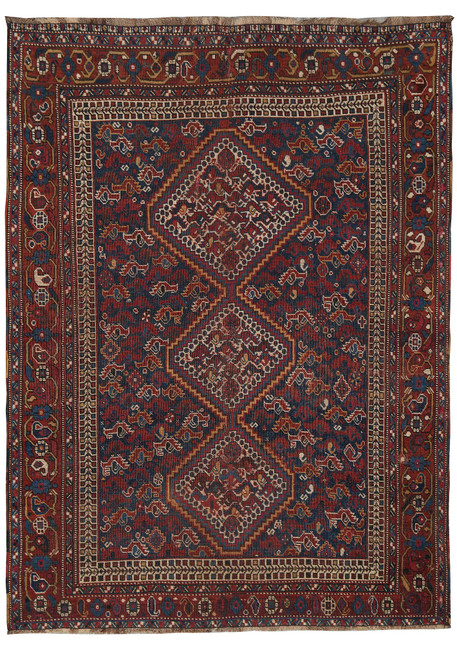
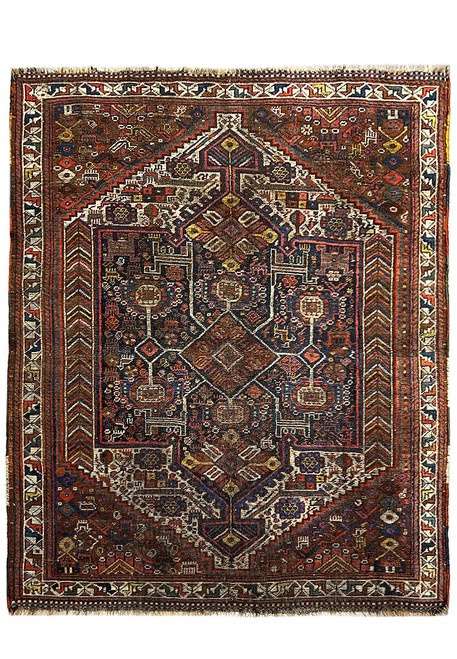
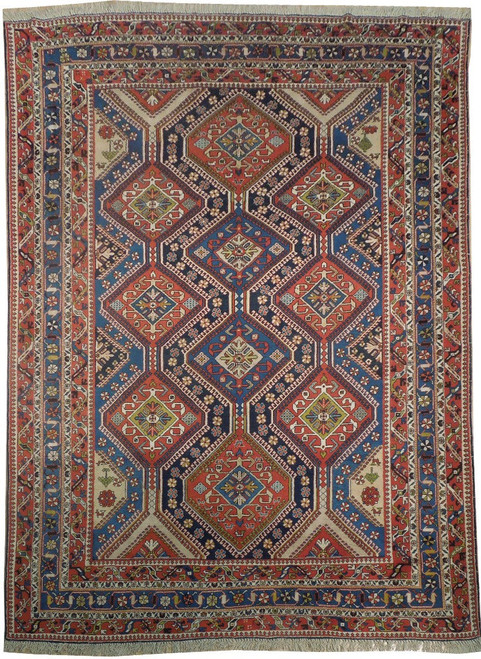
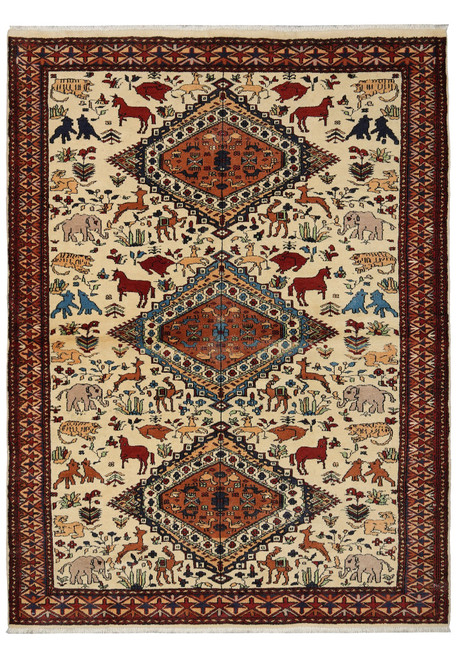
The Qashqai are a confederation of tribes in Fars, in the southern Zagros, and they wove on horizontal looms that could be rolled up and carried to the next pasture. Nothing was drawn first. The designs are stepped diamond medallions, hooked borders and small figures dropped in wherever there was space, all in wool with a long, glossy staple.
The loom decides the rug
A Qashqai loom is two beams pegged to the ground. It has to come apart, travel on an animal and be reassembled, and the half-finished rug rolls up with it. That single fact explains most of what a Qashqai looks like. Width is limited to what two weavers sitting side by side can reach, so long narrow formats and runners are natural and very large pieces are not. Tension changes when the loom is struck and reset, so the sides are rarely perfectly parallel. And because there is no paper design pinned above the work, the pattern is carried in the weaver's memory and adjusted as she goes.
Worked from memory
City weaving separates the designer from the weaver. In a fine Isfahan or Nain one person draws and another executes, knot by knot, to a plan. Qashqai weaving does not split the job. The weaver knows a repertoire and builds the rug as she works, which is why two Qashqais of the same design are never the same rug. Fields fill up as space allows: a bird here, a comb, a hand, a small horse with a rider, a boteh turned the wrong way because it fitted better that way. Motifs shrink to squeeze into a corner, and borders occasionally run out of room and stop. Collectors pay for exactly that. If regularity is what you want, an Abadeh does the same vocabulary with a ruler.
Wool worth the name
The Qashqai migration takes the flocks into high summer pasture in the Zagros, and the fleece that comes off those animals has a long staple and a high natural grease content. Hand spun and dyed with madder, indigo, weld and walnut, it produces a pile with genuine sheen, and one that keeps improving: a Qashqai that has been walked on for fifty years is glossier than a new one, not duller. This is the main reason an old Qashqai outperforms much finer wool rugs on looks alone. Traditionally the foundation is wool as well, warp and weft both, sometimes with goat hair in the selvages. Wool on wool gives a rug that is supple, light for its size and slightly restless: it will move on a hard floor and wants an underlay.
Abrash, and why nobody apologises for it
Dye lots in a tent are small. When one runs out, the next is close but not identical, and the change shows as a horizontal band across the field where the colour steps lighter or darker. That is abrash. In a workshop rug it would be a fault; in a Qashqai it is the signature of hand spun yarn dyed in batches, and dealers treat it as evidence of authenticity rather than a defect to be discounted. Some of the best old pieces have fields that drift through three shades of madder from one end to the other. It is also why Qashqais sit comfortably in the multi-colour and red and burgundy registers at once.
Subtribes and the fine end
The confederation is not one weaving group. The Kashkuli, Darrehshuri, Shishboluki, Amaleh and Farsimadan all weave, and the trade distinguishes them. Kashkuli work is generally the finest: tighter knotting, smaller motifs, sometimes an all-over flowering field that comes surprisingly close to city drawing. Darrehshuri pieces tend to be bolder and more openly geometric. Much regional output was collected and sold through the provincial capital and so reaches the market simply as Shiraz, and the coarsest, thickest work of the same weavers is sold as gabbeh. Flat woven bags, saddle covers and salt bags from the same tents appear among flat weaves.
Buying an old one
Age suits these rugs. A pre-1970 Qashqai in honest condition, with low even pile and full colour, is usually a better purchase than a newer piece of the same size, and semi-antique examples are the practical middle ground. Check the ends, since kilim finishes go first, and expect the rug not to be square. Sizes cluster in accent and small formats; anything above medium size is rare enough to be priced accordingly. It belongs in the wider story of tribal and Persian weaving as the case for doing without a drawing.