Watch the film
| Size in ft: | Width: 4'4" x Length: 6'1" |
| Size in Inch: | Width: 52" x Length: 73" |
| Size in meters: | Length: 1.85 x Width: 1.32 m |
| Colors: | Blue, Rust, Ivory, Camel Gold |
| Shape: | Rectangular |
| Woven: | 100% Hand-knotted | Handmade |
| Foundation: | Hand-spun wool warp and weft |
| Pile: | |
| Age: | 1940's | Antique |
| Design: | Shiraz | Triple diamond medallion | Tribal all-over |
| Origin: | Persian Qashqai | Made in Persia |
| Condition: | Excellent | Low pile |
4'4" x 6'1" Persian Qashqai Tribal Rug | Triple Diamond Medallions | Circa 1940s Shiraz Weave
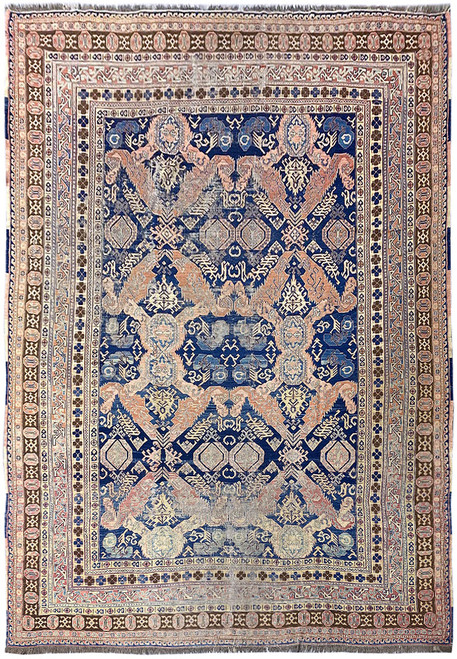
This 4'4" x 6'1" Qashqai was knotted by hand in the 1940s in the tribal districts southwest of Shiraz, and it carries everything collectors look for in tribal Persian rugs of that generation: three stacked diamond medallions, a field crowded with small animals, and dyes that have aged into one another instead of flattening out. The wool is the hard, lustrous fleece of the Fars flocks, and the pile now sits low and even after decades of real use, which is exactly how a weaving of this age should look. At 52" by 73" it works as a reading-chair rug, a bedside piece or the centerpiece of a small sitting area, and it is an unusually honest entry into collectable 4x6 Persian rugs. Every rug we sell, this one included, ships with a certificate of authenticity.
Please Note About the Photographs:
The close-up photographs show a low, evenly worn nap and softened fringe ends at both ends of the rug. That is the honest surface of an antique that spent years on a floor, not fade or damage, and the drawing still reads clearly from medallion to border. The rug is professionally cleaned, steamed and pressed before it leaves our warehouse.
Design and Motifs
Three diamond medallions run up the center of the field, each outlined in ivory pearl beading and ringed by stepped latch-hook zigzags in camel gold and rust. Inside each medallion sits a small red ground filled with rosettes, hooked leaves and tiny stick figures drawn freehand rather than from a cartoon. The surrounding field is packed with the Qashqai vocabulary: short-legged quadrupeds, perched birds, 8 petal flower heads, boteh, combs and scattered "S" devices, with no two repeats quite identical. A wide rust main border carries alternating hexagonal rosettes and hooked boteh, framed on both sides by ivory reciprocal diamond bands and barber-pole stripes. The result is a classic 4 corner tribal composition that belongs squarely among geometric Persian rugs.
Indigo, Madder Rust and Camel Gold
The field reads as a deep indigo that shifts toward mid sky blue in horizontal bands where the weaver moved from one dye lot to the next, the natural abrash that only hand-spun, vegetable-dyed wool produces. Over that sits madder rust: a brick red in the medallion grounds and main border, warmer and more terracotta where the pile has worn lowest. Undyed ivory wool does the structural work, outlining the diamonds and running through the reciprocal guard bands, while a saffron camel gold picks out the zigzag frames, leaf stems and border vines. Small accents of brown-black, soft rose and a single green knot appear in the animals. Anyone shopping navy and blue Persian rugs will find this palette warm rather than cool, thanks to all that rust.
Qashqai Weaving and the Shiraz Tradition
The Qashqai are a confederation of Turkic-speaking tribes who migrated for generations between the summer pastures of the Zagros and the winter plains of Fars province, trading their weavings through the bazaars of Shiraz, which is why the design is still catalogued as a Shiraz. Rugs were knotted on portable horizontal looms, all wool, with the weaver working from memory, so drawing is bold and slightly irregular by design. Pile is kept short and the knots beaten down hard, which is what lets a 1940s piece like this survive 80 years of floor life with its pattern intact. If you want to understand how pieces like this are placed in time, our guide on how to date an antique Oriental rug walks through the same clues we used here.
4'4" x 6'1" Persian Qashqai Tribal Rug | Triple Diamond Medallions | Circa 1940s Shiraz Weave
Ask about this rug
This piece is the only one of it, so the things worth knowing about it are particular to it. If you want to talk through the size, the colour in your own light, or the weave, speak to someone here first.