Moud Rugs
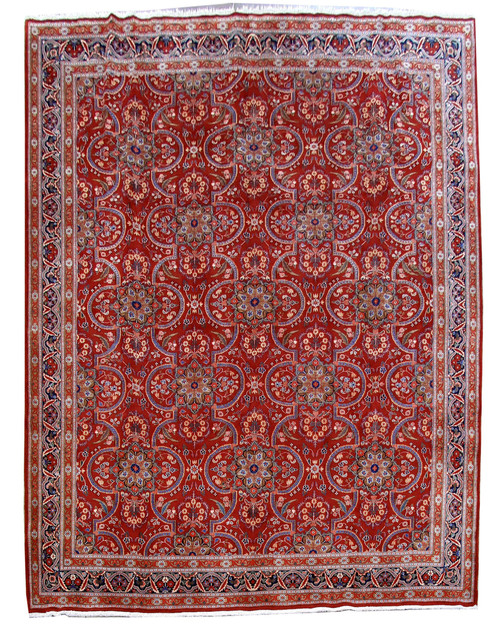
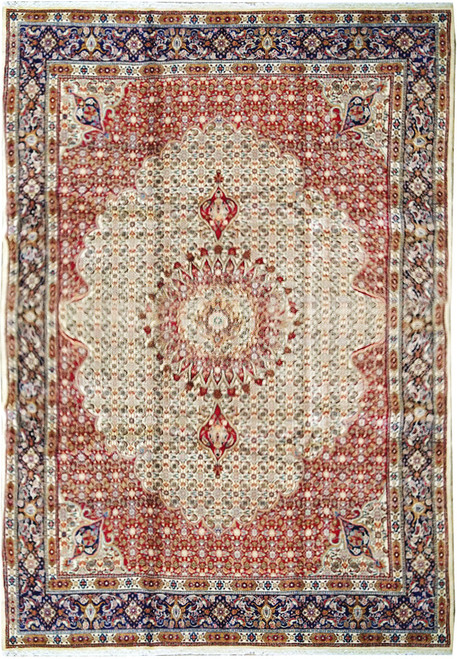
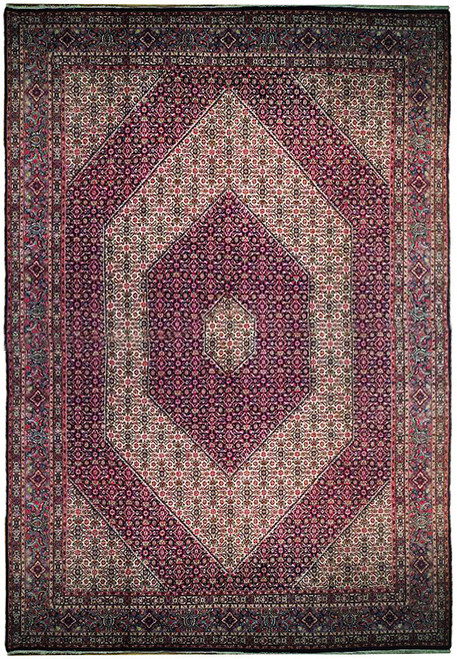
Moud is a village near Birjand, in South Khorasan, and it weaves essentially one design. The field carries an all-over Herati pattern at small scale, usually on ivory or a soft blue, with curvilinear corners, a restrained star medallion and silk highlights in the pile. The knotting is fine and very regular, and the finished rug lies dead flat.
One pattern, done properly
Most weaving towns offer a range. Moud offers a specialisation, and the specialisation is the Herati: a lattice of diamonds, each enclosing a rosette, with four curved serrated leaves around it that read as fish swimming round a pool. Persian weavers call the arrangement mahi, meaning fish. It is an old and widely used pattern, worked at Senneh, Bijar, Tabriz and across Khorasan, but Moud draws it smaller and more evenly than almost anyone, and repeats it edge to edge. Compare it against a Senneh, which draws the same lattice crisply but on a much thinner rug, or a Bijar, which draws it heavily on a foundation like a board, and the family resemblance across the Herati tradition is obvious.
The composition, and why it suits furniture
A Moud usually has a small star or lobed medallion at the centre and curvilinear spandrels in the corners, but these are deliberately understated. The pattern does not stop for them. That is a structural advantage that very few fine Persian rugs have. A medallion carpet is a centred composition: put a sofa across one end and a coffee table in the middle and you have covered the part of the rug that was drawn to be looked at. An all-over field has no single focal point, so a large Moud can run under furniture, be partly hidden, and still make sense as a whole. Anyone who has tried to place a large Kerman or Isfahan medallion carpet in a furnished room knows the problem this solves.
Fineness and the flat handle
Moud is wool pile on a cotton foundation, knotted finely and clipped short. The knot line is notably regular, which is what allows the small-scale lattice to hold its shape across a big field without drifting. The consequence is a thin, firm, dense rug that lies absolutely flat from the day it is unrolled: no waves, no curling corners, no lifting at the ends. Doors clear it. Chairs slide over it. It is one of the easier fine Persian rugs to live with for exactly this reason. What it is not is soft. If you want depth and warmth underfoot, a short-pile wool rug of this kind is the wrong answer and a gabbeh is the right one.
The silk
Moud weavers habitually work silk into the pile as highlights rather than weaving in silk throughout: a rosette outline, a leaf, the medallion, picked out so it catches light at a different angle from the wool around it. This is a small effect and a durable one, because the silk is a minority of the surface and the wool takes the wear. It also means a Moud gives some of what people want from silk without the fragility, which is a different bargain from a full wool and silk rug and a very different one from a pure silk Qom. Silk belongs where it will be walked on lightly. Moud's approach is to keep it to the parts that will not be.
How it wears
This is the quiet case for the name. A short, dense, evenly knotted pile has very little to lose: there is no long fibre to crush, so a Moud does not develop the flattened traffic paths that a thicker rug shows within a couple of years. It wears slowly and, more importantly, evenly. The pale grounds, typically ivory, soft blue or a light blue green, do show soiling in the way any pale rug does, so this is not the piece for the route from the back door, but for a sitting room, a study, a bedroom or a dining room it will look much the same after fifteen years as after two. The palette puts most examples in the ivory and beige or soft blue range.
Sizes, and the neighbours
Moud is woven across the useful range: accent pieces, small and medium sizes, runners, and large carpets where the all-over field is at its most convincing. Birjand, the nearby town, weaves closely related rugs, and Kashmar further north covers the large pale end of Khorasan production with a coarser weave and a bolder design. Within traditional Persian weaving, Moud is the sensible choice rather than the spectacular one, which is usually a compliment.