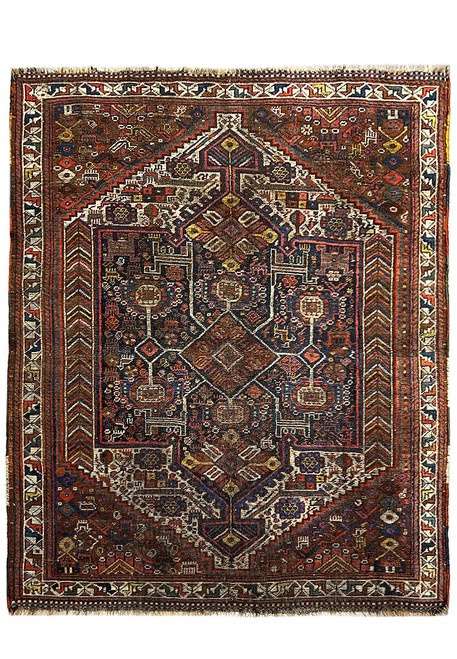
Shiraz Rugs
Shiraz never had a weaving industry of its own. It had a bazaar. The rugs sold under the name were woven in the tents and villages of Fars by the Qashqai, the Khamseh and settled villagers, then brought into the city and traded out from there. So Shiraz is a family of related designs rather than a house style, and it is the most affordable way into genuinely old tribal weaving.
A trade name, honestly stated
It is worth being clear about this, because the name is often sold as though it described a workshop. Shiraz is the provincial capital of Fars and was the collecting point for the region's weaving. A rug labelled Shiraz was made somewhere else in the province, by people who would not have called it that. The two main sources are the Qashqai confederation and the Khamseh, a grouping of five tribes of Arab, Turkic and Persian descent, with a large volume from settled villages between them. Nobody should treat the label as an origin claim more precise than the province. Treated as what it is, a regional family within Persian weaving, it is a useful name.
How to recognise one
The structural marks are more reliable than the pattern. Most Shiraz rugs are wool pile on a wool foundation. The selvages are wrapped, very often in two alternating colours so the edge reads as a barber's pole of red and blue or brown and ivory. The ends finish in a band of flat weave, sometimes striped, sometimes with a few rows of knotted work, and the warps are frequently braided rather than cut straight. The weave is coarser than a village workshop rug, the pile is medium, and the rug is rarely a true rectangle. Turn one over and the back tells you more than the front.
The designs, in the plural
Expect one of a small number of arrangements: a single stepped diamond medallion; a column of two or three of them stacked up the field; or an all-over pattern of boteh, diamonds or small hooked motifs with no medallion at all. Latch hooks project from almost every outline. The Khamseh contribution is often a field of small birds, which the trade calls the murgh design. Fields are usually madder red or deep indigo, so most of these rugs land in the red and burgundy or deep indigo range, with ivory reserved for borders and outlines. Where the same weavers worked thicker and simpler, the result is sold as gabbeh; where a village workshop tidied the same motifs into a regular layout, it is sold as Abadeh. Yalameh and Afshar are the neighbours.
Why they cost less, and what you give up
Shiraz is the entry point to old tribal weaving, and the reason is knot count. The market pays for fineness, and these rugs are not fine. What you get instead is old wool, natural dyes and a composition nobody drew, which is why a pre-1970 Shiraz is the usual first genuinely old rug people buy. What you give up is precision, symmetry and flatness. The drawing is loose. The sides may bow. A wool foundation moves on a hard floor and will need an underlay. Fine drawing at a distance is not on offer here: for that the cities are the answer, and a Kerman or a Tabriz is a different proposition entirely.
Condition is the whole negotiation
These rugs were used. Low pile is normal and not in itself a problem, since a century of even wear leaves a dense, glossy surface that no new rug has. What matters is whether the wear is even, whether the ends and selvages are intact or have been rebuilt, and whether there are old repairs in the field. Ends and edges are the first things to go on a wool-foundation rug, and restoring them properly is skilled work. Semi-antique pieces from the 1970s onward are the low-risk option if you would rather not manage any of that, and new weaving in the same idiom is still produced.
Where they fit
Sizes run small. Accent and small formats dominate, runners are plentiful because ground looms suit them, and anything over medium size is scarce. That makes a Shiraz a rug for a bedroom, a study, a landing or a layered arrangement rather than the single piece that fills a drawing room. Flat woven bags and covers from the same tents sit with the flat weaves.