Abadeh Rugs
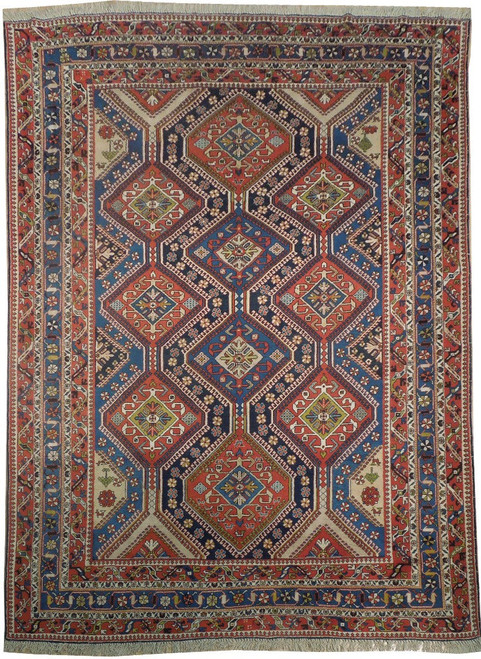
Abadeh is a town between Isfahan and Shiraz, and its rugs sit between the two in character. The motifs are tribal, inherited from the weavers of Fars, but the drawing is regular and the weave is a workshop weave. The result is a firm, flat rug with a sharp diamond medallion, stylised trees, birds and small animals, and none of the wander of a nomadic piece.
What the geography explains
Abadeh lies on the road between two very different weaving worlds. To the north is Isfahan, where designers draw curves on paper and weavers follow them. To the south is the tribal country of Fars, where Qashqai weavers work from memory on looms that roll up. Abadeh took the vocabulary of the second and the discipline of the first. The motifs are the ones the tribes use, but they are set out on a vertical loom in a settled village workshop, with a repeating layout and an even knot line. The combination is the reason Abadehs are easy to recognise and easy to place.
The standard layout
Most Abadehs are built the same way, and that consistency is the point. A single hexagonal or stepped diamond medallion holds the centre. Geometric spandrels fill the four corners. The field around the medallion is populated rather than covered: small stylised cypress and other trees, birds, peacocks, and little quadrupeds that could be deer, goats or dogs depending on the weaver. Nothing curves that does not have to. Borders are narrow, often three of them, with a running geometric main border. Read one Abadeh and you can read the rest, which is a fair description of most good village weaving and the opposite of the one-off compositions in tribal work.
Heybatlu
The variant the trade asks for by name is Heybatlu, also written Heibatlu, after a tribal group of the region. A Heybatlu Abadeh is the fully populated version: the diamond medallion, and around it a dense scatter of animals, birds and trees on a madder red or dark blue ground. It is the design people mean when they say an Abadeh looks like a tribal rug that finally sat still. Plainer Abadehs with a quiet field and an all-over boteh also exist and are less sought after, which usually makes them the better value of the two.
Structure, and what firm means
Abadeh is wool pile on a cotton foundation, knotted at a moderate to good density, with the pile clipped short. That produces a specific handle: the rug is stiff, flat and heavy for its size, and it lies still. A cotton foundation does not stretch and shift the way an all-wool tribal foundation does, so an Abadeh does not creep, ruck or grow a wave in the middle of a hallway. Against that, it has none of the flop and glossy give of a wool-on-wool Shiraz, and it will feel harder underfoot than a gabbeh. If softness matters more than flatness, this is not the rug. If you want a wool rug that behaves itself in a busy corridor, it is a very good one.
Red, blue, and very little else
The usual field is madder red, sometimes a deep brick, with dark indigo and ivory doing most of the secondary work and small amounts of green, gold and undyed camel in the motifs. That makes the average Abadeh a red or burgundy rug with a navy border, which is a conventional pairing and an enduringly useful one. Ivory grounds turn up but are far less common, so anyone wanting a pale floor is better served by a Kashmar or a Moud.
Sizes and what they suit
Village production means practical formats. Abadehs are common in accent and small sizes, regular in medium, and well represented in runners and squares. Very large Abadehs are uncommon, because the design does not scale well: blow up a single diamond medallion to fill a drawing room and the field looks thin. For big floors in the same broadly traditional register, the medallion carpets of Kerman or the all-over patterns of Khorasan hold a room better. Where an Abadeh earns its place is at a size you can take in at a glance, in a spot that gets walked on every day. Related weaving from the same corner of Fars sits under Yalameh and Afshar, both of which trade geometry for a little more colour.