Qom Rugs
Qom is the youngest of the great Persian weaving names and the only one that never had a coarse end. The city wove almost nothing before the 1930s, and when it started it aimed straight at the top of the market. What that produced is a tradition of fine, formal, frequently signed rugs, a large share of them in pure silk.
Why Qom has no cheap end
Most Persian weaving centres grew from village work upward, which is why a name like Hamadan covers everything from a rough runner to a fine village rug. Qom had no such history to carry. Its weavers learned from Kashan and Isfahan masters in the 1930s and began at their level, so the floor of the market is high and the range is narrow. When a dealer says a rug is a Qom, he is telling you about knot count before he tells you anything else.
Silk, and the trick of the changing colour
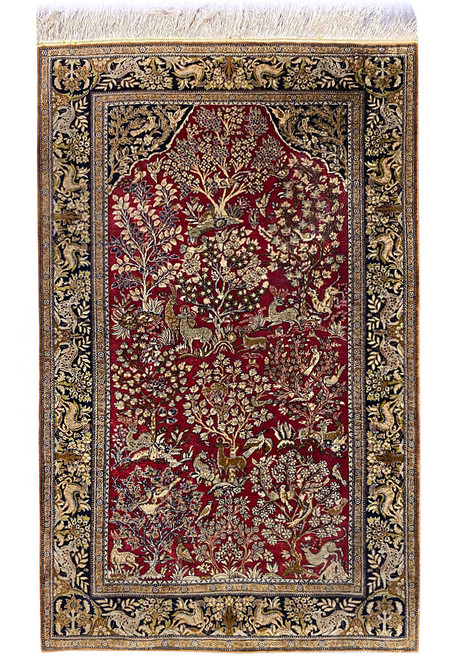
A pure silk Qom is usually knotted on a silk foundation, which is what lets the drawing hold a curve at very small scale. It also produces the effect these rugs are bought for: the pile lies in one direction, so the same rug reads deep and saturated from one end of a room and pale and luminous from the other. Walk around it and the gold in a border swings from cream to amber while a navy field shifts from near black to blue. Nothing is changing but your position. It is the reason a fine silk Qom is as often hung on a wall as laid on a floor, and it is worth seeing in person before choosing between this and a Nain, which is quieter, or a Kashan, which is heavier in colour.
What the designs actually show
Qom designs are drawn by a designer rather than remembered by the weaver, and the fields are typically filled edge to edge, because at this knot count there is no reason to leave space. Expect dense floral grounds, medallion and corner compositions, hunting scenes, and pictorial panels lifted from miniature painting. Prayer formats and small square pieces are common. If you want an open, uncluttered ground you are looking at the wrong city: try Kerman or an antique Bijar.
Reading a signature
A workshop signs only what it is prepared to be judged by, which is why most rugs carry no signature at all and a good proportion of Qoms do. The name is knotted into a cartouche in the border or at the top of the field, in the same silk as everything around it. Kashizadeh, Erami and Khales are names collectors look for. A signature is not a guarantee of quality on its own, but it is a statement of accountability, and it is the closest thing this trade has to a maker's mark.
Living with one
Silk is strong in tension and weak against grit, so a silk Qom belongs where it will be walked on lightly: a bedroom, a study, a formal sitting room, a wall. It is the wrong rug for a hallway or under a dining table. For those, stay in wool: a Bijar will take decades of traffic, and a Tabriz is the compromise between fineness and durability. Qom also weaves fine wool and wool-with-silk pieces, which handle daily life far better than pure silk and keep much of the drawing.
Sizes and what they suit
Qom is strongest in small and mid formats, because that is where the knot count is economically sensible. Expect plenty in accent and small sizes, a good supply of medium pieces, and comparatively few palace formats. If you need to cover a large room at this level of fineness, Tabriz and Isfahan are the more likely sources.
Browse the whole city's output in Qom rugs, or start from the material in silk and wool and silk.
-

4'5" x 6'7" 4'5" x 6'7" Persian Qum Rug | Charming Bird Garden | Ivory Fine Kork Wool | 2000's
Was: $7,130.00Now: $6,799.00 -

-

-
-

-

-
-

-

-

-

-
