| Size in ft: | Width: 8' x Length: 11' |
| Size in Inch: | Width: 96" x Length: 132" |
| Size in meters: | Length: 3.35 x Width: 2.44 m |
| Colors: | Green, Emerald, Copper Rose, Ivory, Beige, Salmon |
| Shape: | Rectangular |
| Woven: | 100% Hand-knotted | Handmade |
| Foundation: | Cotton |
| Pile: | |
| Age: | 1980's | Vintage |
| Signature: | Signed | Woven cartouche in the end border |
| Design: | Qum Floral Medallion | All-over vine field | Multi-band border |
| Origin: | Persian Qum | Made in Persia |
| Condition: | Fair | Even overall fading and low pile in areas |
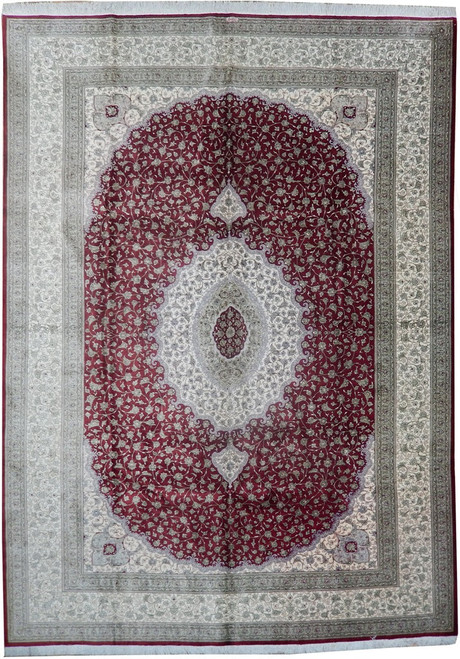
8' x 11' Persian Qum Silk Rug | Overdyed Green Field with Copper Medallion | Signed, 1980s
A silk Persian Qum rug from the 1980s that has aged into something no new rug can imitate. The pile is pure silk throughout, so the surface shifts from deep emerald to pale sea green as you walk around it, and the copper rose medallion at the center looks lit from within under lamplight. The weaver signed the piece in a small cartouche at one end, which on a Qum means a workshop was willing to put its name on the drawing. Four decades of light and use have softened the palette into an overdyed, antique-washed look that decorators pay a premium to fake. Every rug we sell ships with a certificate of authenticity confirming origin, materials and hand-knotted construction.
Please Note About the Photographs:
This rug is graded Fair and is sold as a decorative, character piece. The photos show it honestly: the field has faded unevenly, the medallion has gone soft and coppery where it once read stronger, and the silk pile sits low in places with light streaking across the surface. These are the marks of a 1980s silk rug that was lived on, not flaws introduced by us. If you want a crisp, saturated Qum, this is not that rug. If you want the washed, muted look at a fraction of mint-condition money, it is exactly that rug.
Design and Motifs
The drawing is classic Qum city work: a large lobed medallion floating on a densely vined field, with matching spandrels closing the 4 corners and the whole composition framed by a wide ivory border of linked palmettes and rosettes. Inside the medallion the weaver packed a rotating swirl of tiny blossoms around a small central roundel, so the eye keeps circling rather than stopping. The field around it carries an all-over scroll of thin curling vines, split leaves and 8 petal rosettes, drawn in the fine curvilinear line that only a high knot count allows, visible up close in the vine detail photograph. The border stack is layered rather than simple: a broad floral main band, narrow reciprocal guard stripes, and an outer salmon band that frames the piece the way a mat frames a print. The end border carries the signature cartouche, flanked by a row of small cypress-like finials.
A Faded Emerald Green Palette with Copper and Ivory
Green is the anchor and the reason to buy this piece. The field reads as a true emerald at the center of the rug and cools toward teal and sea green along the edges, with the silk catching light so that the same square foot looks dark from one side and almost mint from the other. Against it the medallion has aged to a dusty copper rose, warm rather than red, and the vinework floats over the green in oyster, pale gold and soft sage. The borders are a mix of clotted cream and sand ivory, with rosettes picked out in faded raspberry, moss and charcoal blue, and the outermost band settles into a muted salmon that ties back to the medallion. It is a palette that sits comfortably with walnut floors, brass, worn leather and off-white walls, and it belongs with the more unusual green Persian rugs rather than the usual red and navy formula.
Qum: Persia's Silk Weaving City
Qum sits south of Tehran and is the youngest of the great Persian weaving centers, with serious production starting only in the 20th century, yet it went straight to the top by refusing to compromise on material. The city's workshops use only the finest silk, and the rivalry between them is what pushes the fineness, the drawing and the dye work higher year after year. Silk takes dye differently from wool, which is why a Qum field changes tone as you move and why an aged Persian silk rug like this one develops patina instead of simply looking tired. The knotting here is tight enough to hold the hairline vine scrolls without breaking the curve, and the ruler photograph shows the density at the border. At 8x11 Persian rugs scale, a signed silk Qum of this period is an uncommon thing to find outside a collection, and the 1980s dating is supported by the wash, the palette and the construction, points covered in our guide on how to date an oriental rug.
8' x 11' Persian Qum Silk Rug | Overdyed Green Field with Copper Medallion | Signed, 1980s
Ask about this rug
This piece is the only one of it, so the things worth knowing about it are particular to it. If you want to talk through the size, the colour in your own light, or the weave, speak to someone here first.