| Size in ft: | Width: 6'6" x Length: 9'10" |
| Size in Inch: | Width: 78" x Length: 118" |
| Size in meters: | Length: 3.00 x Width: 1.98 m |
| Colors: | Ivory, Coral Red, Green, Blue |
| Shape: | Rectangular |
| Woven: | 100% Hand-knotted | Handmade |
| Foundation: | Cotton |
| Pile: | Wool and Silk |
| Age: | 1980s | Never used |
| Design: | Tabriz Medallion | Floral Arabesque | Corner Spandrels |
| Origin: | Persian Tabriz | Made in Persia |
| Condition: | Perfect | Never used |
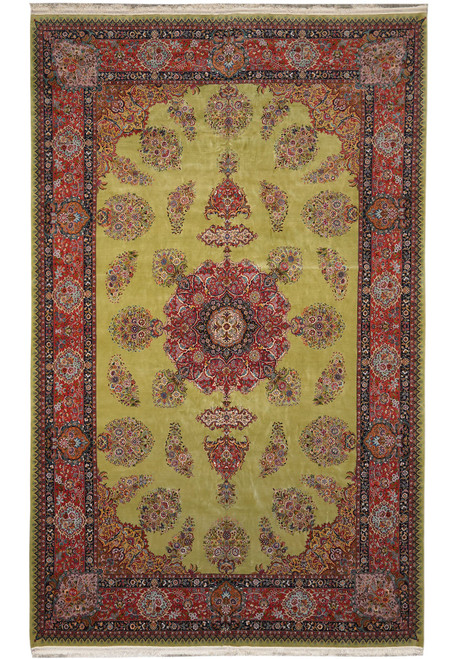
6'6" x 9'10" Persian Tabriz Rug | Ivory Field, Green Medallion, Wool & Silk | 1980s, Never Used
This is a 1980s Tabriz that never made it onto a floor. The ivory field still carries the full body of an unwalked pile, the coral red border has kept its depth, and the silk passages drawn through the scrolling vines still catch light the way they did on the loom. At 6'6" x 9'10" it sits in the most useful of the classic proportions, wide enough to anchor a seating group and long enough to read as a formal room rug rather than an accent, which is why buyers searching 7 x 10 Persian rugs keep coming back to this size. Hand-knotted in wool with silk highlights on a cotton foundation, it ships with our certificate of authenticity confirming origin, materials and hand-knotted construction.
Design and Motifs
The drawing follows the classical Tabriz formula of central medallion, matching pendants and 4 corner spandrels, but the execution is unusually busy in the best sense. A wide lobed medallion floats at the center, filled with a small rosette core and 4 dark cartouche panels containing tight arabesque tracery. Around it the ivory ground is covered edge to edge with curling saz leaves, palmettes, split arabesques and small 8 petal rosettes on vines so fine they read almost as pen work. The spandrels break away from the field with their own gold ground and their own larger flower heads, giving the corners real weight. The border runs a continuous palmette and vine on coral red, framed by two narrow floral guard stripes, and the close-up photograph shows how the tiny outlines in dark brown and ivory keep every element separate instead of letting the pattern blur.
Color Palette: Ivory Ground, Green Medallion, Coral Red Border
The field is a warm ivory, closer to cream and old parchment than to a cold white, and it gives the rug an immediate lightness. The medallion is the counterweight: a soft sage to sea green, shaded slightly lighter toward its edges, with dark chocolate brown panels and touches of gold and ivory inside it. The border is a coral red with a brick undertone, warmer and less blue than a Kashan red, and the guard stripes run a pale celadon green that cools the transition between border and field. Scattered through the vines are blues ranging from a deep midnight to a clear turquoise, along with rose pink flower heads, mustard gold and small notes of dark brown that act as outlines. The gold spandrels at the 4 corners are the third major color block and read as caramel under natural light. Where silk is used, mostly in the leaf scrolls and medallion detail, the color shifts as you walk past the rug.
Tabriz Origin and Weaving Quality
Tabriz sits in northwest Persia and has been the country's most commercially serious weaving city for centuries, working from paper cartoons rather than memory, which is exactly why a curved medallion of this kind holds its shape across 9'10" without wobbling. Tabriz weavers measure fineness in Raj, the number of knots across a gereh of about 2.75 inches, and the density visible on the back of this piece, along with the crisp definition of the smallest rosettes, places it well above village commercial grade. The foundation is cotton, taut and flat, the selvedges are tight and the ivory warp fringe is original and unshortened. A 1980s weaving that was rolled and stored rather than used is uncommon, and for anyone learning how to date an Oriental rug, the full pile, unfaded reds and untouched fringe on this one tell the story clearly.
6'6" x 9'10" Persian Tabriz Rug | Ivory Field, Green Medallion, Wool & Silk | 1980s, Never Used
Ask about this rug
This piece is the only one of it, so the things worth knowing about it are particular to it. If you want to talk through the size, the colour in your own light, or the weave, speak to someone here first.