| Size in ft: | Width: 6'9" x Length: 9'10" |
| Size in Inch: | Width: 81" x Length: 118" |
| Size in meters: | Length: 3.00 x Width: 2.06 m |
| Colors: | Ivory, Green, Rust Red, Blue, Beige, Brown |
| Shape: | Rectangular |
| Woven: | 100% Hand-knotted | Handmade |
| Foundation: | 100% Cotton |
| Pile: | Wool with a Touch of Silk |
| Age: | 1980's | Never used |
| Design: | Tabriz Floral Medallion | All-Over Vine Field | Rust Palmette Border |
| Origin: | Persian Tabriz | Made in Persia |
| Condition: | Excellent | Never used |
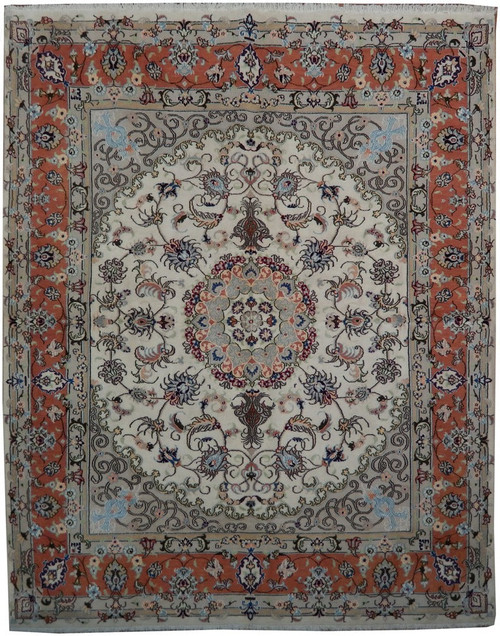
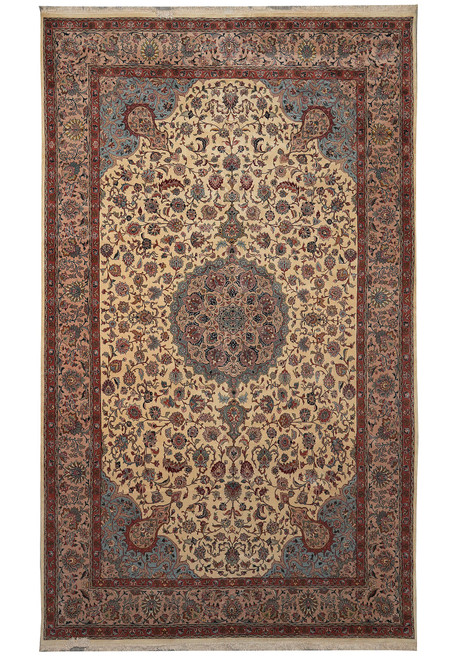
6'9" x 9'10" Persian Tabriz Rug | Ivory Floral Medallion | Wool & Silk, 1980s Never Used
This is a 1980s Tabriz that was rolled away and never put on a floor, and you can see it in the pile: the wool still stands upright, the silk highlights still flash when the light moves, and the ivory ground has none of the greying that comes with foot traffic. At 6'9" x 9'10" it sits squarely in the most useful of all room sizes, one of the reasons 7x10 Persian rugs get asked for more than any other proportion. The pile is fine wool with a touch of silk worked into the medallion and the flower heads, knotted on a cotton foundation, and the drawing is tight enough that the curved vines hold their line all the way into the corners. Every rug we ship carries a certificate of authenticity recording origin, materials and measurements.
Design and Motifs
The center holds a lobed medallion built in layers: a rust brick outline, a ring of green cartouche lobes carrying small floral sprays, and a pale turquoise heart set with an 8 petal rosette. Slim pendants drop from the top and bottom of the medallion into the field. Unlike the open-ground Tabriz formula, this field is filled edge to edge with an all-over composition of curling split-leaf vines, palmettes, serrated leaves and hundreds of small blossoms, so the medallion floats on pattern rather than on empty ivory. The 4 corners carry large brown and salmon palmette clusters that read as spandrels without ever being closed off from the field. The main border is a rust ground running a repeat of hooked palmettes, rosettes and turning vine, and it is framed on both sides by narrow green guard stripes with a trailing flower meander, a Tabriz habit that keeps the border from crowding the field.
A Palette of Ivory, Rust and Garden Green
The ground is a warm ivory, closer to unbleached cream than to white, and it is what makes this piece work in a bright room. Over it runs the full garden range of greens: apple and moss in the leaves, a deeper pine in the guard borders, and a soft sage in the medallion lobes. Rust terracotta carries the main border and the medallion frame, warming toward brick where the wool takes the dye more heavily. The blues run from a pale sky and turquoise in the flower centers down to a near-black navy used for outlining, which is what gives the drawing its crispness. Brown and chestnut fill the corner palmettes, with peach, salmon, gold and small dots of pure white scattered through the blossoms. Seen from one direction the rug reads soft and creamy; walk around it and the rust and green come forward, the usual sign of a good wool pile with silk worked into the highlights.
Tabriz: The Workshop City of Northwest Persia
Tabriz sits in the far northwest of Persia and has been the country's workshop city for centuries, the place where a designer draws a cartoon and a master weaver executes it knot by knot. Fineness there is measured in Raj, the count of knots across a gereh of about 2.75 inches, and the difference between commercial and workshop weaving shows up exactly where this rug is strongest: in the unbroken curve of a vine, the clean outline of a leaf, and the symmetry of a medallion that repeats without drifting. The cotton warps and wefts hold the rug flat and square, which is why Tabriz pieces lie well straight out of the roll. Placing it in the 1980s is a matter of reading wool, dye and handle together, the same evidence used in dating an Oriental rug, and in this case the rug has spent those decades in storage rather than under furniture.
6'9" x 9'10" Persian Tabriz Rug | Ivory Floral Medallion | Wool & Silk, 1980s Never Used
Ask about this rug
This piece is the only one of it, so the things worth knowing about it are particular to it. If you want to talk through the size, the colour in your own light, or the weave, speak to someone here first.