| Size in ft: | Width: 6'9" x Length: 8'2" |
| Size in Inch: | Width: 81" x Length: 98" |
| Size in meters: | Length: 2.49 x Width: 2.06 m |
| Colors: | Ivory, Coral, Peach, Pink, Green, Blue |
| Shape: | Rectangular |
| Woven: | 100% Hand-knotted | Handmade |
| Foundation: | Cotton |
| Pile: | Wool and Silk |
| Age: | 2000's | Unused |
| Design: | Tabriz Floral Medallion | Scrolling Vine Field |
| Origin: | Persian Tabriz | Made in Persia |
| Condition: | Perfect | Never used |
6'9" x 8'2" Persian Tabriz Rug | Ivory & Coral Floral Medallion | Wool & Silk, Never Used
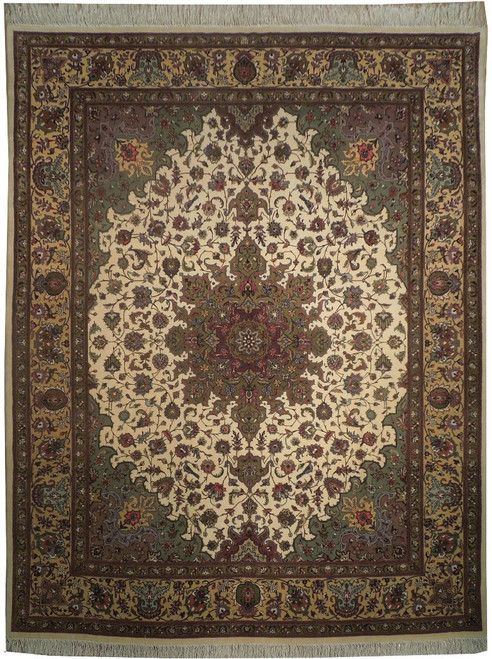
This 6'9" x 8'2" Persian Tabriz was woven in the 2000's and has never been on a floor. The pile is wool with silk worked into the highlights, and the sheen shifts across the field as you walk around it, which is exactly what you want from a workshop Tabriz of this type. The proportions are unusual, a little under 7 feet by a little over 8 feet, so it sits almost square and fills a seating area or a smaller dining room without the leftover length of a standard 8x10. Pile height is full and even, the ends and selvedges are intact, and the back reads clean and tight with no repairs or reweaves. A certificate of authenticity is included with every rug we ship.
Design and Motifs
The drawing is classic Tabriz workshop work: a round central medallion built in layers, with an inner ring of small rosettes, a band of heart shaped cartouches, and a garland of tiny red and ivory flowerheads circling the whole thing. Above and below the medallion sit dark pendant finials, and the ivory field around them carries a symmetrical arrangement of large feathered palmettes, curling split leaves and thin vine scrolls that run corner to corner. Look at the 4 corners and you will find pale blue arabesque scrolls set against the ivory ground, drawn in a lighter weight than the field so they read as spandrels without a hard outline. The main coral border alternates ivory cartouches with blue and olive palmettes on a vine, framed by narrow guard borders of small flowers and a plain ivory outer stripe. Curved line drawing of this kind only holds together at a high knot count, and here every leaf tip and vine junction stays crisp.
A Palette of Ivory, Coral and Soft Blue
The field is a warm ivory, closer to cream than to white, and it is the reason the rug feels light rather than formal. Against it the main border runs a soft coral, a terracotta salmon tone that photographs slightly warmer in daylight than under lamps. The medallion is where the color really works: pale sky blue and gray blue petals, peach and apricot infill, deep navy accents inside the heart forms, and a garland of crimson and pink rosettes tying it together. Scattered through the field are pink and peach blossoms, sage and olive green leaves, chocolate brown vine outlines, and small sky blue birds and cloud bands that only appear once you are close to the rug. Because these are wool and silk Persian rugs, the silk sits in the pale blues and the ivory outlines and catches the light, so the palette never goes flat.
Woven in Tabriz, Northwest Persia
Tabriz sits in the northwest of Persia and has been the reference point for fine Persian weaving for centuries. Its weavers work on a cotton foundation with a hook tool rather than a knife, which lets them pack the knots tightly and keep the medallion perfectly circular and the borders square at the corners. Fineness in Tabriz is measured in Raj, the knot count across a gereh of about 2.75 inches, and workshop pieces with silk highlights like this one belong to the upper end of the town's output rather than its commercial grades. The evidence is in the photographs: the back shows small, regular knots with no shifting in the pattern, the fringe is an extension of the warps rather than an applied edge, and the design repeats identically top to bottom without distortion. That combination of drawing discipline and tough Azerbaijan wool is why a Tabriz of this quality stays beautiful for generations.
6'9" x 8'2" Persian Tabriz Rug | Ivory & Coral Floral Medallion | Wool & Silk, Never Used
Ask about this rug
This piece is the only one of it, so the things worth knowing about it are particular to it. If you want to talk through the size, the colour in your own light, or the weave, speak to someone here first.