| Size in ft: | Width: 8'2" x Length: 10' |
| Size in Inch: | Width: 98" x Length: 120" |
| Size in meters: | Length: 3.05 x Width: 2.49 m |
| Colors: | Black Blue, Warm Red, Ivory, Green |
| Shape: | Rectangular |
| Woven: | 100% Hand-knotted | Handmade |
| Foundation: | Cotton |
| Pile: | Wool and Silk |
| Age: | 2000's | Unused |
| Design: | Tabriz Floral Medallion | Curvilinear Vine Field |
| Origin: | Persian Tabriz | Made in Persia |
| Condition: | Perfect | Never used |
8'2" x 10' Persian Tabriz Rug | Black Field Floral Medallion | Wool & Silk Pile
A black ground is the hardest field a Tabriz workshop can attempt, because every stem, every leaf tip and every silk highlight has to be drawn cleanly against it or the pattern turns to mud. This one holds. Woven in the 2000's and never put on a floor, it measures 8'2" x 10', a true room size that sits comfortably among 8x10 Persian rugs without the compromises that usually come with a dark palette. The pile is wool with silk worked into the medallion, the palmettes and the vine work, so the surface changes character as you walk around it. Every rug we sell ships with a certificate of authenticity confirming origin, materials and hand-knotted construction.
Design and Motifs
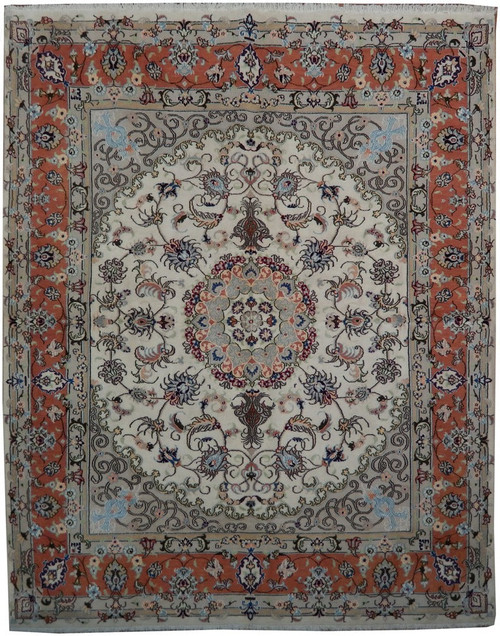
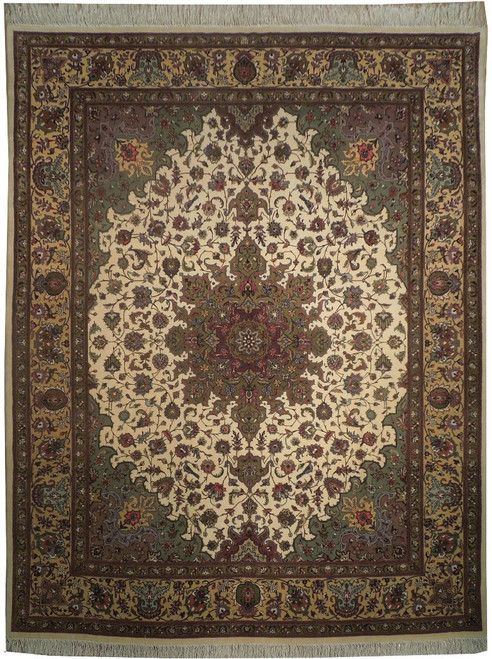
The center holds a round, scalloped medallion built in tiers: a small rosette at the heart, a ring of stylized blossoms around it, then an ivory band of curling arabesque scrollwork, then a toothed outer ring of red packed with tiny floral heads. Slim pendants drop above and below on the long axis, each one a small palmette cartouche in the same red and ivory. The 4 corners carry ivory spandrels drawn as quarter sections of the same idea, which is how a Tabriz cartoon keeps a field this busy under control. Between them the black ground is filled with a curvilinear vine system, large serrated palmettes, feathery lanceolate leaves, split arabesques and flowering sprays that mirror across both axes rather than repeat mechanically. The main border runs a continuous meander of palmettes and rosettes on the warm red ground, fenced by ivory guard stripes carrying a small vine and blossom chain, and the ends finish in plain woven kilim and cotton fringe.
A Black Field Framed in Warm Red
The field is a black that carries a blue undertone, closer to a very deep midnight than a flat jet, and it reads differently depending on the light: near a window it opens up and shows the blue, under lamplight it goes almost to charcoal. The border is the counterweight, a warm brick red that leans toward salmon and terracotta in daylight, which is what keeps the rug from feeling heavy. Ivory does the drawing work, outlining the medallion, the spandrels and the guard stripes so the composition stays legible against the dark ground. Inside the pattern there is far more color than a first glance suggests: sage and olive green in the leaves, soft rose and dusty pink in the palmette petals, pale grey blue in the scrollwork, gold and camel in the vine, with small hits of deep burgundy and teal in the flower centers. The silk sits mainly in the lighter tones, so the ivory and rose elements lift and shine while the wool holds the darker values matte.
Tabriz Weaving in Northwest Persia
Tabriz sits in the northwest of Persia and has been the country's design capital for centuries, the place where the cartoon, the drawing on paper that the weavers follow knot by knot, was raised to a discipline. Workshops there weave on a cotton foundation using the hook-ended knife, which is what allows the very fine counts Tabriz is known for, measured locally in Raj across the width of the rug. The quality of a Tabriz shows in whether the curves stay curved: look at the outer ring of the medallion in the close-up photographs and the arabesques sweep in unbroken lines rather than stepping like a village weave. The back confirms the work, with the pattern reading almost as clearly as the face and the knots lying in tight, even rows. Pile depth is low and level, the selvedges are firm, and because the rug was never used the wool still has its full body and the silk its original luster.
8'2" x 10' Persian Tabriz Rug | Black Field Floral Medallion | Wool and Silk, Never Used
Ask about this rug
This piece is the only one of it, so the things worth knowing about it are particular to it. If you want to talk through the size, the colour in your own light, or the weave, speak to someone here first.