Tibetan & Nepalese Rugs
Tibetan rugs are not knotted in the way everything else here is knotted. The yarn is looped around a metal rod laid across the warps, row by row, and then the loops are cut. It is a different craft with a different result: a pile that stands more upright, a slightly springier handle, and a structure that suits plain fields better than fine drawing.
The cut-loop technique
A weaver runs a continuous yarn around the warps and over a rod, building a row of loops, then slices along the rod to release them into a pile. Because the yarn is continuous, the density is described in lines per inch rather than knots per square inch, and the common qualities run from about 60 up to 150 lines. It is quicker than tying individual knots, which is part of why the tradition adapted so well to contemporary production.
Where it is woven now
Very little of this weaving happens in Tibet. The craft moved with Tibetan communities to Nepal in the second half of the twentieth century, and Kathmandu became the centre; a great deal is also woven in India today. The technique travelled intact, which is why a rug described as Tibetan is a statement about construction rather than about geography.
Wool, and why it is spoken of
Highland sheep at altitude grow a fleece high in lanolin, and the traditional yarn is hand-carded and hand-spun rather than combed. That leaves the fibre slightly irregular, which is exactly what makes the pile catch light unevenly and why a plain Tibetan field never looks flat. It is also very hard-wearing wool, and it takes a natural dye deeply.
The designs
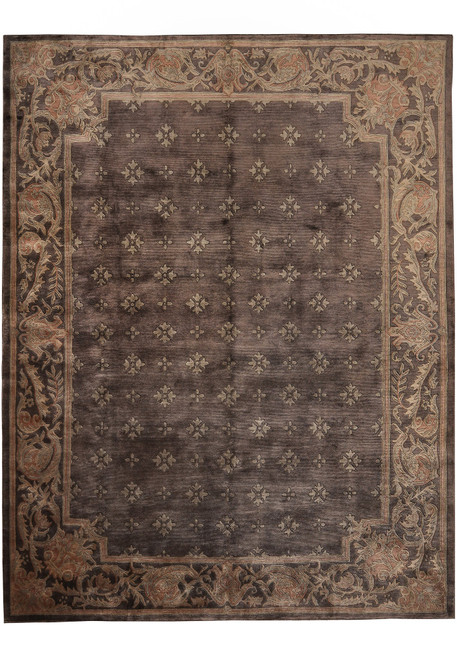
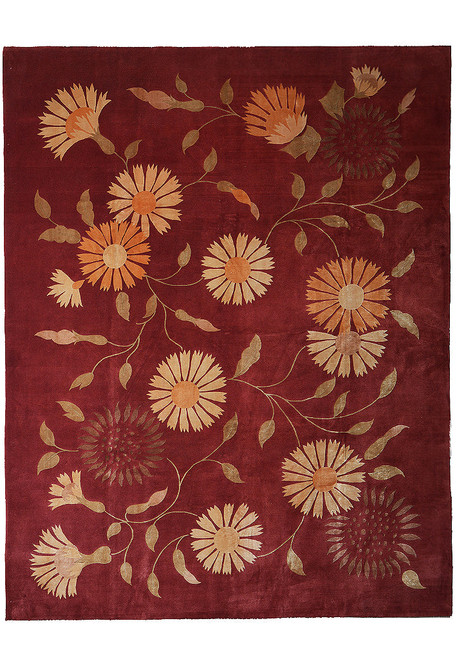
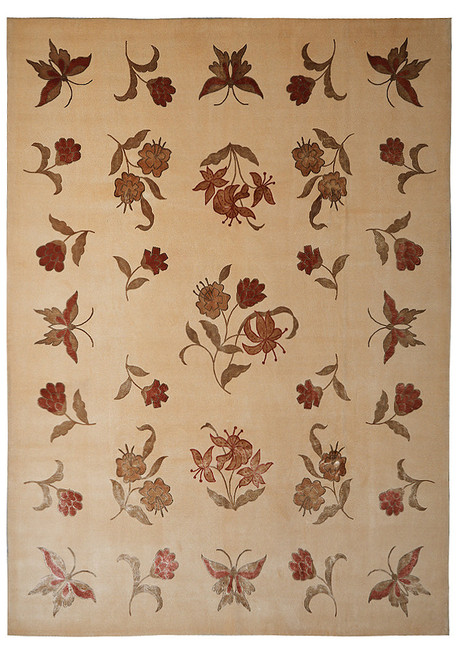
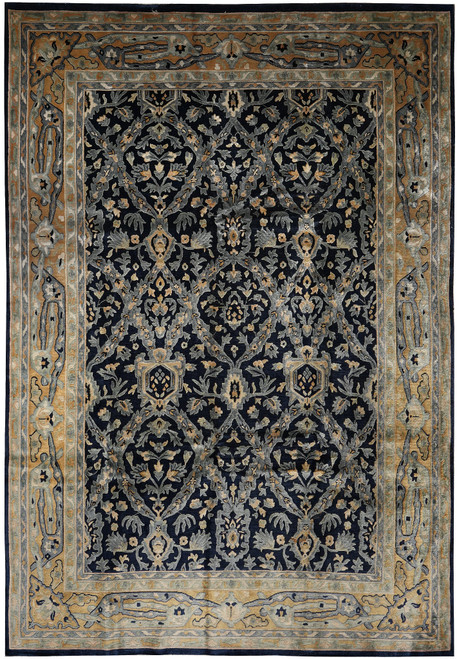
The old repertoire is Chinese-influenced: dragons, cloud bands, the endless knot, a medallion on open ground, close to what the Chinese tradition does. The modern repertoire is something else entirely, and Tibetan construction is now the default for hand-knotted modern design: solid fields, gradients, abstract blocks, and mixed piles that set wool against silk in the same rug.
Mixed piles
Because the technique handles a change of yarn easily, Tibetan weaving is where you most often meet a field that is part wool and part silk, or part bamboo silk. The contrast is textural as much as visual: the silk areas lie flatter and shine, the wool areas stand up and absorb. Check which fibre is where before choosing a spot for it, since the two wear very differently.
Where it belongs
An all-wool Tibetan rug is a genuinely robust floor covering and suits a sitting room or a bedroom without qualification. A heavily silk-blended one is a decorative piece and should be treated like one. For something with the same quiet field but an older character, look at transitional designs or the soft palettes in the colour families.