Yalameh Rugs
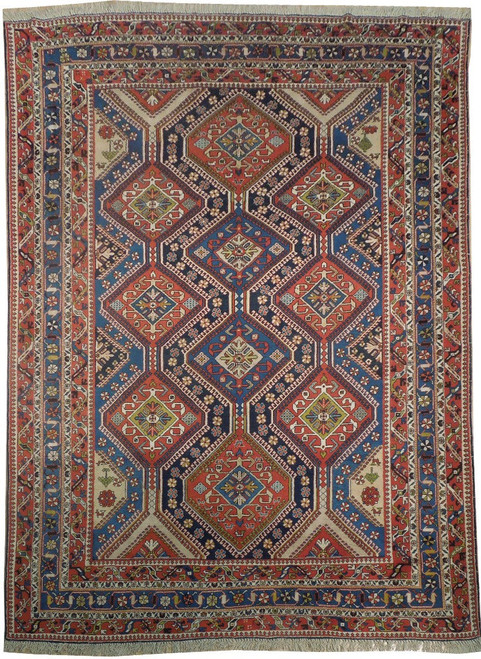
Yalameh rugs come from the villages on the border between Isfahan and Fars provinces, woven by Luri and Khamseh weavers with a strong tribal design habit and unusually good wool. The design is almost always the same and almost always works: columns of stepped diamond medallions locked into each other, running the length of the field in saturated red, indigo and ivory.
Who weaves them
Yalameh is a weaving group rather than a town. The rugs are made in the highland villages along the boundary between Isfahan and Fars, by weavers of Luri descent and by families associated with the Khamseh confederation, a grouping of southern tribes that also includes people of Arab, Turkic and Persian origin. The name reached the market relatively recently, which is why older pieces of the same weaving often travelled under other labels, usually Shiraz or one of the broader tribal names. Anyone tracing provenance in this corner of Iran should expect the categories to be commercial rather than ethnographic. What is consistent is the weaving itself.
Columns of stepped diamonds
The Yalameh field is one idea done well. A vertical column of diamond medallions, each built from concentric stepped outlines in alternating colours, each locked into the one above and below it so the column reads as a single chain. Small hooks project from the edges, and the ground between the columns fills with tiny animals, birds, combs and rosettes. In a runner there is one column; in a wider rug, two or three. The design does not need a border to organise it and does not need size to make sense, which is the opposite of the panel grids of Bakhtiari weaving further north. A Yalameh works at four by six as well as it works at eight by ten.
Dye, and why the colour is uneven
The colour is the reason to buy one. Deep madder red, dark indigo blue, undyed ivory and a strong green or aubergine used in the medallion outlines, all at full strength. Natural dyeing in small batches does not produce uniform colour, and across a wide field the difference between one dye lot and the next shows as a horizontal band of slightly different tone. The trade calls that abrash. It is not a flaw and it is not damage. It is the record of the rug being made a few inches at a time over months, and on a tribal rug it is usually the most attractive thing about the surface. A rug with no abrash at all in a natural palette is worth a second look, not a first choice. For the general range, see multi-colour.
Wool worth handling
Yalameh wool is among the best of the southern tribal weavings: long-fibred, greasy with lanolin, and spun by hand so the yarn varies slightly in thickness. The pile is medium to thick and the handle is soft without being slack, which is unusual for a geometric rug. The foundation is often wool as well, sometimes cotton in more recent village production. A wool foundation makes the rug lighter and more pliable than any city rug of the same size, and it also means the rug will not stay perfectly flat and square. Slightly wavy edges and a field that is not exactly a rectangle are normal here. A rug that must sit dead flat in a tight space is a job for a cotton-founded city weave such as Tabriz.
The southern family
The tribal weavings of Fars and its borders are easy to mix up and worth separating. Qashqai work is finer and often uses a single large medallion or a diagonal lattice. Abadeh is village-regular, with a small central diamond on an open ground. Gabbeh gives up pattern for thick plain colour. Yalameh is the one built entirely on the interlocking diamond, and of the group it has the deepest colour. All of it sits inside tribal weaving and inside the wider Persian tradition.
Where to put one
A Yalameh is a working rug. The dark saturated palette hides a great deal, the geometry stays legible as the pile shortens, and the wool recovers from compression better than most. It suits a hallway, a kitchen, a family room, and it is a good runner, since the single column of medallions is exactly a runner design. Where it is the wrong choice is a room that already has a lot going on, or a formal scheme built on pale colour, because nothing about this rug is quiet. The natural sizes are four by six to six by nine, and pieces beyond eight by ten are uncommon.