Gabbeh Rugs
Gabbeh means raw, or unclipped, and that is a fair description. These are the rugs the Luri and Qashqai weavers of the Zagros made for their own floors: few knots to the inch, a long pile, almost no pattern, and often wool left the colour it grew. It is the one traditional Persian rug a modern room takes without an argument.
The word is the specification
Most Persian rug names are places. Gabbeh is not. It is a Persian word meaning raw, natural or unclipped, and it describes the weave rather than the town. A gabbeh has a knot count of a different order from a city carpet: where a fine Isfahan is counted in hundreds of knots per square inch, a gabbeh is counted in tens. The pile is left long instead of being shorn close. Nothing about that is a failure of skill. It is a different object with a different job, and judging it by knot count is like judging a sheepskin by thread count.
Woven for the weaver, not the market
Gabbehs were domestic goods. Nomadic and semi-nomadic families in the Zagros made them for sleeping on, sitting on and keeping the cold of the ground out, which is why the pile is thick and the design is whatever the weaver felt like. There was no client, no cartoon and no drawing to follow. Commercial interest in them is recent: for most of the twentieth century they were the rugs Western dealers left behind, and it was only in the 1980s and after that they became an export line in their own right. The same weaving groups produce the finer, tighter work sold as Qashqai and traded through the bazaar as Shiraz, so a gabbeh sits at one end of a much wider tribal tradition rather than outside it.
The wool is the whole argument
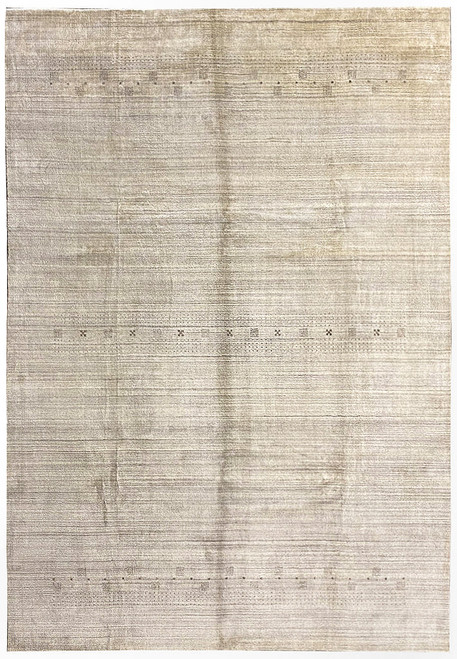
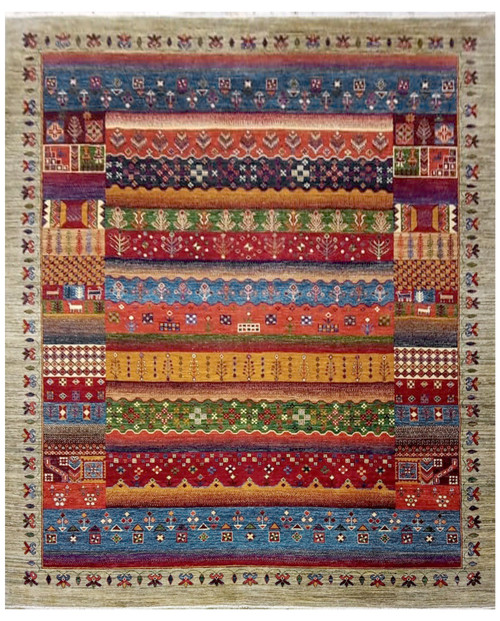
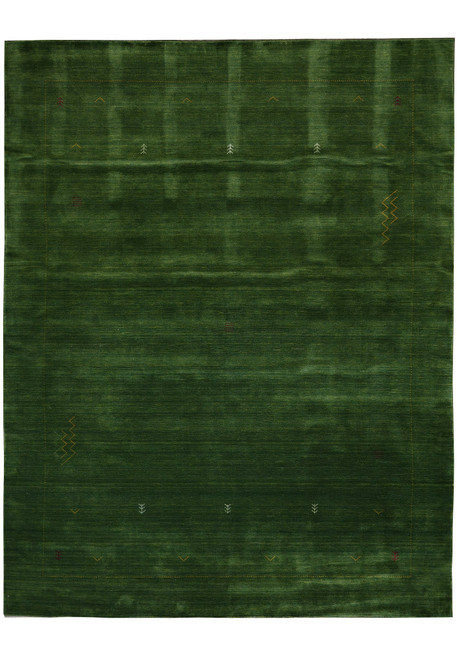
A gabbeh is bought for its wool. The flocks graze high summer pasture, the fleece is hand spun rather than machine spun, and the natural grease is not stripped out, so the finished wool pile is soft, slightly springy and resists dirt better than it looks as though it should. A large share of gabbehs use undyed fleece straight from the animal, which gives cream, oatmeal, camel, grey and near black without a dye pot. Where there is colour it is usually a short list: madder red, indigo, walnut, pomegranate rind. Undyed grounds are why so many gabbehs sit naturally with ivory and beige or brown schemes. Hand spinning also means uneven yarn, which means abrash: bands where a colour shifts lighter or darker across the field. In a gabbeh that is not a flaw to be discounted, it is the evidence of how it was made.
Design by subtraction
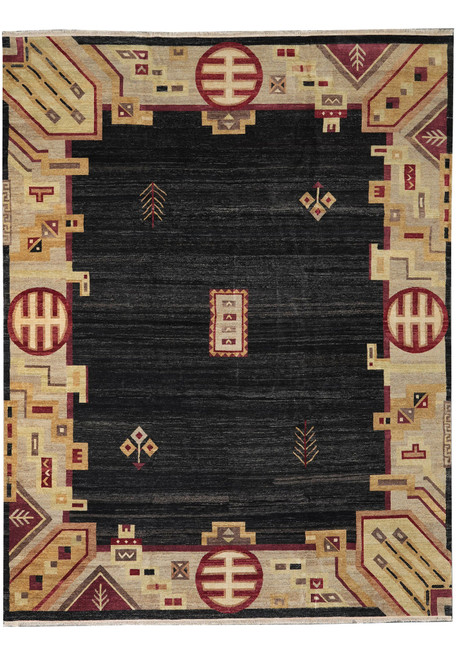
Expect an open field, blocks and bands of colour, a few lines, and sometimes a single lion, a tree, a row of small animals or a scatter of diamonds placed by eye. The drawing is childlike in the accurate sense: unmediated, not naive for effect. This is the reason gabbehs get bought for rooms that reject everything else in Persian weaving, and why they read as comfortably alongside modern and transitional designs as they do with old furniture. If you want the filled, formal field of classical Persia, this is the wrong tradition and an Abadeh or a Kerman is the better place to look.
What a thick pile is bad at
Height has consequences. A gabbeh will shed loose fibre for the first months, and a new one will not sit flush under a door that already clears the floor by a hair. It is a poor choice under a dining table, because chair legs sink into the pile and drag rather than slide, and a poor choice if the rug has to disappear under low furniture. It is also not the rug for a room where you want the pattern read from across the space: there is very little pattern to read. For flat, low and dead level, a flat weave or the very short pile of a Moud does that job properly. What a gabbeh is genuinely good at is warmth, comfort underfoot, and absorbing traffic in a family room without showing every footfall.
Sizes, and the honest limits
Because the tradition is a domestic one, gabbehs are strongest in accent and small formats, with a reasonable supply of medium pieces and runners. Genuinely large gabbehs are woven, mostly on workshop looms rather than tribal ones, but they are the exception. Shapes tend to be slightly irregular, and an old one may not be a true rectangle. That is normal for the type and is worth knowing before measuring an alcove to the centimetre.