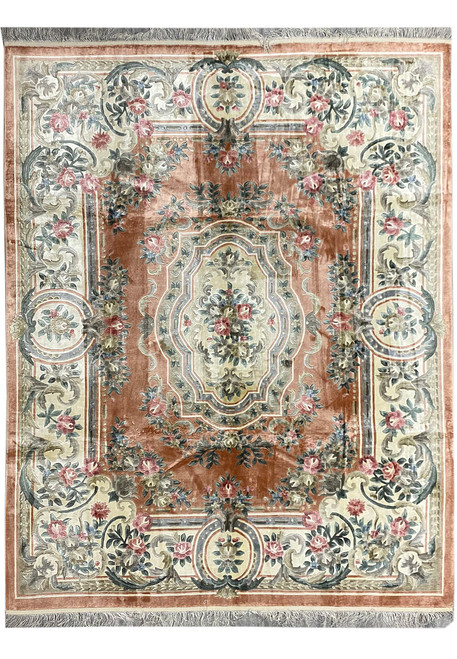
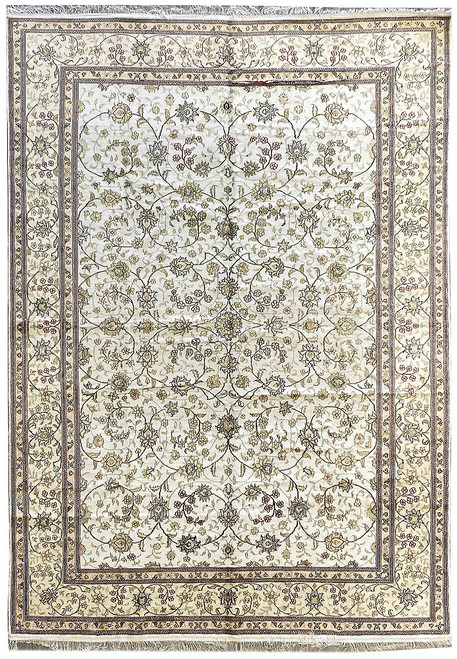
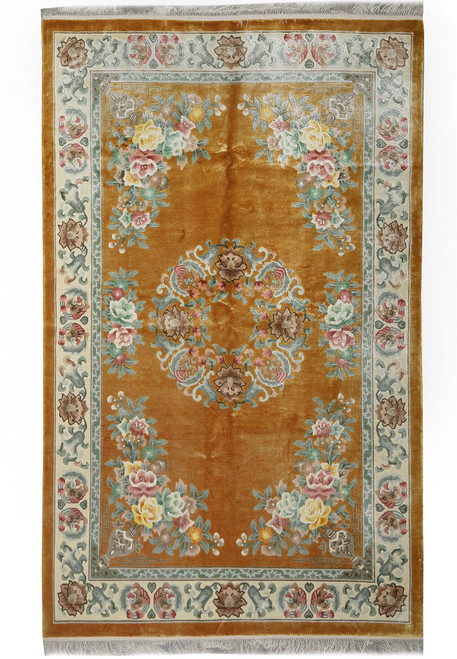
Bamboo Silk Rugs
Bamboo silk is not silk. It is a regenerated cellulose fibre, the same family as viscose and rayon, made by dissolving plant pulp and pushing it through a die into filaments. That is worth saying first, because everything else about the material follows from it: the shine, the clarity of the colour, the low cost, and the fact that it will not take traffic.
Said plainly, at the start
No bamboo was woven into the rug. Bamboo, or more often eucalyptus, beech or another fast-growing pulp, is broken down chemically into cellulose, extruded as filament and spun into yarn. The result is a manufactured fibre of plant origin. Calling it silk is a habit the trade has never quite given up, and it appears under several names: bamboo silk, banana silk, art silk, artificial silk, viscose, rayon and occasionally just soft silk. All of those are the same chemistry. Real silk is a protein filament reeled from a cocoon and has nothing to do with any of it.
Why weavers use it anyway
Because it dyes cleanly and it shines. Cellulose takes colour with a clarity wool cannot match, so the dyes come out deep and even, and the filament reflects light along its length in a way that reads as silk from across a room. It costs a fraction of what silk costs, and it can be knotted as finely as the loom allows. For a modern design that is mostly flat colour and sheen, it does the job it was chosen for. A great deal of contemporary Indian and Nepalese weaving uses it, usually as blocks of shine set against a wool ground.
Water is the real problem
Regenerated cellulose loses much of its strength when it is wet. A fibre that behaves perfectly well dry becomes weak and easily broken under pressure while damp, so rubbing at a wet patch can pull the pile apart, and the cellulose itself can yellow or brown as it dries, leaving a ring that is not soil at all. This is the single largest difference between the material and wool, and it is why a spill matters here more than anywhere else in the catalogue. Kitchens, bathrooms, entrances and anywhere people stand holding a drink are the wrong rooms.
Underfoot, and the track that stays
Bamboo silk has almost no resilience. Wool crushes and springs back because the fibre is crimped; this fibre crushes and stays crushed, so the line people walk across a room prints itself into the pile and does not lift out. It also sheds more than wool while new, and the shed fibre is fine and pale enough to be noticed. None of that is a manufacturing fault. It is what the material does, and the only real answer is to put it somewhere it is not walked.
Where it can honestly go
Treat a bamboo silk rug as a decorative object and it will do exactly what it was made to do. A bedroom, beside the bed rather than under the traffic. A guest room, a study, a quiet sitting room, a wall, or an accent size that gets looked at more than crossed. Not a hall, not under a dining table, not under an office chair, not in front of a sofa in nightly use. If a busy room is the one that wants the shine, the better answer is wool with silk outlines, which puts the light in the drawing and leaves the wear to wool. If the room takes real punishment, a Bijar or a Heriz is a different order of object altogether.
Telling the two apart
Feel is a poor test, because a well-finished viscose pile is convincingly smooth. The trade's test is to burn a single fibre: silk is a protein, smells of burnt hair and leaves a small brittle bead, while cellulose smells of burnt paper and leaves soft ash. It destroys the fibre, so it is done once and on purpose. Short of that, read what is written down. A rug described as new work in art silk, bamboo silk or viscose is saying plainly what it is, and there is nothing wrong with buying one for what it actually is rather than for what the word silk suggests.