Watch the film
| Size in ft: | Width: 8' x Length: 10' |
| Size in Inch: | Width: 96" x Length: 120" |
| Size in meters: | Length: 3.05 x Width: 2.44 m |
| Colors: | Blue, Ivory, Red |
| Shape: | Rectangular |
| Woven: | Hand-Knotted |
| Pile: | Wool $ Silk |
| Design: | Bijar |
| Age: | 1980's |
| Condition: | Perfect |
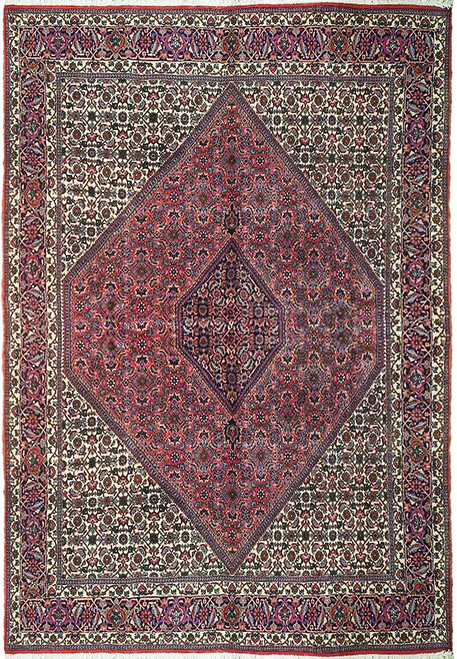
8' x 10' Persian Bijar Rug | Navy Herati Field with Ivory Diamond Medallion | Wool & Silk, 1980s
This is a Kurdish weaving from the Bijar district in the Sanandaj region of northwest Persia, woven in the 1980s and kept in perfect condition. It is heavy in the hand the way a proper Bijar should be, with a dense wool pile carrying fine silk highlights over a cotton foundation, and it lies dead flat without a ripple. The drawing is textbook: a strict all-over Herati field in deep navy, interrupted by a large ivory diamond that carries the same pattern in reverse, all held by a brick red main border of palmettes and rosettes. At 8' x 10' it covers a standard seating group or a table for 8 without crowding the walls, and it sits comfortably alongside our other 8x10 Persian rugs. Every rug we sell ships with a certificate of authenticity documenting origin, materials and hand-knotted construction.
Design and Motifs
The field is the Herati, known equally as mahi or the fish pattern: a lattice of small diamonds, each enclosing a rosette and flanked by 4 curved lanceolate leaves that give the design its fish name. It repeats across the whole ground without a break in rhythm, which is the hardest way to draw a rug because any drift in the count shows immediately. Over it sits a stepped diamond medallion outlined in ivory, its edges built from tiny squared-off ziggurat steps rather than a curved line, with small pendant finials at top and bottom. The medallion does not clear the field, it frames a second navy panel that continues the same Herati repeat, so the eye reads depth rather than interruption. The main border runs a red ground with alternating turtle palmettes and 8 petal rosettes joined by serrated leaves, flanked on both sides by barber-pole guard stripes and a narrow reciprocal trefoil line along the very edge. The corners resolve cleanly, a fair test of a weaver working from a village cartoon.
Color Palette
The ground is a dark indigo navy, almost black where the pile leans away from the light and clearly blue where it leans into it. Against that sit the two colors that carry the rug: a warm ivory to soft cream in the medallion outline and in the smaller rosettes, and a deep brick red, closer to oxblood than to tomato, that fills the main border and reappears as scattered blossoms and palmettes across the field. Between them the weaver worked in slate blue and dusty teal on the leaves and border cartouches, a muted rose pink in the small flowerheads, and touches of apricot and tan that warm the ivory medallion without brightening it. The silk in the pile shows itself where the light catches the leaf tips and the finer rosette centers, a quiet gloss rather than a shine. The overall reading is cool and formal from a distance, warmer and unmistakably red and cream once you are standing on it, which is why this palette works over dark hardwood as easily as it does over pale oak.
Bijar Origin and Weaving Quality
Bijar sits in Kurdistan, in the hills near Sanandaj, and its weavers earned the trade name the iron rug of Persia. The reason is technique rather than marketing: the wefts are pulled tight and the pile is beaten down with a heavy metal comb, row after row, until the structure is compacted to a degree no other Persian village attempts. The result is a rug that is thick, weighty, resistant to creasing and effectively indestructible in normal household use, which is why so many 1980s examples like this one still have full pile and crisp drawing. The local Kurdish wool is long-stapled and high in lanolin, so it takes dye deeply and burnishes rather than dulls with foot traffic, and the silk accents here add definition to the smallest motifs. If you want the background on structure and the regional sub-groups, read our guide to Bijar rugs and the comparison covering Bijar Tekab and Bijar Bukan weaving differences.
8' x 10' Persian Bijar Rug | Navy Herati Field with Ivory Diamond Medallion | Wool & Silk, 1980s
Ask about this rug
This piece is the only one of it, so the things worth knowing about it are particular to it. If you want to talk through the size, the colour in your own light, or the weave, speak to someone here first.