Watch the film
| Size in ft: | Width: 6'7" x Length: 8'2" |
| Size in Inch: | Width: 79" x Length: 98" |
| Size in meters: | Length: 2.49 x Width: 2.01 m |
| Colors: | Red, Cream, Black, Beige, Brown, Green |
| Shape: | Rectangular |
| Woven: | 100% Hand-knotted | Handmade |
| Foundation: | Cotton |
| Pile: | |
| Age: | 1980's |
| Design: | Bijar | Herati Mahi Field | Diamond Medallion |
| Origin: | Persian Bijar | Made in Persia |
| Condition: | Excellent | Never used |
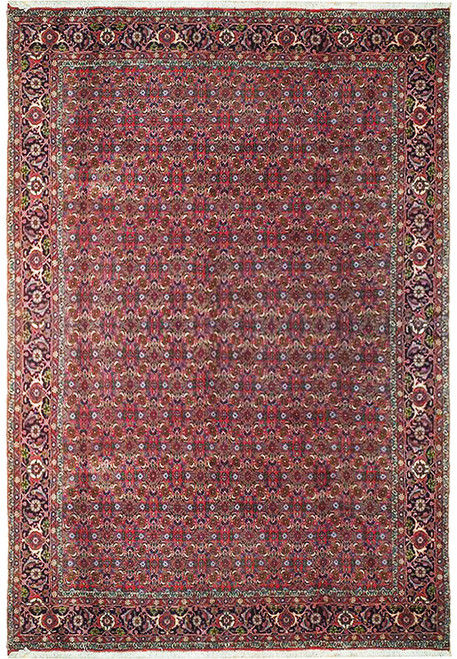
6'7" x 8'2" Persian Bijar Rug | Red Herati Field with Black Diamond Medallion | 1980s Wool
Pick this one up and you understand the reputation immediately: it is heavy for its size, stiff in the hand, and the back is packed so tightly that the knots feel like grain in wood. That weight is the whole point of Bijar rugs, woven in Kurdish western Persia and beaten down with a metal comb until the pile cannot shift. Woven in the 1980's on a cotton foundation with a 3/8" wool pile, it pairs a red center diamond with a cream Herati field and a near black main border, in a 6'7" x 8'2" format that suits a seating area or a smaller dining set without dominating the floor. Condition is excellent and the rug has never been used. A certificate of authenticity ships with it.
Please Note About the Photographs:
The two full overhead photographs were shot under bright light, which reads the center field as a cooler rose red. The close-up images show the truer warm salmon red of the wool. The drawing, knotting and condition are the same in every shot.
Design and Motifs
The whole surface is Herati, also called mahi or fish pattern: a lattice of small diamonds, each holding a rosette, each corner flanked by the curved lanceolate leaves that give the pattern its fish name. Bijar weavers draw it small and repeat it without a break, so the design runs edge to edge and the medallion is simply a change of ground color rather than a separate figure. The center is a large red diamond outlined in a pale blue-grey line, holding a smaller black diamond medallion filled with pink, gold and ivory rosettes and finished with a serrated ivory edge. Around it the field turns cream, carrying the same Herati lattice in red, black, brown and green, with four corner areas that read as quiet open ground by comparison. The main border is a black band of alternating palmettes and boteh leaves in salmon, ivory and gold, framed by narrow salmon guard stripes of linked rosettes, and the ivory fringe at both ends is clean and full.
The Red, Cream and Black Palette
Red is the main color, but it is a soft brick to salmon red rather than a hot crimson, and it appears twice: as the ground of the center diamond and again in the thin guard stripes and the rosettes scattered through the cream field. That cream ground is what makes this piece easy to live with, since it keeps the overall tone light and lets a dark room breathe. The black of the medallion center and the main border is deep and slightly inky, reading nearly blue-black in daylight, and it does the structural work of separating the red from the cream. Inside that framework the weaver worked in beige, warm brown, olive and grass green, plus small touches of pale sky blue and rose pink in the medallion flowers. The wool has a low luster typical of tough Kurdish fleece, so the colors stay matte and settled rather than glossy, which is one reason a Bijar looks the same at year 30 as it did on day one.
Bijar, the Iron Rug of Persia
Bijar sits in Kurdistan, in the hills of western Persia, and its weavers are known for one thing above all: compression. The weft is wetted and driven down with a heavy metal comb after every row of knots, which forces the wool into a block so solid that the finished rug will not crease, buckle or wear thin under traffic. Dealers have called these the iron rugs of Persia for well over a century, and the phrase is literal rather than poetic. The broader group covers several weaving centers, and the differences between Bijar, Bijar Zanjan, Bijar Tekab and Bijar Bukan come down to handle, wool quality and how finely the Herati is drawn. This example is drawn fine for a village weave, with small clean rosettes and straight border repeats, and the handle is stiff and dense exactly as it should be for a piece of this school.
6'7" x 8'2" Persian Bijar Rug | Red Herati Field with Black Diamond Medallion | 1980s Wool
Ask about this rug
This piece is the only one of it, so the things worth knowing about it are particular to it. If you want to talk through the size, the colour in your own light, or the weave, speak to someone here first.