Watch the film
| Size in ft: | Width: 6'7" x Length: 10' |
| Size in Inch: | Width: 79" x Length: 120" |
| Size in meters: | Length: 3.05 x Width: 2.01 m |
| Colors: | Coral red, navy blue, beige, cream, orange, black |
| Shape: | Rectangular |
| Woven: | 100% Hand-knotted | Handmade |
| Foundation: | Cotton |
| Pile: | |
| Age: | 1990's |
| Design: | Bijar | All-over Herati (Mahi) | Stepped diamond medallion |
| Origin: | Persian Bijar | Made in Persia |
| Condition: | Excellent | Full even pile |
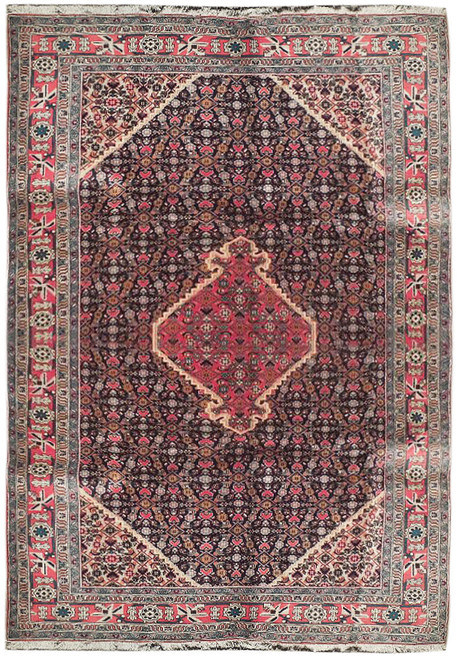
6'7" x 10' Persian Bijar Rug | Herati Mahi Field, Stepped Diamond Medallion | 1990s Kurdish Weave
Pick this rug up by one corner and you feel immediately what it is. Woven in the Kurdish town of Bijar in western Persia during the 1990's, it carries the weight, stiffness and board-flat handle that only the Bijar beat-down produces. The coral red field is filled edge to edge with the all-over Herati lattice, interrupted only by a single navy stepped diamond at the center, and the whole composition is held inside a broad ivory border. The 3/8" wool pile sits on a cotton foundation, the pile is full and even across all 4 corners, and at 6'7" x 10' it lands squarely in the useful 7 x 10 Persian rug range for a seating group or a smaller dining table. Every rug we ship leaves Freeport with a certificate of authenticity recording origin, materials and measurements.
Please Note About the Photographs:
The diagonal lines and shadows running across the field in the full-length photographs are fold marks from pallet storage. They are not wear, not fading and not damage, and they relax once the rug is laid flat. Every rug is professionally steamed and pressed before it ships. The overhead shots also read darker and cooler than the rug actually is; the close-up detail images show the true coral red of the field.
Design and Motifs
The field is a textbook Herati, the pattern also called mahi, or fish: a diamond lattice with a small rosette at each intersection and 4 curved lanceolate leaves turning around it, the leaves being the fish that give the design its name. Here the lattice is drawn small and repeated hundreds of times, so the field reads as continuous texture rather than as a row of separate motifs, with cream rosettes and navy leaf-work sparking against the coral ground. At the center sits a stepped diamond medallion on a navy ground, outlined first in pale celadon and then in ivory, with slender navy pendants reaching out to the left and right and terminating in small rosettes. The 4 spandrels repeat the same navy ground with a cross-and-rosette filling, their edges cut in clean stair steps rather than curves. Framing all of it is a wide ivory main border carrying the arabesque and vine known to collectors as the turtle border, flanked by coral guard stripes of zigzag ribbons, paired leaves and small flowerheads, and a final navy outer stripe.
A Coral Red Field Against Navy and Ivory
Coral red is the note that makes this piece unusual. It is not the deep madder crimson of most Bijar weaving but a warmer, softer salmon-toned red, and it gives the rug an easier, lighter presence than the origin usually has. Against it the navy blue of the medallion, spandrels and lattice leaves reads almost black in low light and resolves into a clear indigo in daylight. Cream and beige carry the rosettes, the medallion outline and the entire main border, and that ivory band is what stops the coral and navy from closing in on each other. Small quantities of orange warm the guard stripes, a pale olive green appears in the leaf tips and the border ribbons, and black is used sparingly for outlining, which is what keeps every small motif legible at this scale. The tonal drift across the field, lighter in some passages, deeper in others, is natural abrash from hand-dyed wool batches and is a mark of authentic village dyeing.
Bijar, the Iron Rug of Persia
Bijar lies in Kurdistan province in western Persia, and the Kurdish weavers there produce what the trade has called for well over a century the iron rug of Persia. The reason is mechanical: the weft is wetted and then hammered down with a heavy metal comb, blow after blow, compacting the knots so tightly that the finished rug is dense, rigid and famously difficult to wear out. That is why Bijars survive generations of hard traffic while lighter weaves thin out, and why they should be rolled rather than folded. Our complete guide to Bijar rugs covers the technique in detail, and if you are comparing weaving towns, the breakdown of Bijar, Zanjan, Tekab and Bukan weaving explains what separates them. This example shows the tradition clearly: tough highland wool with a dry, durable luster, a cotton foundation, small precise knotting that holds the Herati lattice without blurring, and a pile that after 30 years remains full from selvage to selvage.
6'7" x 10' Persian Bijar Rug | Herati Mahi Field, Stepped Diamond Medallion | 1990s Kurdish Weave
Ask about this rug
This piece is the only one of it, so the things worth knowing about it are particular to it. If you want to talk through the size, the colour in your own light, or the weave, speak to someone here first.