Watch the film
| Size in ft: | Width: 11' x Length: 13'9" |
| Size in Inch: | Width: 132" x Length: 165" |
| Size in meters: | Length: 4.19 x Width: 3.35 m |
| Colors: | Antique Red, Navy Blue, Ivory, Soft Red, Muted Blue, Green Accents |
| Shape: | Rectangular |
| Woven: | 100% Hand-knotted | Handmade |
| Foundation: | Cotton |
| Pile: | |
| Age: | 1970's |
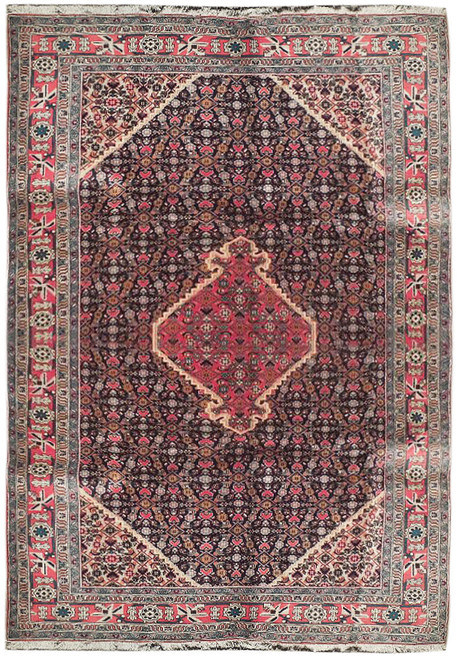
| Design: | Bijar | All-over Herati (mahi) field | Ivory diamond medallion |
| Origin: | Persian Bijar | Made in Persia |
| Condition: | Excellent | Even full pile throughout |
11' x 13'9" Persian Bijar Rug | Herati Fish Pattern Field | Ivory Diamond Medallion | 1970s Kurdish Weave
This is a heavy, honest room-size Bijar from the 1970s, hand-knotted in wool on a cotton foundation in the Kurdish highlands of western Persia. Pick up a corner and you feel the difference immediately: the weave is compacted, the handle is stiff and board-like, and the pile stands up straight rather than flopping over. That density is exactly why collectors call these the iron rugs of Persia. At 11' x 13'9" it covers a genuine great room or a long formal dining setting, and it sits comfortably in the same footprint buyers search for among large 11x14 Persian rugs. Condition is excellent with full even pile edge to edge, original ends and sides, and a certificate of authenticity is issued with the rug.
Please Note About the Photographs:
The soft shadow lines running across the field in several photographs are storage fold marks from the rug being stacked on a pallet. They are not wear, not fading and not damage. Fold marks relax and disappear once the rug is laid flat, and every rug leaves us professionally steamed and pressed before shipping.
Design and Motifs
The field carries the classic Bijar reading of the Herati pattern, known in Persia as mahi or fish: a lattice of small rosettes framed by paired lancet leaves that curve around each flower head like fish circling a pond. It repeats across the entire field in a dense diagonal rhythm, and because the knots are packed so tightly the small leaves stay crisp instead of blurring. At the center sits a stepped ivory diamond medallion enclosing a muted blue cartouche filled with red and green palmettes, with slender pendants reaching north and south. Four large ivory spandrels anchor the corners and are drawn with the same vine and rosette vocabulary, so the field reads as one continuous garden rather than separate zones. The border system runs five bands deep: a wide ivory main border of alternating turtle palmettes and rosettes, flanked by navy floral guards and finished with a fine reciprocal minor stripe, then a plain deep red outer band and cotton fringe at both ends.
The Color Palette: Antique Red, Navy and Ivory
The ground is a deep antique red that has aged into a burgundy tone, warmer and darker than a bright madder and with the faint variation across the surface that only comes from hand-dyed wool. Woven into it is a heavy proportion of navy blue, which is what gives the field its almost plum-toned depth from a standing height, while the Herati leaves carry a mid-tone indigo that separates cleanly against the darker ground in the close-up photographs. Ivory does the structural work: it lights the medallion, the 4 corner spandrels and the main border, and it keeps a rug this large from reading as a solid dark block. Scattered through the drawing are soft red rosettes, a clear emerald green in the leaf tips and flower centers, and small ivory blossoms that flicker across the field. It is a traditional, formal palette that lives easily with dark wood, leather and warm neutral walls.
Bijar, the Weaving Town of Persian Kurdistan
Bijar sits high in the Kurdish country of western Persia, and its weavers are known for one technique above all: the wefts are driven home with a heavy metal comb, pounded row after row so the foundation is beaten into a single compressed slab. The result is a rug that weighs far more than its size suggests and is very close to indestructible, which is why Bijars from the 1960s and 1970s are still turning up with full pile while lighter weaves of the same age have gone thin. Kurdish wool from the surrounding pastures is long-stapled and high in lanolin, so the surface keeps a quiet sheen and resists soil. Buyers researching the group often want to know how the town itself compares with the satellite weaving centers, and the differences between Bijar, Bijar Zanjan, Bijar Tekab and Bijar Bukan are worth understanding before you buy. This piece shows the town standard: a fine village-level knot count, a rigid dense handle and the disciplined Herati drawing Bijar built its name on.
11' x 13'9" Persian Bijar Rug | Herati Fish Pattern Field | Ivory Diamond Medallion | 1970s Kurdish Weave
Ask about this rug
This piece is the only one of it, so the things worth knowing about it are particular to it. If you want to talk through the size, the colour in your own light, or the weave, speak to someone here first.