Watch the film
| Size in ft: | Width: 13'6" x Length: 20' |
| Size in Inch: | Width: 162" x Length: 240" |
| Size in meters: | Length: 6.10 x Width: 4.11 m |
| Colors: | Red, Blue, Ivory |
| Shape: | Rectangular |
| Woven: | 100% Hand-knotted | Handmade |
| Foundation: | Cotton |
| Pile: | |
| Design: | Bidjar | Concentric Diamond Medallion | All-Over Herati (Mahi) |
| Origin: | Persian Bijar | Made in Persia |
| Condition: | Excellent |
13'6" x 20' Persian Bijar Rug | Concentric Diamond Medallion with Herati Fish Pattern | Oversize
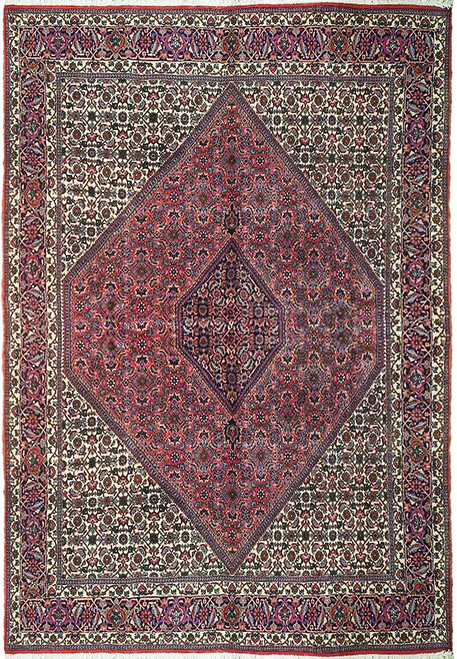
This is a true palace piece: 13'6" x 20' of hand-knotted Bijar weaving, heavy in the hand and built on the dense, compacted structure that made Persian Bijar rugs famous as the iron rug of Persia. The field is covered edge to edge with the small Herati fish pattern, then organized into a series of concentric diamond and hexagonal zones that alternate brick red and ivory, so the design reads as one continuous carpet-wide medallion rather than a motif floating in open ground. Wool pile on a cotton foundation, rectangular, and large enough to define a great room, a formal salon or a long banquet-style dining space where smaller pieces would look lost. Among oversize Persian rugs, a Bijar in this format is uncommon, because the weight of the weave makes a 20 foot loom a serious undertaking. Every rug ships with a certificate of authenticity.
Please Note About the Photographs:
A rug this large is stored rolled and folded on a pallet, so the wide-angle photos show a fold line and some lighting shadows running across the field. Those are not wear, not fade and not damage. They relax once the rug is laid flat, and every rug is professionally steamed and pressed before it leaves us.
Design and Motifs
The drawing is classic Bijar architecture. A small ivory hexagon sits at the exact center, ringed by a red hexagonal band, then an ivory diamond, then a wider red diamond, each outline traced by a fine sawtooth guard line so the transitions stay crisp. Those concentric frames expand outward until the largest diamond touches the corners of the field, and the four corner triangles are filled with the same repeating pattern in reversed coloring, which is why the eye reads depth and movement in what is actually a flat, disciplined geometry. Every zone, light or dark, is packed with the Herati, also called mahi or fish pattern: a small rosette inside a diamond, flanked by four curved lanceolate leaves. Two slender pendant motifs drop from the top and bottom of the inner medallion. The main border reverses the mood with curling vine work, large cream and gold palmettes and blue and rose rosettes on a rust ground, framed by narrow reciprocating guard stripes on both sides.
A Study in Red, Ivory and Blue
The dominant color is a warm brick red that shifts between rust, terracotta and a softer salmon tone depending on how light crosses the pile, exactly the kind of gentle variation you want from well-dyed Persian wool. Against it, the ivory and cream bands do the structural work, lighting up alternate diamonds and the outer field so the layered medallion stays legible from across a large room. Navy and deep indigo appear in the Herati outlines, in the small diamond lattices and in the fine guard stripes, giving the red and ivory the contrast they need to stay sharp rather than sweet. The border adds the accent colors: soft gold, pale cream, powder blue rosettes and touches of green in the leafwork, all read clearly in the close-up border photograph. Overall the palette is warm and traditional, easy beside walnut, mahogany and antique brass, and forgiving enough for busy rooms.
Bijar: Kurdish Weaving in Northwest Persia
Bijar sits in Kurdistan in northwestern Persia, and its weavers work on a heavy warp with wet wefts beaten down hard with a metal comb. That single technique is the whole reputation: the pile is compressed so tightly that the finished rug is stiff, dense and nearly indestructible, which is why the trade calls it the iron rug of Persia and why Bijars routinely outlive the houses they were bought for. The Herati field with a stepped concentric medallion is the town's signature statement, and the weavers of the district keep to it with real discipline generation after generation. If you are comparing pieces from the surrounding weaving centers, the differences between Bijar, Bijar Zanjan, Bijar Tekab and Bijar Bukan come down to handle, wool and beat-down, and this piece has the weight and body of the genuine article at a size very few looms ever attempt.
13'6" x 20' Persian Bijar Rug | Concentric Diamond Medallion with Herati Fish Pattern | Oversize
Ask about this rug
This piece is the only one of it, so the things worth knowing about it are particular to it. If you want to talk through the size, the colour in your own light, or the weave, speak to someone here first.