Watch the film
| Size in ft: | Width: 6'9" x Length: 9'10" |
| Size in Inch: | Width: 81" x Length: 118" |
| Size in meters: | Length: 3.00 x Width: 2.06 m |
| Colors: | Deep red, black, cream, burgundy, brown, pink |
| Shape: | Rectangular |
| Woven: | 100% Hand-knotted | Handmade |
| Foundation: | 100% Cotton |
| Pile: | 3/8" | 100% Wool |
| Age: | 2000's |
| Design: | Bijar Herati | Mahi Fish All-Over | Hexagonal Medallion |
| Origin: | Persian Bijar | Made in Persia |
| Condition: | Excellent | Never used |
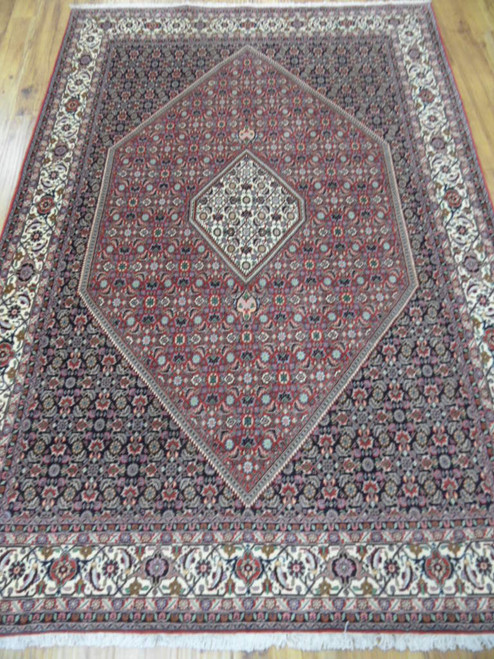
6'9" x 9'10" Persian Bijar Rug | Herati Fish Design, Navy Medallion | Dense Weave, Excellent Condition
Pick this rug up by one corner and you feel immediately what separates it from an ordinary wool rug: it is heavy, board-flat and packed solid, exactly the way Persian Bijar rugs have been built for generations. The weavers beat each row of knots down with a heavy metal comb, which is why the 3/8" wool pile sits so tight and upright and why the drawing of the small Herati repeat stays crisp from one end to the other. At 6'9" x 9'10" it sits squarely in the most useful of the 7x10 Persian rug proportions, large enough to anchor a seating group without swallowing the room. Woven in the 2000's, never used and in excellent condition, it ships with a certificate of authenticity confirming it as a hand-knotted Persian Bijar.
Design and Motifs
The whole field, inside and outside the medallion, is covered in the Herati repeat, known also as mahi or the fish pattern: a small diamond lattice with a rosette at the center of each compartment and 4 curved lanceolate leaves turned around it like fish circling a pool. A large elongated hexagonal medallion sits in the middle, outlined in a pale ivory-green serrated line, with a smaller ivory lozenge at its heart and a single palmette pendant floating above and below it. The corner spandrels are cut on the same stepped hexagonal geometry rather than drawn as curved arches, which is typical of good Bijar workshop drawing. The main border runs an ivory ground with alternating boteh and rosette heads linked by a dark vine, framed by narrow guard stripes of small flower heads, and the whole layout is perfectly balanced end to end.
Deep Red, Ink-Black Navy and Ivory
The open field is a deep red that photographs closer to rose or salmon under showroom light, a warm brick tone softened by the ivory and cream detail scattered through the lattice. Against it the medallion reads almost black, a very dark inky navy that makes the gold and mustard rosettes inside it glow, with touches of pink, soft green and pale blue picked out in the tiny leaves. Burgundy and brown carry the outlines and the vine work, while the ivory main border lifts the whole rug and keeps the dense pattern from reading heavy. The center lozenge is the lightest note in the rug, a clean cream ground with black and rose tracery, and the dark navy outer guard stripe closes everything off against a red selvage. It is a warm, traditional palette that works in a room with wood floors, leather and antique furniture.
Bijar, the Iron Rug of Persia
Bijar sits in Kurdistan in northwest Persia, and the Kurdish weavers there produce what dealers have called the iron rug of Persia for well over a century. The warps are strung under high tension and each weft is hammered home with a heavy metal comb, compressing the wool until the finished rug is stiff, dense and nearly indestructible underfoot. The local wool is greasy and resilient, so the pile springs back instead of flattening in traffic lanes. Weaving is spread across the town and its satellite villages, and the differences between Bijar, Bijar Tekab, Bijar Bukan and Bijar Zanjan come down to exactly this kind of weave quality and drawing discipline. This piece is a fine dense example: tight knotting, even shearing, straight edges and a Herati repeat small enough to stay legible across nearly 10 feet of length.
6'9" x 9'10" Persian Bijar Rug | Herati Fish Design, Navy Medallion | Dense Weave, Excellent Condition
Ask about this rug
This piece is the only one of it, so the things worth knowing about it are particular to it. If you want to talk through the size, the colour in your own light, or the weave, speak to someone here first.