Watch the film
| Size in ft: | Width: 6'7" x Length: 9'9" |
| Size in Inch: | Width: 79" x Length: 117" |
| Size in meters: | Length: 2.97 x Width: 2.01 m |
| Colors: | Blue, Soft Red, Ivory |
| Shape: | Rectangular |
| Woven: | Hand-Knotted |
| Pile: | 3/8" Wool |
| Origin: | Persia |
| Design: | Bijar |
| Condition: | Excellent |
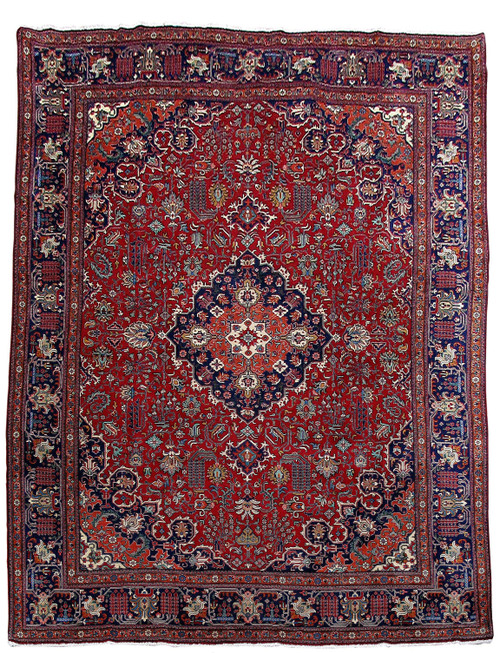
6'7" x 9'9" Persian Bijar Rug | Navy Herati Field, Soft Red Medallion | Excellent Condition
This 6'7" x 9'9" Persian Bijar rug still wears the cloth import tag it left the warehouse with, printed with the number 49738-986, the province line "Bidjar", and the metric size "297 x 200", which converts exactly to the 6'7" x 9'9" measured here. The pile is a dense 3/8" wool on a cotton foundation, packed hard in the way Bijar weavers are known for, and the rug lies flat and heavy with no ripple at the edges. Condition is excellent: full pile from selvedge to selvedge, clean ivory fringe, and even color across the whole field. A certificate of authenticity ships with the rug.
Design and Motifs
The drawing is the classic Bijar formula worked at full scale. A large elongated hexagonal medallion fills most of the field, outlined by a fine sawtooth band, with a small stepped ivory diamond at the exact center and a single pendant hanging from each end. Herati, the same pattern the trade calls mahi or fish, runs edge to edge without a break: a lattice of small rosettes, each ringed by four curved lanceolate leaves, the leaves reading as fish circling the flower. The pattern continues straight through the medallion outline rather than stopping at it, so the medallion is defined by color change alone, which is a hallmark of good Bijar drafting. The wide ivory main border carries alternating turtle palmettes and hooked leaf forms on a thin connecting vine, framed by narrow reciprocal guard stripes in soft red and navy. This is 8 to 9 feet of repeating small-scale ornament with no filler and no visible abrash, and it sits naturally with other 7x10 Persian rugs in a seating area.
A Navy, Soft Red and Ivory Palette
Three tones carry the rug. The outer field is a deep navy blue, dark enough at a distance to read almost black, and every Herati rosette in it flickers with small points of rust, ivory, soft green and pale lilac. Inside the medallion the ground shifts to a soft rose red, lighter and warmer than the tomato red of many Persian city rugs, which lifts the center and makes the medallion visible from across a room. The small central diamond is ivory, matching the wide main border, so the eye travels from the ivory core outward to the ivory frame. Secondary color does most of the quiet work: celadon green leaves, muted mauve, walnut brown and a chalky cream appear in rotation through the lattice, keeping the surface lively rather than flat. Under lamplight the navy warms and the soft red deepens, while daylight brings out the green and lilac accents that are easy to miss at first glance.
Bijar Weaving and the Iron Rug of Persia
Bijar sits in Kurdistan in western Persia, and its rugs earned the nickname the iron rug of Persia for one reason: the weavers beat each row down with a heavy metal comb, often wetting the warps first, which compresses the wefts into a foundation so tight the finished rug is almost impossible to bend against its length. That is why this piece is noticeably heavier than a Tabriz or Sarough of the same size, and why Bijars from the same period are still in service in hallways and dining rooms decades later. The wool from the region is tough, high in lanolin and takes dye cleanly, which is what keeps the navy and the soft red this saturated. Buyers comparing weaving groups can read our breakdown of Bijar, Bijar Tekab and Bijar Bukan to understand where a piece like this one belongs.
6'7" x 9'9" Persian Bijar Rug | Navy Herati Field, Soft Red Medallion | Excellent Condition
Ask about this rug
This piece is the only one of it, so the things worth knowing about it are particular to it. If you want to talk through the size, the colour in your own light, or the weave, speak to someone here first.