| Size in ft: | Width: 8'2" x Length: 11'7" |
| Size in Inch: | Width: 98" x Length: 139" |
| Size in meters: | Length: 3.53 x Width: 2.49 m |
| Colors: | Ivory, Coral, Green, Blue |
| Shape: | Rectangular |
| Woven: | 100% Hand-knotted | Handmade |
| Foundation: | Silk |
| Pile: | |
| Age: | 1980s | Unused |
| Signature: | Signed | Woven cartouche in the upper border |
| Design: | Qum | Central Medallion | All-Over Floral |
| Origin: | Persian Qum | Made in Persia |
| Condition: | Perfect | Never used |
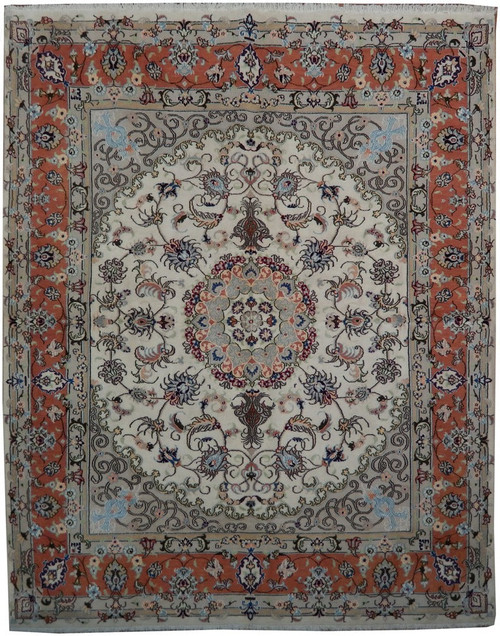
8'2" x 11'7" Persian Qum Silk Rug | Ivory Field with Coral Medallion | Signed, 1980s, Never Used
A room size silk rug from Qum is an unusual thing to find, and finding one that has never been walked on is rarer still. This 8'2" x 11'7" piece was woven in the 1980s in pure silk, pile and foundation, and it has been kept rolled since it left the loom. The weaver signed it in a small cartouche at the top of the border, which on Persian Qum silk rugs is the workshop putting its name behind the work. The handle is light, cool and dense, the pile is low and evenly clipped, and the silk fringe is full and untrimmed on both ends. Every rug we ship carries our certificate of authenticity recording size, material, origin and hand-knotted construction.
Please Note About the Photographs:
The first flat overhead photograph reads darker and greyer than the rug actually is. The close-up shots of the medallion and the border show the true tones: a clean ivory ground and a warm coral rose rather than a dusty brick. Silk also shifts noticeably with the direction of the light, so the same area can look pale from one side of the room and deeper from the other.
Design and Motifs
The drawing is the classic Qum formula of a lobed central medallion set in a densely flowered field. At the very center sits a soft green cartouche filled with small rosettes and paired birds of paradise, ringed by a navy outline, then a wide coral medallion carrying palmettes, cypress sprays and hyacinth clusters. Long pendants run out of the medallion toward both ends. The ivory field around it is not left open for a moment: curling arabesque leaves, split palmettes, grape clusters and tight floral sprays repeat in mirrored pairs, drawn with the thin fluid line that only a high knot count allows. The 4 corners carry matching spandrels in the same coral and green, so the medallion reads as a formal frame within a frame. The main border is a coral ground with alternating palmettes and vine scrolls, held between ivory guard stripes of 8 petal rosettes and a fine sawtooth ribbon, and the outer edge closes in plain red. The signature cartouche breaks the top border, visible in the close-up of the fringe end.
A Detailed Look at the Colors
The ground is a warm ivory, closer to cream than to white, and because it is silk it throws light back and changes value as you move around it. Against that ivory the palette is built on coral rose: the medallion, the spandrels and the main border all share it, ranging from a pale blush in the border flowers to a deeper salmon red in the medallion ground. Green appears in two registers, a pale celadon in the medallion core and small leaves, and a darker olive in the vine work. Blue does the outlining work, an ink navy drawing the leaf edges and palmette spines, with flashes of bright sky blue and turquoise in individual flower heads that keep the field from reading flat. Add small notes of chocolate brown, brick and pale pink and the whole surface holds together as a soft, light, formal scheme rather than a saturated one. This is the kind of color balance that makes Persian silk rugs so easy to place in a pale room, and the knotted edges and both end finishes are clean with no abrash, no fading and no sun line.
Qum: The Town and the Weave
Qum sits in central Persia, south of Tehran, and it is a young weaving center by Persian standards, established in the 20th century rather than inherited from the Safavid court. What the town built instead was a reputation for fineness. Qum workshops use only the finest silk, the rivalry between ateliers is direct and personal, and a weaver who signs a piece is staking a name on it. The result is the drawing seen here: curves that stay curved, floral stems no thicker than a pencil line, and a back so tight that the knot rows disappear into each other, as the ruler shot shows. A silk Qum in the 8 x 11 to 8 x 12 class is also a serious commitment of loom time, since most Qum output is scatter size and runners, which is why room size examples like this one turn up far less often than 8 x 11 Persian rugs in wool. Collectors buy them for the floor of a formal room, and just as often hang them, because at this weave the piece functions as much as textile art as it does as a rug.
8'2" x 11'7" Persian Qum Silk Rug | Ivory Field with Coral Medallion | Signed, 1980s, Never Used
Ask about this rug
This piece is the only one of it, so the things worth knowing about it are particular to it. If you want to talk through the size, the colour in your own light, or the weave, speak to someone here first.