Watch the film
| Size in ft: | Width: 7'4" x Length: 9'5" |
| Size in Inch: | Width: 88" x Length: 113" |
| Size in meters: | Length: 2.87 x Width: 2.24 m |
| Colors: | Brown, Blue, Rust |
| Shape: | Rectangular |
| Woven: | 100% Hand-knotted | Handmade |
| Foundation: | Wool |
| Pile: | |
| Age: | 1940's | Approx. 80 years old |
| Design: | Sumak | All-over diamond lattice | 7 borders |
| Origin: | Caucasian Sumak | Made in the Caucasus |
| Condition: | Very Good | Age patina with softly worn passages in the field |
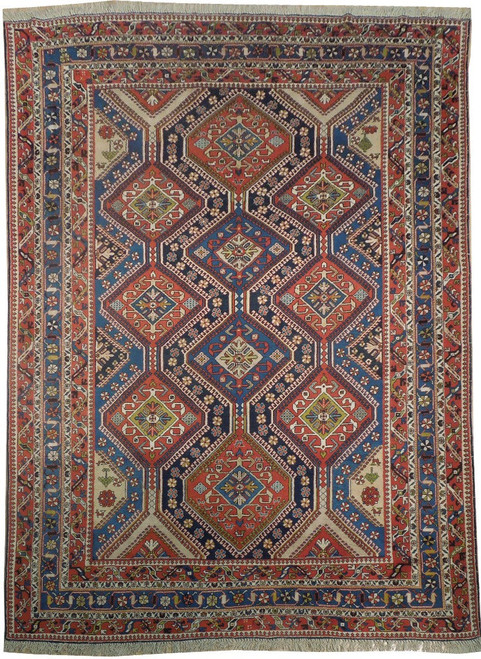
7'4" x 9'5" Caucasian Sumak Rug | Indigo Field with Rust Diamond Lattice | Circa 1940s Tribal Weaving
This is an old Caucasian Sumak from the 1940s, 7'4" x 9'5", and it reads like a piece of weaving history rather than a decorator's rug. The field is a deep indigo, crossed corner to corner by broad salmon and rust bands that lock together into a diamond lattice, and every open space inside that lattice is filled with ivory octagons, hooked leaves and small stepped stars. Seven concentric borders frame it, the widest of them a chocolate brown band carrying rose and sky blue cartouches. The wool is dry-spun highland fleece with the slight crinkle and lustre that only comes with age, and the colors have settled into the soft, uneven tones that collectors of antique tribal rugs look for first. Every rug we sell ships with a certificate of authenticity, and if you want to understand how a weaving like this is placed in time, our guide on how to date an antique Oriental rug walks through the same clues we used here.
Please Note About the Photographs:
The paler, softly worn passages you can see in the lower part of the field and along one side are original age patina on a weaving that is roughly 80 years old. They are not photo glare and not new damage, and the rug remains firm and even underfoot. It is professionally cleaned, steamed and pressed before it leaves our warehouse.
Design and Motifs
The drawing is pure highland geometry, built entirely from straight lines and stepped angles with no curved vine anywhere. Wide rust bands run diagonally across the indigo ground and meet in the center, dividing the field into large diamond compartments; inside each one sit paired ivory octagons with hooked interiors, flanked by serrated palmettes that look like feathered leaves. Smaller blue and ivory rosettes fill the gaps, and a scatter of latch-hook crosses keeps the eye moving from one compartment to the next, which is exactly how a good all over pattern rug should behave. The border system is the other half of the story: a dark brown main band with rose medallions and eight pointed stars, then an ivory band of angular hooked brackets, then a rose band of tiny 6 petal rosettes, then narrow reciprocal wave stripes at the very edge. Corner resolutions are not perfectly squared, which is normal and desirable in village work of this age and one of the surest signs the design was carried in the weaver's head rather than copied from a paper cartoon.
A Palette of Indigo, Rust and Brown
Color is the reason this rug stops people. The ground moves between a saturated ink indigo at the ends and a lighter, cloudier mid blue through the center, a natural abrash from separate dye lots that no machine can imitate, and it sits comfortably alongside the deeper navy blue rugs collectors favor. Against it, the lattice bands read as a warm salmon rust, somewhere between terracotta and apricot, softened by decades of light. The ivory motifs have mellowed to a buttery cream rather than a bright white, and pale celadon green appears in a few of the larger rosettes along the lower border. The main border is a true walnut brown, unusual and very much a Caucasian signature, and the rose and dusty pink of the secondary bands pick up the rust of the field so the whole thing closes as one palette. Small accents of sky blue and a rare touch of aubergine appear in the guard stripes. Nothing is loud, nothing is sharp, and the overall tone is warm brown and blue, which is why it settles so easily into rooms with wood floors and leather.
Sumak Weaving in the Caucasus
Sumak takes its name from the town of Shemakha in the eastern Caucasus, the mountain corridor between the Black Sea and the Caspian where tribal and village weavers have worked wool for centuries. The tradition is known for exactly what you see here: a dense, tightly drawn surface, bold geometry on a dark ground, and dyes taken from indigo, madder and walnut husk. Weavers in these villages worked on wool warps with local highland fleece, which is coarser and far stronger than lowland wool, and that is why a rug of this age can still carry traffic. Pieces from the 1940s are the last generation woven entirely with the old materials and the old drawing before commercial production took over, which makes a complete room size example at 7'4" x 9'5" considerably harder to find than a small mat or a bag face. Alongside the great Persian workshop weavings, Caucasian work of this kind sits at the other end of the Oriental rug world: not court refinement, but confidence, color and an unmistakable hand.
7'4" x 9'5" Caucasian Sumak Rug | Indigo Field with Rust Diamond Lattice | Circa 1940s Tribal Weaving
Ask about this rug
This piece is the only one of it, so the things worth knowing about it are particular to it. If you want to talk through the size, the colour in your own light, or the weave, speak to someone here first.