| Size in ft: | Width: 5' x Length: 16'2" |
| Size in Inch: | Width: 60" x Length: 194" |
| Size in meters: | Length: 4.93 x Width: 1.52 m |
| Colors: | Navy Blue, Burgundy, Teal, Red, Ivory, Gold |
| Shape: | Runner |
| Woven: | 100% Hand-knotted | Handmade |
| Foundation: | Cotton |
| Pile: | Flat Weave Kilim | Wool |
| Age: | 1940's | Approx. 80 years old |
| Design: | Sumak | 4 Connected Medallions | Tribal Geometric |
| Origin: | Caucasian Sumak | Woven in the Caucasus |
| Condition: | Excellent |
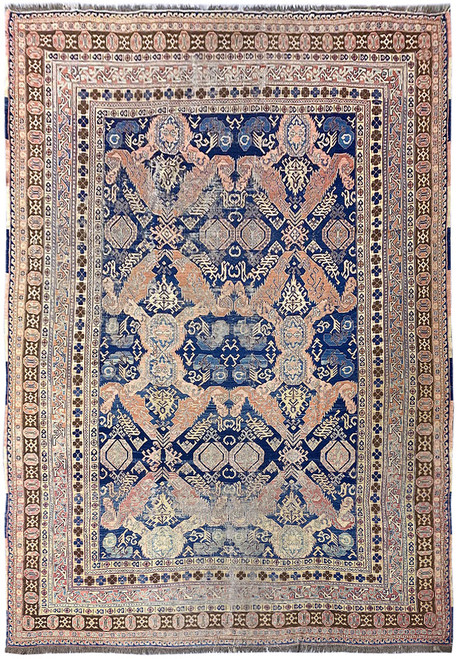
5' x 16'2" Caucasian Sumak Flat Weave Runner Rug | 4 Medallion Tribal Design | Circa 1940s
This 5' x 16'2" Sumak was woven in the Caucasus in the 1940s, and at 5 feet wide by just over 16 feet long it belongs to the gallery class: too wide to read as an ordinary hall runner, long enough to carry an entire corridor, a stair landing or the open side of a large room. The surface is a weft-wrapped flat weave rather than a knotted pile, so the wool lies in fine raised ridges you can feel with your hand, and the whole piece is thin, supple and reversible in handle. Four connected medallions march the length of a deep indigo field. It is a true tribal Oriental rug, in excellent condition for its age, and it ships with a certificate of authenticity.
Design and Motifs
The layout is a column of 4 hexagonal medallions, each ringed by a fine ivory and dark barber-pole outline and set inside a large stepped cartouche that runs corner to corner across the width. Inside every medallion sits a slim red staff flanked by tiny hooked leaves, birds and blossoms, drawn freehand so that no two repeats are identical. Between the medallions the field fills with small stars, combs, latch-hook rosettes and standing tree forms, with paired dark panels resembling stylized looms above and below each center. The burgundy main border carries turquoise tree of life figures, and narrow ivory zigzag guard stripes separate every band. This is the freehand vocabulary that collectors look for in tribal geometric rugs.
A Palette of Indigo Blue and Burgundy
The ground is a deep indigo that reads almost black in low light and opens into a clear midnight blue under a lamp, which you can see in the close detail shots. Against it the weaver set a rich burgundy, used for the stepped cartouches, the main border and many of the larger motifs, so the two dominant colors trade places along the length of the runner. The drawing itself is picked out in bright madder red, a cool teal turquoise, soft olive green, apricot and small touches of gold, all of them tempered by the dark ground rather than competing with it. Ivory appears only in the outlines, the zigzag guard stripes and the cotton fringe, and that restraint is what keeps a busy tribal field looking calm on the floor.
The Caucasus and the Sumak Weave
Sumak takes its name from the weaving villages of the eastern Caucasus, the mountain belt between the Black Sea and the Caspian, where weavers wrapped the colored wool weft around pairs of warps instead of knotting it. The technique is slower than plain kilim and produces a denser, flatter, far more durable textile, with the loose tails left on the reverse, exactly as shown in the fold photographs here. Because the wrapped stitch leans in one direction, the surface catches light in fine diagonal ridges. Pieces of this width and length were house furnishings rather than commercial goods, which is why the drawing wanders and the colors shift. The wool is glossy and the color still saturated, both good signals when you try to date an Oriental rug by eye.
5' x 16'2" Caucasian Sumak Flat Weave Runner Rug | 4 Medallion Tribal Design | Circa 1940s
Ask about this rug
This piece is the only one of it, so the things worth knowing about it are particular to it. If you want to talk through the size, the colour in your own light, or the weave, speak to someone here first.