Watch the film
| Size in ft: | Width: 2'10" x Length: 5'7" |
| Size in Inch: | Width: 34" x Length: 67" |
| Size in meters: | Length: 1.70 x Width: 0.86 m |
| Colors: | Rust Red, Indigo Blue, Ivory, Saffron Gold, Olive Green, Dark Brown |
| Shape: | Rectangular |
| Woven: | 100% Hand-knotted | Handmade |
| Foundation: | Wool |
| Pile: | |
| Age: | Circa 1940s | Vintage |
| Design: | Kazak | Triple Medallion | Geometric Tribal |
| Origin: | Caucasian Kazak | Woven in the Caucasus |
| Condition: | Excellent | Even pile with light age patina |
2'10" x 5'7" Caucasian Kazak Rug | Triple Medallion Geometric Design | Circa 1940s, Excellent Condition
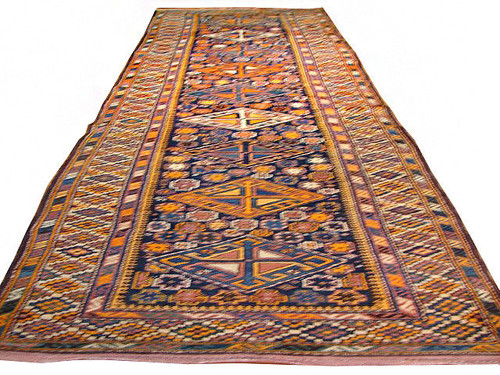
This 2'10" x 5'7" Caucasian Kazak was hand-knotted in wool in the 1940s, and eight decades later it still reads the way a good village weave should: heavy in the hand, glossy where the light catches the pile, and drawn entirely in straight lines and hooks. The field is divided into 3 compartments, each holding its own medallion, and the whole thing is held inside a stack of narrow borders that tighten toward the edge. Colors have mellowed into each other without going flat, which is the honest patina of a piece that has been lived with rather than stored. It is a small format, easy to place at an entry, beside a bed or in front of a reading chair, and it is the kind of tribal Oriental rug collectors buy first and keep longest. It ships with a certificate of authenticity confirming age, origin, materials and hand-knotted construction.
Design and Motifs
The center compartment carries the main event: an indigo panel framed in ivory latch hooks, with a stepped diamond medallion inside it and a saffron lozenge at the core, quartered by small hooked arms. Above and below sit 2 further panels, each anchored by a broad ivory motif with squared arms, flanked by paired ram's horn hooks in gold and olive and sprinkled with tiny stars, combs and rosettes that the weaver clearly placed by eye rather than from a cartoon. Nothing is symmetrical to the millimeter, and that is exactly what separates this from a factory product. The border system runs 5 deep, with a wide diagonal barber pole stripe on the outside, a bold ivory running dog band, and thin reciprocal sawtooth guards keeping the whole composition square. Buyers who gravitate toward geometric rugs will recognize the vocabulary immediately: hooks, steps, stars and reciprocal edges, all drawn with a confident hand.
A Multi Color Palette of Rust, Indigo, Ivory and Saffron
Rust red does the heavy lifting here, running through the compartment grounds, the outer border and the reciprocal bands in a warm terracotta tone that shifts toward brick where the pile leans. Against it, 2 depths of blue: a dark indigo in the medallion panels and a softer slate blue in the diagonal stripe border, both of which cool the red down and keep the rug from reading orange in a warm room. Ivory is used as an outline color rather than a field color, tracing the hooks, the running dog band and the edges of every medallion so the drawing stays legible from across the room. Saffron gold appears in the central lozenge, in the barber pole stripe and in small hooked fills, with olive green and a chocolate brown to black used sparingly for definition. The overall effect is multi colored but not busy, because the ivory outlining gives the eye a clear path through the composition.
The Caucasus, Kazak Weaving and Village Quality
Kazak weaving comes out of the highland districts of the southwestern Caucasus, a mountain region whose weavers worked on wool foundations with lustrous, long staple local wool and a relatively coarse knot count. That is not a shortcoming, it is the point: a thick wool pile on a wool foundation gives the rug weight, spring and a service life measured in generations, which is why surviving Caucasian tribal rugs from the first half of the 20th century are still on floors today. Designs were carried in memory and passed down within families, so no 2 pieces match exactly, and the small irregularities in the compartment widths and the abrash in the blues are the fingerprints of a single weaver at a single loom. The back shows a clean, even handle with the knotting visible row by row, and the selvages and ends have been kept intact. For anyone curious about the signals that place a piece in this period, our guide on how to date an Oriental rug walks through wool, dyes, wear and construction the same way we assessed this one.
2'10" x 5'7" Caucasian Kazak Rug | Triple Medallion Geometric Design | Circa 1940s, Excellent Condition
Ask about this rug
This piece is the only one of it, so the things worth knowing about it are particular to it. If you want to talk through the size, the colour in your own light, or the weave, speak to someone here first.