Watch the film
| Size in ft: | Width: 7'1" x Length: 10'3" |
| Size in Inch: | Width: 85" x Length: 123" |
| Size in meters: | Length: 3.12 x Width: 2.16 m |
| Colors: | Brick, Blue, Green, Ivory |
| Shape: | Rectangular |
| Woven: | Hand-Knotted |
| Pile: | Wool |
| Origin: | Persia |
| Design: | Heriz |
| Age: | 1950's |
| Condition: | Excellent |
7'1" x 10'3" Persian Heriz Rug | Geometric Medallion | Circa 1950s, Excellent Condition
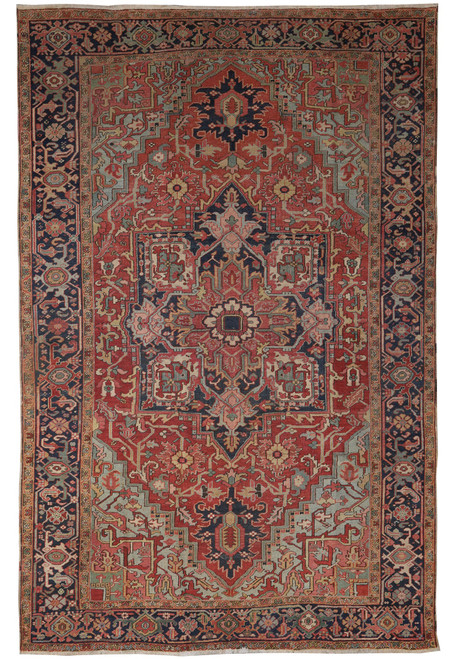
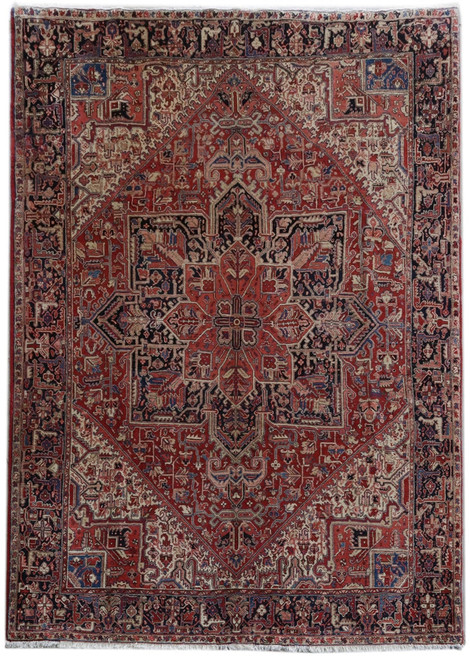
This is the kind of Heriz that gets bought once and kept for forty years. Hand-knotted in wool in northwest Persia around the 1950s, it measures 7'1" x 10'3", a true room size that sits comfortably in the 7x10 Persian rug range, and it has aged exactly the way a good village weave should: the brick field has mellowed into a warm terracotta, the indigo has held its depth, and the pile still stands evenly from end to end. The back photograph shows clean, tight rows over a cotton foundation, and the curled pile shots show wool with real body and a low natural sheen. Every rug we sell ships with a certificate of authenticity confirming it is a genuine hand-knotted piece, origin and age included.
Design and Motifs
The drawing is classic Heriz: everything is built from straight lines and stepped angles rather than curves, which is what separates these village weaves from the curvilinear city workshops. A large 8 sided medallion sits dead center on an indigo ground, with an olive green inner field and a small square rosette carrying a cross motif at its heart. Stepped pendants run north and south of it, each finished with a serrated leaf and a pair of hooked palmettes. The 4 corners carry ivory spandrels filled with vine scrolls, rosettes and angular leaf forms, and the brick field between them is packed with small hooked vines and blossoms rather than left open. The main border runs a navy ground with alternating rosettes and turtle palmettes, framed inside and out by narrow olive and ivory guard stripes. If you like geometric Persian rugs, this is the pattern the whole category is measured against.
Brick, Indigo, Sky Blue and Olive Green
The field is a soft brick red that leans terracotta and salmon in daylight, with gentle abrash banding across the width that tells you the wool was dyed in small lots. Against it the borders and medallion ground read deep indigo navy, nearly black in the corner detail shots, while a lighter sky blue fills the medallion cartouches, the leaf forms and much of the spandrel work, giving the rug real depth instead of a flat two tone look. Olive and chartreuse green carry the medallion interior and the outer guard stripe, an unusual and very collectible note in a Heriz. Ivory outlines every major shape and keeps the geometry legible from across the room, and small touches of chocolate brown, coral and old gold appear in the rosettes. The palette is warm, faded in the good way, and forgiving with wood floors, leather and both cream and charcoal upholstery.
Woven in the Heriz Villages East of Tabriz
Heriz is a group of villages east of Tabriz, on the slopes below Mount Sabalan, and the reputation rests on two things: the mineral rich water the local flocks drink, which produces famously tough and resilient wool, and a weaving tradition that works from memory and simple village cartoons rather than a full workshop drawing. That is why the medallion here is drawn in steps and angles and why no two Heriz rugs of the same layout are ever quite identical. Village work of this type is generally knotted below 200 knots per square inch, traded for durability over fineness, and the result is a heavy, hard wearing rug that survives decades of real traffic. The structure, the cotton foundation and the palette all point to the 1950s, and if you want to understand how those clues are read, our guide on how to date an Oriental rug walks through the same method we used on this piece.
7'1" x 10'3" Persian Heriz Rug | Geometric Medallion | Circa 1950s, Excellent Condition
Ask about this rug
This piece is the only one of it, so the things worth knowing about it are particular to it. If you want to talk through the size, the colour in your own light, or the weave, speak to someone here first.