| Size in ft: | Width: 8' x Length: 11'3" |
| Size in Inch: | Width: 96" x Length: 135" |
| Size in meters: | Length: 3.43 x Width: 2.44 m |
| Colors: | Rust Red, Beige, Blue, Navy, Green |
| Shape: | Rectangular |
| Woven: | 100% Hand-knotted | Handmade |
| Foundation: | Cotton Foundation |
| Pile: | |
| Age: | Circa 1940s | Antique |
| Design: | Serapi | Stepped Geometric Medallion | Heriz District Drawing |
| Origin: | Persian Serapi | Made in Persia |
| Condition: | Very Good | Low even pile with antique patina |
8' x 11'3" Persian Serapi Rug | Rust Red Geometric Medallion | Circa 1940s Antique
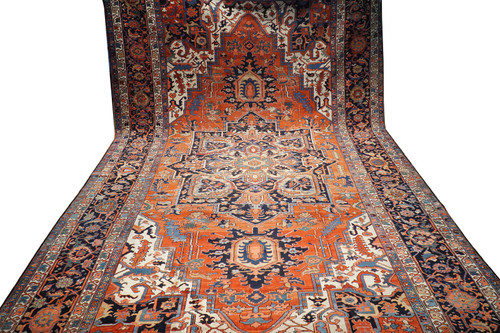
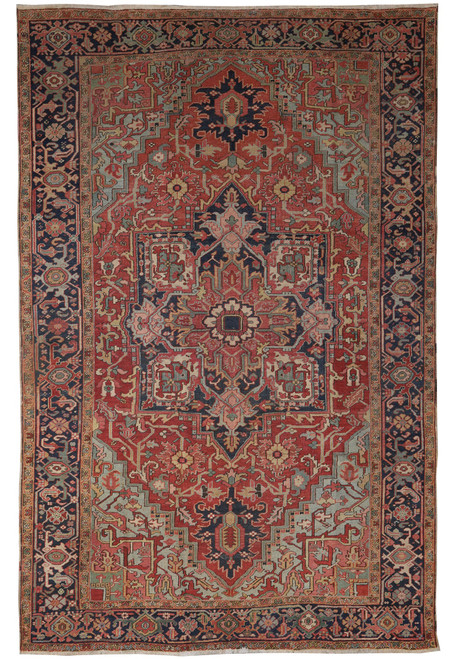
A rug from the 1940s that has spent eighty years settling into itself. This 8' x 11'3" Persian Serapi was hand-knotted in wool on a cotton foundation in the Heriz district of northwest Persia, and it carries every mark of a genuine village piece: a rust red field that has softened unevenly into terracotta and salmon, a stepped navy medallion drawn by eye rather than by ruler, and camel spandrels that spread into the corners like open hands. The pile is low and even, the kind of surface that only comes from decades of real use, and the drawing reads more clearly for it. Among 8x11 Persian rugs this is a size that anchors a full seating group without crowding the walls. Every rug we ship carries a certificate of authenticity.
Please Note About the Photographs:
One photograph is a close macro of the weave, taken from a few inches away. It shows the low pile, the cotton foundation reading through in places and one small thinned spot near the spandrel. This is honest age on a rug woven in the 1940s, not damage, and at standing height none of it registers. We photograph antiques this closely on purpose so you buy with your eyes open.
Design and Motifs
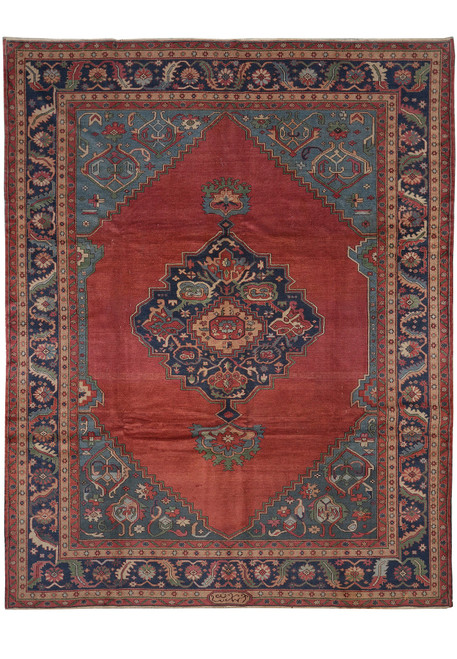
The center holds a small stepped medallion in deep navy, notched along all 4 sides, with an inner panel of teal green framing a single beige rosette. Out of it grow long serrated leaves and hooked vine arms that reach into the corners and meet the camel spandrels, which are themselves filled with jagged palmettes and blossom heads. The field between them is not empty for a moment: 8 petal rosettes, angular flower heads, arrowhead leaves and small stepped lozenges in blue, ivory and salmon fill every open space, the way geometric Persian rugs from this district always do. The main border runs a navy ground with alternating rosette cartouches and diagonal barbed leaves, flanked by salmon minor borders of continuous vine, and a narrow sage green guard stripe separates border from field. Nothing repeats mechanically, and the slight drift in the corner resolutions is the signature of a weaver working from memory.
A Rust Red Field Worn Into Terracotta and Camel
The dominant color is a madder rust red, and it is far from flat. Across the field it shifts from brick to terracotta to a dusty salmon, lighter along the long axis where the pile sits lowest, deeper near the border where the wool has been protected. The spandrels and the broad arms around the medallion are camel beige going to pale straw, giving the whole composition its light. Against that, 2 distinct blues do the work: a strong indigo navy in the medallion, the border ground and the small dart motifs, and a lighter sky blue in the leaves, rosette centers and vine stems. Green appears twice and quietly, as the teal green panel inside the medallion and as the thin sage guard stripe at the field edge. Ivory and cream pick out the small blossoms and the outlines that keep the geometry legible, and the fringe at both ends is clean white cotton. It is a warm, sun-faded palette that sits easily with wood floors, leather and unpainted plaster.
Serapi Weaving in the Heriz Villages
Serapi is the trade name given to the best of the older Heriz weavings, from the cluster of villages east of Tabriz below Mount Sabalan. The water there is mineral rich and the local wool is famously tough, which is why rugs from this district survive generations of traffic while finer city weaves wear through. The drawing is deliberately angular, all straight lines and stepped corners, because these were knotted on village looms from a remembered plan rather than a full cartoon. Knot counts here sit below 200 per square inch by design; the value is in the wool, the natural dyes and the confidence of the drawing, not in fineness. Reading the low even pile, the softened dyes and the cotton foundation together is exactly how to date an Oriental rug, and everything here agrees with the 1940s attribution. A piece like this is now finished aging: what you see is what it will look like in another 30 years.
8' x 11'3" Persian Serapi Rug | Rust Red Geometric Medallion | Circa 1940s Antique
Ask about this rug
This piece is the only one of it, so the things worth knowing about it are particular to it. If you want to talk through the size, the colour in your own light, or the weave, speak to someone here first.