| Size in ft: | Width: 7'3" x Length: 11'3" |
| Size in Inch: | Width: 87" x Length: 135" |
| Size in meters: | Length: 3.43 x Width: 2.21 m |
| Colors: | Rust Red, Blue, Navy, Beige, White |
| Shape: | Rectangular |
| Woven: | 100% Hand-knotted | Handmade |
| Foundation: | Cotton | Hand-spun warp and weft |
| Pile: | Wool | Slightly worn |
| Age: | 1950s | Vintage |
| Design: | Heriz Serapi | Geometric medallion | Stepped corner spandrels |
| Origin: | Persian Heriz | Made in Persia |
| Condition: | Good | Slightly worn pile with low areas |
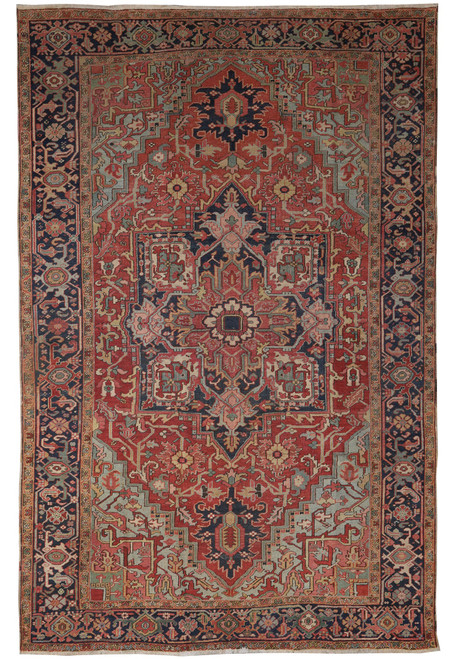
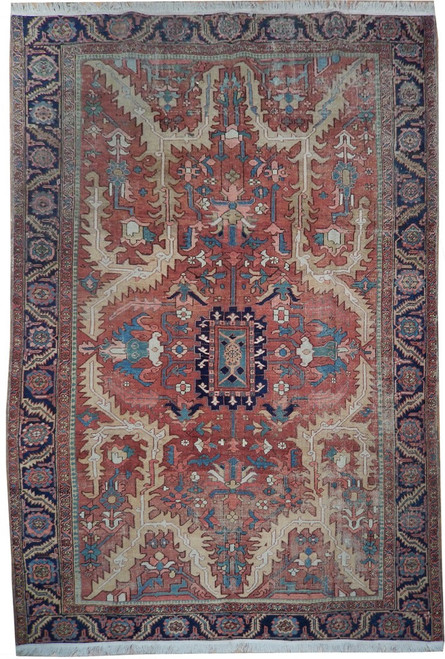
7'3" x 11'3" Persian Heriz Serapi Rug | Rust Red Geometric Medallion | 1950s Gently Worn Wool
This is a village piece from the 1950s that has spent its life on a floor and shows it in the best way. The 7'3" x 11'3" format is the classic Heriz room size, drawn in the Serapi manner with a big navy medallion sitting on a terracotta ground and a wide sky blue border carrying the whole thing. The wool is hand-spun and hand-knotted on a cotton foundation, and decades of use have taken the pile down slightly in places, which is exactly what gives an old Heriz its flat, painterly surface and its soft colour. It ships with a certificate of authenticity confirming origin, age, materials and hand-knotted construction. If you want to understand how a piece like this is dated, our guide on how to date an Oriental rug walks through the same evidence we used here: weave, dye behaviour, wear pattern and drawing.
Please Note About the Photographs:
The close-up photos show this rug honestly. The pile is slightly worn with lower areas across the field and along one side, and the ends and edges show light age. This is normal, stable wear on a rug from the 1950s, not damage, and it is priced accordingly. Every rug is professionally cleaned, steamed and pressed before it leaves us.
Design and Motifs
The centre holds a large stepped diamond medallion in deep navy, edged with an ivory outline that keeps the shape crisp against the rust field. Inside it sits a smaller rosette cartouche flanked by two hooked palmettes, and long serrated pendants run off the top and bottom points toward each end of the rug. The field around the medallion is filled with angular vine work, big serrated leaves, hooked lozenges and small cypress-like sprays, all drawn in straight lines and 45 degree steps rather than curves, which is the signature of village drawing from this district. Each of the 4 corners carries a navy spandrel with an ivory stepped outline and its own palmette cluster, and the balance between those corners and the central diamond is what collectors look for in a Serapi layout. The main border runs a repeating rosette and vine pattern with hexagonal cartouches, framed by narrow reciprocal guard stripes. Buyers who respond to this kind of drawing usually want to see more geometric Persian rugs before deciding.
Rust Red, Navy and Sky Blue Colour Detail
The field reads rust red, closer to terracotta and old brick than to a modern crimson, and it shifts gently from panel to panel in the way hand-dyed wool does when dye lots change on the loom. Against it, the medallion and corner spandrels are a very dark navy that goes almost black in the shadows and opens up to inky indigo in daylight. The main border is a lighter sky blue, clearly cooler and brighter than the navy, and it lifts the whole rug so the red field does not dominate a room. Between those three anchors there is a great deal of soft pink and salmon in the palmettes, a warm beige in the guard stripes, olive and camel in the smaller leaf forms, and clean white outlines that separate one colour from the next. The white ivory in the spandrels and the outlining is the detail that makes this piece photograph so well. Gentle wear has taken the sheen off the surface and left the colours muted and blended, the finish decorators pay extra to fake on new production.
Heriz Weaving and the Serapi Tradition
Heriz is a group of villages east of Tabriz, on the slopes below Mount Sabalan in northwest Persia. The water there is mineral-rich, and the local sheep grow a famously tough, springy fleece that resists crushing, which is why Heriz rugs are the pieces that survive 70 years of family traffic and still hold their pattern. Weavers here work from memory and from village cartoons rather than a fully painted master drawing, so every rug comes out slightly its own, with small asymmetries you can find in the border repeats and in the way the corners resolve. Serapi is the trade name long used for the finer, more open, more spaciously drawn examples from this district, and this rug earns it: the medallion is well proportioned, the field is not crowded, and the palette stays clear. Village work of this type is usually woven below 200 knots per square inch, with the strength coming from heavy wool and a solid cotton foundation rather than from fineness. Laid flat in a 7'3" x 11'3" space, it behaves the way a good Heriz should, holding its shape and taking daily traffic without complaint.
7'3" x 11'3" Persian Heriz Serapi Rug | Rust Red Geometric Medallion | 1950s Gently Worn Wool
Ask about this rug
This piece is the only one of it, so the things worth knowing about it are particular to it. If you want to talk through the size, the colour in your own light, or the weave, speak to someone here first.