| Size in ft: | Width: 8'9" x Length: 11'8" |
| Size in Inch: | Width: 105" x Length: 140" |
| Size in meters: | Length: 3.56 x Width: 2.67 m |
| Colors: | Rust, Blue, Ivory, Salmon |
| Shape: | Rectangular |
| Woven: | Hand-Knotted |
| Pile: | Low Wool Pile |
| Origin: | Persia |
| Design: | Heriz |
| Age: | 1940's |
| Condition: | Very Good |
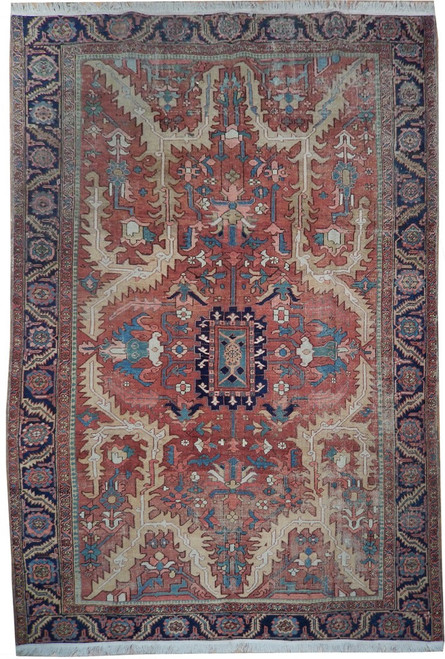
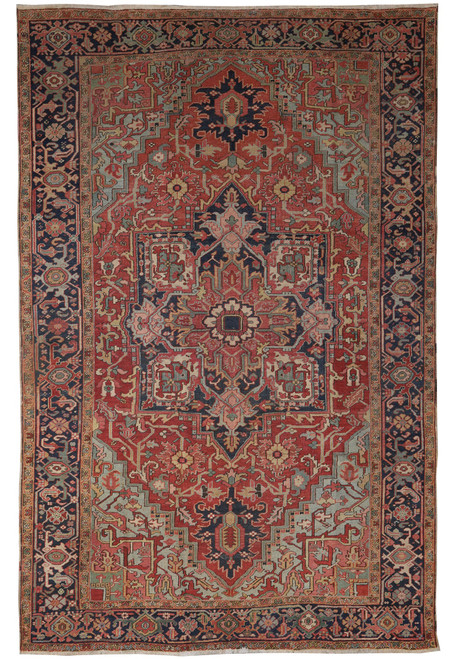
8'9" x 11'8" Persian Heriz Serapi Rug | Rust Geometric Medallion | Circa 1940s
This is a village piece from the Heriz district of north west Persia, knotted around the 1940s on a cotton foundation with tough highland wool, and it has spent 80 years earning the surface it now has. The drawing is the older Serapi Bakhshayesh manner: a big ivory and camel medallion sitting on a rust field, everything squared off, nothing curved, the kind of confident angular geometry that village looms do better than any city workshop. At 8'9" x 11'8" it covers a standard living or dining room floor without crowding it, which is exactly why collectors and decorators keep chasing 9x12 Persian rugs of this vintage. The pile is low and even, the colors have mellowed to the soft brick and indigo tones people pay extra for, and the rug ships with a certificate of authenticity documenting origin, age and construction.
Please Note About the Photographs:
This is an antique with a low, evenly worn pile. The lighter passages across the field and the color shifts in the rust ground are patina and natural abrash from vegetable dyed wool, not damage or stains. The rug lies flat, the foundation is sound and the pile is even underfoot. Every rug is professionally cleaned, steamed and pressed before it ships.
Design and Motifs
The center holds a stepped medallion outlined in ivory, built up in camel and gold, with a small squared rosette at its heart ringed by a comb of blue tabs. Radiating out from it are navy hooked palmettes and serrated leaf forms, each one drawn in straight lines and right angles, a hallmark of the best geometric Persian rugs. Large ivory and pale blue spandrels anchor all 4 corners of the field, filled with angular vinework and blossom heads that echo the medallion rather than copy it. The open rust ground between them carries scattered palmettes, serrated leaves and small birdlike sprays, drawn freehand so no 2 repeats are identical. The main border runs a procession of 8 petal rosettes and turtle palmettes on indigo, separated by hooked bracket forms, and it is framed inside and out by narrow reciprocal guard stripes in salmon and soft green. That is the Serapi look in full: bold shapes, generous spacing, and a weaver working from memory rather than a cartoon.
A Palette of Rust, Indigo, Ivory and Salmon
The field reads as a warm brick rust that drifts toward terracotta and dusty salmon across the width, natural abrash from dye lots that were never meant to match perfectly. Against it the border sits in a deep near black indigo, the darkest note in the rug, which is what makes the ivory medallion outline and the ivory corner spandrels jump forward the way they do. Between those 2 poles the weaver worked in camel and old gold through the medallion arms, a soft blue-green that shows up in the leaf forms and border rosettes, and a clear mid blue in the small central square. Touches of chalky cream and faded rose appear in the flower heads, the palmette centers and the guard stripes. It is a warm, low contrast, lived-in palette, easy with wood floors, leather, brass and painted plaster, and it reads considerably softer in a room than the photographs suggest.
Heriz Weaving and the Serapi Tradition
Heriz is a cluster of villages east of Tabriz, on the slopes below Mount Sabalan, where mineral rich water and hard winters produce a wool that is famously tough and takes dye with unusual depth. The older and more coarsely knotted pieces from that district, especially those with this open angular drawing, have long been sold under the names Serapi and Bakhshayesh, after the villages the trade associated with them. This rug is a true village weave: symmetrical knots on a cotton warp and weft, a knot count well under 200 per square inch, and the slight irregularity in the medallion and field that tells you it came off a loom rather than out of a factory. That structure is precisely why Heriz rugs survive generations of foot traffic while finer city pieces wear out. If you want to understand how weavers, dealers and specialists read age from wool, dyes and wear, our guide on how to date an antique Oriental rug covers what to look for on a piece like this one.
8'9" x 11'8" Persian Heriz Serapi Rug | Rust Geometric Medallion | Circa 1940s
Ask about this rug
This piece is the only one of it, so the things worth knowing about it are particular to it. If you want to talk through the size, the colour in your own light, or the weave, speak to someone here first.