Watch the film
| Size in ft: | Width: 3'5" x Length: 18'3" |
| Size in Inch: | Width: 41" x Length: 219" |
| Size in meters: | Length: 5.56 x Width: 1.04 m |
| Colors: | Blue, Rust |
| Shape: | Runner |
| Woven: | Hand-Knotted |
| Pile: | 1/4" Wool |
| Origin: | Persia |
| Design: | Heriz |
| Age: | 1940's |
| Condition: | Excellent |
3'5" x 18'3" Persian Heriz Karaja Runner Rug | Antique 1940s Geometric Medallions | Navy and Rust
Runners this long almost never survive in this state. Woven in the 1940s in the Heriz district of northwest Persia, this piece measures a full 18'3" from end to end on a narrow 3'5" width, which is exactly the proportion a long stair hall or gallery corridor asks for and almost never finds. The pile sits at a healthy 1/4", the ends and selvages are original, and the wool still carries the dry, slightly glassy sheen that only decades of use and careful washing produce. It ships with a certificate of authenticity confirming age, origin and hand-knotted construction, and it is the rare antique hallway runner that can be laid down and simply used rather than protected.
Design and Motifs
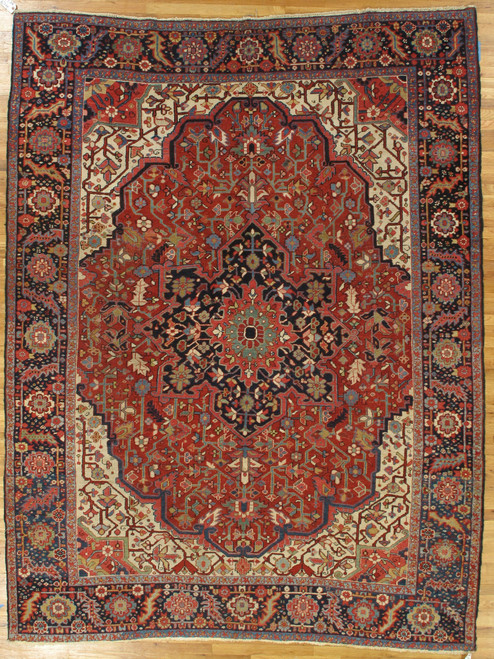
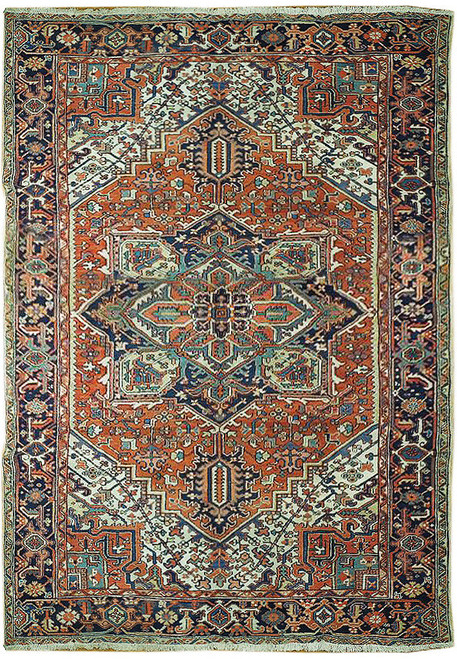
The field runs as a single column of alternating medallions rather than one centered anchor, which is the drawing the Karaja weavers of the Heriz district are known for. Large 8 lobed star medallions in sage green and rust trade places with elongated ivory diamond lozenges edged in serrated latch hooks, and between them sit smaller stepped crosses, hooked anchors and paired ivory pendants that read almost like a woven alphabet running the length of the rug. Small square cartouches float against the field at regular intervals, each filled with a 4 part rosette. Every line here is angular and drawn on the grid, with no curved vine anywhere, which is the honest mark of village geometric rugs from this corner of Persia. The main border breaks the rhythm with a softer floral vine of palmettes and rosettes, and narrow reciprocal guard stripes in ivory and rust frame it on both sides.
A Navy Ground Lit by Teal, Rust and Sage
The ground is a deep indigo navy that photographs nearly black in the close detail shots and opens up to true blue in daylight. Against it the medallions carry terracotta rust, warm apricot, a pale celery sage green and clean undyed ivory, and those four tones repeat down the run so the eye keeps finding the same notes at intervals. The wide main border is the surprise: a soft, chalky teal blue, noticeably lighter and greener than the field, which lifts the whole piece and keeps 18 feet of navy from reading heavy. Narrow rust and copper guard bands separate field from border on each side, and scattered touches of pale olive and rose show up in the border flowers. There is gentle abrash, a natural variation in the dye lots, visible as soft horizontal banding in the field and the teal border, which is the signature of hand-spun wool dyed in small batches.
Heriz Weaving and the Karaja Village Hand
Heriz is a cluster of villages east of Tabriz, on the slopes below Mount Sabalan, where mineral-rich water and famously tough highland wool combine to produce a pile that resists crushing for generations. Karaja sits at the northern edge of that group and keeps its own drawing, the repeating medallion column rather than the single large star, and its own palette with more teal and green than a classic Heriz. Village looms here work at a moderate knot count by design, since the weight and durability of the wool matter more than fineness, and the 1/4" pile on this runner is still full and even after roughly 80 years. If you want to understand how the wear pattern, dye behavior and weave together place a piece in the 1940s, our guide on how to date an Oriental rug walks through the same evidence we used on this one.
3'5" x 18'3" Persian Heriz Karaja Runner Rug | Antique 1940s Geometric Medallions | Navy and Rust
Ask about this rug
This piece is the only one of it, so the things worth knowing about it are particular to it. If you want to talk through the size, the colour in your own light, or the weave, speak to someone here first.