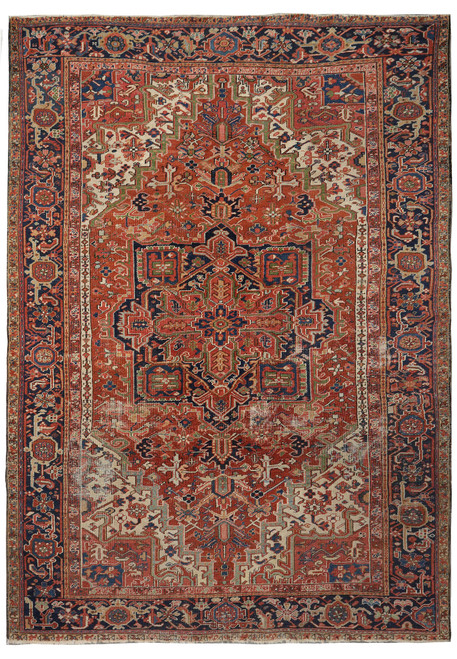
| Size in ft: | Width: 9' x Length: 12' |
| Size in Inch: | Width: 108" x Length: 144" |
| Size in meters: | Length: 3.66 x Width: 2.74 m |
| Colors: | Brick, Navy Blue, Ivory, Olive |
| Shape: | Rectangular |
| Woven: | 100% Hand-knotted | Handmade |
| Foundation: | Cotton |
| Pile: | |
| Age: | Circa 1940s | Antique |
| Design: | Heriz | Geometric Medallion | Ivory Spandrels |
| Origin: | Persian Heriz | Made in Persia |
| Condition: | Excellent | Antique |
9' x 12' Persian Heriz Rug | 1940s Antique Geometric Medallion | Brick & Navy Wool
This is a genuine antique from the 1940s, a full room size 9' x 12' Heriz woven in the villages of northwest Persia and still carrying the heavy, chalky wool handle that made these pieces famous. The brick red field holds a broad navy medallion with ivory spandrels at the 4 corners, and the whole drawing is angular rather than curved, which is the honest signature of a village loom working from memory instead of a paper cartoon. The pile is wool on a cotton foundation, the back shows a clean even knot line and a dark brown wool selvage, and the fringe is original. A rug of this age and scale has already proven itself across 80 years of floors, which is the strongest argument any antique can make. Every piece we sell ships with a certificate of authenticity documenting origin, age, materials and construction. Buyers working to a fixed footprint can browse our other 9x12 Persian rugs alongside this one.
Please Note About the Photographs:
These photos were taken under different lighting. In one full view the field reads as a deep oxblood, while the daylight images show it as a brighter brick red with clear coral and olive accents. The daylight shots are the truer reading. This is a lighting difference only, not fade, not wear and not a change in the wool.
Design and Motifs
The layout is the classic Heriz arrangement read in pure straight lines. A large navy medallion sits dead center, stepped and hooked at its edges, with anchor shaped pendants reaching toward each end of the field. Inside it a small 8 point star rosette in olive, coral and sky blue marks the exact middle of the rug. Around the medallion the brick field is filled with serrated palmettes, angular vine arms and blunt leaf forms that turn in sharp 90 degree corners, the drawing style that separates a village Heriz from a workshop piece. The ivory spandrels at the 4 corners carry their own small red and navy blossom arrangements, and the main navy border runs a repeating chain of ivory and coral rosettes linked by hooked vinework, with narrow reciprocal guard stripes on both sides. Collectors of geometric Persian rugs will recognize how disciplined the symmetry is here, right down to the matching corner resolutions in the border.
The Brick, Navy, Ivory and Olive Palette
Color is the reason people buy these rugs, and this one has real depth in it. The field is a warm brick red that shifts between rust and terracotta as the light moves across the pile, a natural abrash you can see clearly in the angled photographs and one that no machine can imitate. The medallion and main border are a deep indigo navy that goes almost black in the shaded areas of the close-up images, with a lighter mid blue used inside the leaf forms for separation. Ivory carries the 4 spandrels and the border rosettes, reading as a soft undyed cream rather than a bright white. Olive is the accent that ties everything together, appearing as a gold green outline on the palmettes, the serrated leaves and the vine arms, and it warms the whole rug against the cool navy. Soft coral and salmon appear inside the flower heads, and small touches of sky blue sit at the centers of the rosettes.
Heriz Weaving East of Tabriz
Heriz is a cluster of villages east of Tabriz, on the slopes below Mount Sabalan in northwest Persia. The water there runs through mineral rich rock, and the local sheep grow a wool that is unusually strong and slightly coarse, which is exactly why Heriz rugs outlive almost everything else on a hard working floor. Weavers work on a cotton foundation with a robust knot count, generally under 200 knots per square inch, because the design is built for boldness and durability rather than fine drawing. That is the point of the type, not a shortcoming. The angular medallion, the stepped corners and the straight line palmettes exist because they translate perfectly at this weave. This particular piece from the 1940s is tightly woven, evenly beaten and flat lying, and anyone curious about reading age from construction, dyes and wear can look through our guide on how to date an Oriental rug.
9' x 12' Persian Heriz Rug | 1940s Antique Geometric Medallion | Brick & Navy Wool
Ask about this rug
This piece is the only one of it, so the things worth knowing about it are particular to it. If you want to talk through the size, the colour in your own light, or the weave, speak to someone here first.