Watch the film
| Size in ft: | Width: 7'7" x Length: 11' |
| Size in Inch: | Width: 91" x Length: 132" |
| Size in meters: | Length: 3.35 x Width: 2.31 m |
| Colors: | Orange Red, Blue, Ivory |
| Shape: | Rectangular |
| Woven: | Hand-Knotted |
| Origin: | Persia |
| Design: | Heriz |
| Condition: | Excellent |
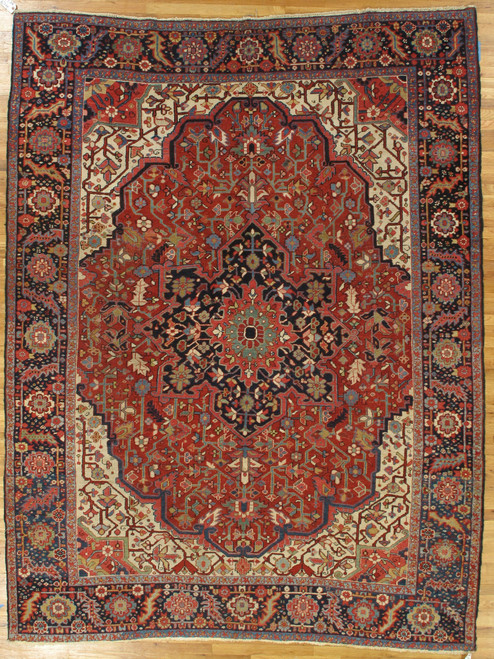
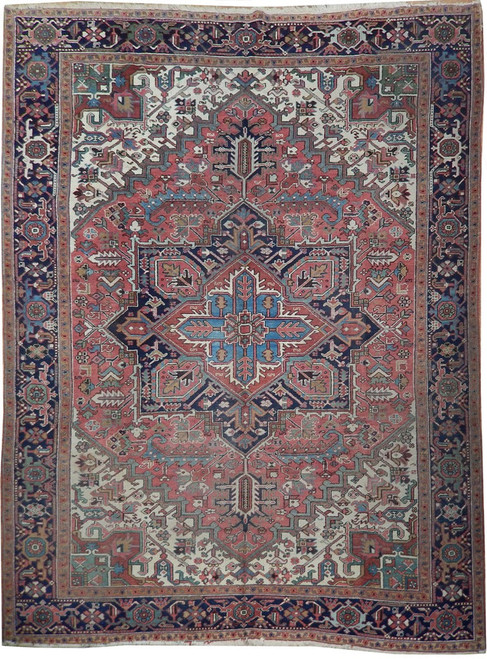
7'7" x 11' Persian Heriz Rug | Geometric Medallion | Semi-Antique Rust Orange, Navy & Ivory
This 7'7" x 11' Persian Heriz is the kind of village weaving that decorators keep coming back to: a big, confident stepped medallion floating on a rust-orange field, deep navy corner spandrels, and wool that has already proved itself over decades of use. Hand-knotted on a cotton foundation with a dense wool pile, it has aged into the softly burnished tone that only real time and real lanolin produce, and the pile is still even from end to end with clean selvedges and original hand-tied fringe. At this size it covers a seating group or a 10 seat table without crowding the walls, and it is priced and sized alongside our other 8x11 Persian rugs. Every piece we ship leaves Freeport with a certificate of authenticity documenting origin, materials and handmade construction.
Design and Motifs
The drawing is pure Heriz: everything curved in a city workshop is redrawn here in straight lines and steps. A large navy medallion sits dead center, filled with an 8 petal rosette and serrated leaf forms in teal, ivory and soft coral, with an ivory octagonal cartouche anchoring each of the 4 inner quarters. Above and below it, long navy pendants shaped like lidded lamps run out toward the ends, each outlined in ivory so it reads instantly from across the room. The rust field between them is packed with angular palmettes, hooked vines and small starburst rosettes, never mechanical, with the drawing shifting slightly from one side to the other the way a village loom always gives it away. Ivory spandrels close off all 4 corners with scrolling arabesques, and the main navy border carries alternating rosettes, turtle palmettes and stylized vases between narrow ivory and terracotta guard stripes. It is one of the most collectible layouts in geometric Persian rugs, and this example draws it with unusual balance.
A Rust Orange, Navy and Ivory Palette
Color is the reason this rug works in so many rooms. The field is a warm orange red, closer to terracotta and old brick than to a modern orange, and it carries gentle abrash where the dye lot changed on the loom, giving the ground depth instead of a flat printed look. Against it the medallion and border run a deep indigo navy that reads almost black in low light and opens into true blue under a lamp. Between those two poles sit the quieter tones that make the rug feel old and settled: chalky ivory in the spandrels and guard stripes, a cool sea teal in the leaf forms and inner cartouches, soft salmon and rose in the border rosettes, and touches of olive and camel in the smaller filler motifs. Ivory outlining around the medallion and pendants keeps the navy from going heavy. The overall effect is warm and grounding, the right partner for walnut and oak floors, leather, brass, and both cream and deep green walls.
Heriz Origin and Weaving Quality
Heriz is a cluster of villages east of Tabriz in northwest Persia, spread along the slopes below Mount Sabalan. The wool there is famously tough, and the mineral-rich water used in washing and dyeing is credited with the hard, glassy sheen that Heriz pile develops as it wears. Weavers work from memory rather than a full cartoon, which is exactly why the design comes out angular and slightly asymmetrical, and why no two are identical. Village Heriz weaving usually sits under 200 knots per square inch, and that is by design: a heavier knot on a stout cotton foundation with a thick wool pile is what makes these rugs the workhorses of the Persian world, the pieces that survive 80 years of hallways, dogs and dining chairs and simply look better for it. The back of this one shows a clean, regular knot, straight sides and no repairs, which tells you it was woven well and cared for. If you are weighing age on a piece like this, our guide to dating an Oriental rug walks through the same clues we use.
7'7" x 11' Persian Heriz Rug | Geometric Medallion | Semi-Antique Rust Orange, Navy & Ivory
Ask about this rug
This piece is the only one of it, so the things worth knowing about it are particular to it. If you want to talk through the size, the colour in your own light, or the weave, speak to someone here first.