Watch the film
| Size in ft: | Width: 10'2" x Length: 12'9" |
| Size in Inch: | Width: 122" x Length: 153" |
| Size in meters: | Length: 3.89 x Width: 3.10 m |
| Colors: | Brick Red, Black Burgundy, Olive Green, Ivory |
| Shape: | Rectangular |
| Woven: | Hand-Knotted |
| Pile: | 3/8" Wool |
| Origin: | Persia |
| Design: | Heriz |
| Condition: | Excellent |
10'2" x 12'9" Persian Heriz Rug | Stepped Geometric Medallion | Semi-Antique, Excellent Condition
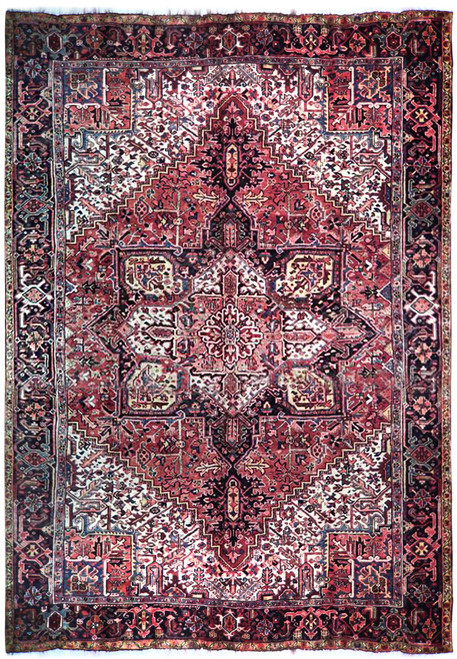
This is the Heriz that dealers keep for themselves: a semi-antique village weaving in a true room size, hand-knotted in wool on a cotton foundation, with a 3/8" pile that still stands up evenly across the whole 122" by 153" surface. The drawing is confident and slightly irregular in the way only a village loom produces, the wool has taken on the soft sheen that comes from decades of use and washing, and the edges and fringes are intact. It sits squarely in the most useful footprint we sell, which puts it alongside our other 10x13 Persian area rugs. Every rug we ship travels with a certificate of authenticity recording origin, materials, size and knot construction.
Please Note About the Photographs:
The first photograph was shot under studio light and reads deeper and more saturated than the rug does in person. The floor photographs taken in daylight are the accurate reference: the field is a softer brick red with natural rose tones through it. That variation is lighting, not a difference in dye or condition.
Design and Motifs
The layout is the classic Heriz formula drawn entirely in straight lines and stepped angles. A large lozenge medallion fills the centre of the field, outlined in ivory and ending in hooked anchor palmettes top and bottom, with a small rosette cartouche at the exact centre. Around it radiate serrated leaves, angular vinework and small blossom heads, and the open red ground is scattered with 4 armed X motifs and tiny geometric flowers that fill the space without crowding it. Four enormous ivory spandrels pull the corners of the rug outward, each packed with hooked vinescroll, stylised birds and blossoms, and each terminating in a squared bracket that frames the field. The main border runs a repeating chain of large rosettes and serrated leaves on a dark burgundy ground, flanked by a camel gold guard stripe and a reciprocal zigzag inner band that gives the whole composition a firm edge. This is drawing you can read from across a room, which is exactly why geometric Persian rugs of this type suit large open spaces so well.
Colors: Brick Red, Black Burgundy, Olive Green and Ivory
The field is a warm brick red that moves between terracotta and a dusty rose across the width, the gentle abrash of naturally dyed village wool rather than any unevenness of wear. Inside the medallion the ground drops to a near black burgundy, almost aubergine where the light catches it, and that same dark tone carries the main border so the design is bracketed by depth at both the centre and the outer edge. Ivory does the structural work: it outlines the medallion, fills the 4 corner spandrels with cream that has mellowed to a soft parchment, and picks out the hooks and brackets throughout. Olive green appears in the shading around the medallion tips and in leaves through the field, and a camel gold guard stripe separates border from field. Small accents of slate blue, soft sky blue, rose pink and charcoal appear in the rosettes and blossom heads, close up giving the rug considerable colour variety while the overall read from standing height stays a rich, settled red.
Origin: The Heriz Villages of Northwest Persia
Heriz is the name of a district of weaving villages east of Tabriz, on the slopes below Mount Sabalan in northwest Persia. The local water is mineral rich, and the sheep grazing those pastures grow a famously tough, high lanolin fleece, which is the practical reason Heriz rugs outlast almost everything else on a floor. Weavers here work from memory and from village drawings rather than from a full cartoon, which is why the medallion and spandrels on this piece are drawn in straight runs and stepped corners instead of the curved line of a city workshop. The knot count in Heriz village work is normally under 200 knots per square inch by design: fewer, larger knots on a stout cotton foundation with a thick wool pile make a rug that takes furniture, traffic and children for generations. This example shows all of that, with a dense handle, a heavy body for its size and a pile that has worn evenly rather than thin in the walking lanes.
10'2" x 12'9" Persian Heriz Rug | Stepped Geometric Medallion | Semi-Antique, Excellent Condition
Ask about this rug
This piece is the only one of it, so the things worth knowing about it are particular to it. If you want to talk through the size, the colour in your own light, or the weave, speak to someone here first.