Watch the film
| Size in ft: | Width: 4'4" x Length: 9'1" |
| Size in Inch: | Width: 52" x Length: 109" |
| Size in meters: | Length: 2.77 x Width: 1.32 m |
| Colors: | Orange Red, Green, Blue |
| Shape: | Rectangular |
| Woven: | 100% Hand-knotted | Handmade |
| Foundation: | Cotton |
| Pile: | |
| Design: | Kazak | Triple stepped medallion | Woven inscription and animal figures |
| Origin: | Caucasus |
| Condition: | Excellent |
4'4" x 9'1" Caucasian Kazak Rug | Triple Stepped Medallion Gallery Piece | Woven Inscription & Animal Figures
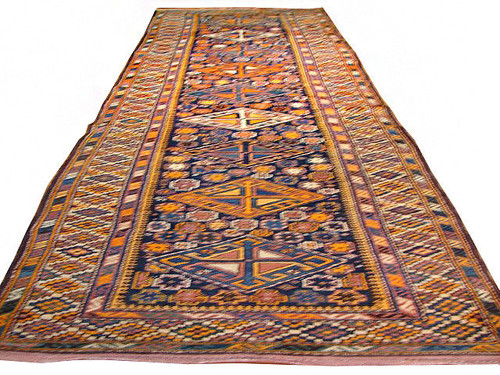
This is a hand-knotted Kazak from the Caucasus, 4'4" x 9'1", a long gallery format carried by three big stepped medallions on a glowing orange red field. It is village weaving at its most confident: thick lustrous wool pile, drawing done freehand rather than off a fully resolved cartoon, and a weaver who signed the open field with an inscription panel and scattered it with small birds, four-legged animals, flowers and lamps. Nothing about it is polite or symmetrical, and that is exactly why collectors chase this kind of Caucasian tribal rug instead of a workshop piece. The condition is excellent, with the pile standing full and even edge to edge, and every rug we ship travels with a certificate of authenticity describing exactly what you are buying.
Design and Motifs
Three hooked, stepped medallions run the length of the field, each built up from concentric outlines that march outward in squared-off steps, with a narrow lozenge panel at the heart of each one filled with tiny leaf and diamond fillers. Serrated leaf arms shoot out from the medallion centers toward the corners, a hallmark of the bold geometric Kazak vocabulary. The open ground between the medallions is where this one becomes a storyteller: small standing birds, a long-legged animal, 8 petal rosettes, stepped diamonds, paired candlestick or lamp forms and a woven block of script characters, all placed by eye rather than mirrored. The main border is a wide salmon ground filled with polychrome stepped and zigzag panels, framed inside and out by gold guard stripes carrying a continuous running scroll, and the whole field is held in thin dark contour lines that sharpen every angle. As an Oriental rug it sits squarely in the tribal camp: no curved lines anywhere, every form resolved into steps and hooks.
A Field of Orange Red With Green and Gold Medallions
The field is a warm orange red that reads closer to terracotta in daylight and deepens toward rust where the pile lies against the light, making this a natural fit for rooms already working in orange and rust tones. Against it the center medallion is a strong forest green, while the medallions above and below it are saffron gold with burnt orange stepped outlines, so the eye moves green, gold, green as it travels down the length. Each medallion core is a soft salmon pink, the same tone used for the main border ground, which ties the field and frame together. Ivory and pale cream outlines separate every color change and keep the stepped edges legible, and a very dark navy-to-black line does the final contouring around the medallions, the border scrolls and the animal figures. Small accents of mustard yellow, brick red, pale green and chalk white appear in the border panels and the scattered field motifs, giving the rug a polychrome, folk-art brightness without ever fighting the dominant orange red.
Kazak Weaving in the Caucasus
Kazak rugs come from the mountain and foothill villages of the Caucasus, the belt of weaving country between the Black Sea and the Caspian, and they were made for use rather than for a showroom. The wool from those high pastures is long, springy and takes dye with real saturation, which is why a Kazak holds a color like this orange red so vividly and why the pile feels heavy and full under bare feet. The knot count in village work of this type is deliberately open compared to city weaving, because the whole point is a thick, robust pile on a sturdy cotton foundation that shrugs off generations of traffic. The long 4'4" x 9'1" gallery proportion was a traditional village format, woven to run the length of a room or a seating area, and the inscription block in the field follows the Caucasian habit of marking a rug with a name or date in the open ground. Handled as a whole, the piece shows the two things buyers look for in this group: honest village drawing, and wool good enough to carry it.
4'4" x 9'1" Caucasian Kazak Rug | Triple Stepped Medallion Gallery Piece | Woven Inscription & Animal Figures
Ask about this rug
This piece is the only one of it, so the things worth knowing about it are particular to it. If you want to talk through the size, the colour in your own light, or the weave, speak to someone here first.