Watch the film
| Size in ft: | Width: 4'4" x Length: 7' |
| Size in Inch: | Width: 52" x Length: 84" |
| Size in meters: | Length: 2.13 x Width: 1.32 m |
| Colors: | Fire Orange, Brown, Ivory, Sage Green, Navy Blue, Saffron Gold |
| Shape: | Rectangular |
| Woven: | 100% Hand-knotted | Handmade |
| Foundation: | Hand-spun Wool |
| Pile: | |
| Age: | 1940s-1960s | Mid-20th Century |
| Design: | Kazak | All Over Palmette and Vine | 5 Borders |
| Origin: | Kazak | Woven in the Caucasus |
| Condition: | Excellent | Even pile throughout |
4'4" x 7' Caucasian Kazak Rug | All Over Palmette Design | Mid-Century, Excellent Condition
This is a mid-century Kazak from the Caucasus, woven between the 1940s and the 1960s, and it is the kind of piece that gets bought for the wool rather than the knot count. The pile is a full 3/8" of glossy hand-spun wool on a wool foundation, the drawing is bold, and the field has that slightly uneven, hand-dyed glow that no workshop rug ever achieves. At 4'4" x 7' it sits in the most usable small room size there is, and as a highland village Oriental rug it belongs to the same family of tough, geometric weavings that collectors have chased for a century. Condition is excellent, with even pile across the whole surface and the original dealer tag still attached. A certificate of authenticity is included with every purchase.
Please Note About the Photographs:
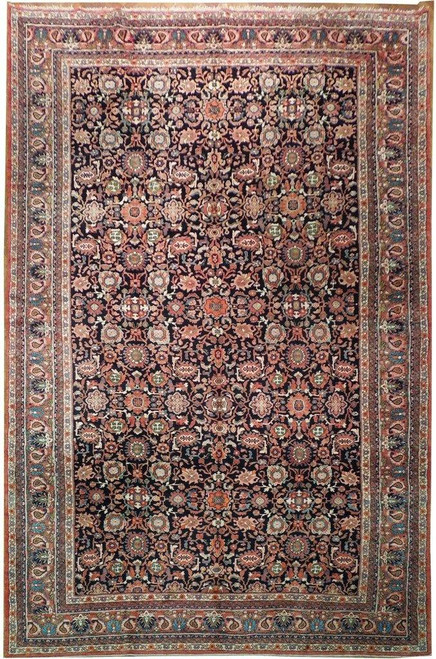
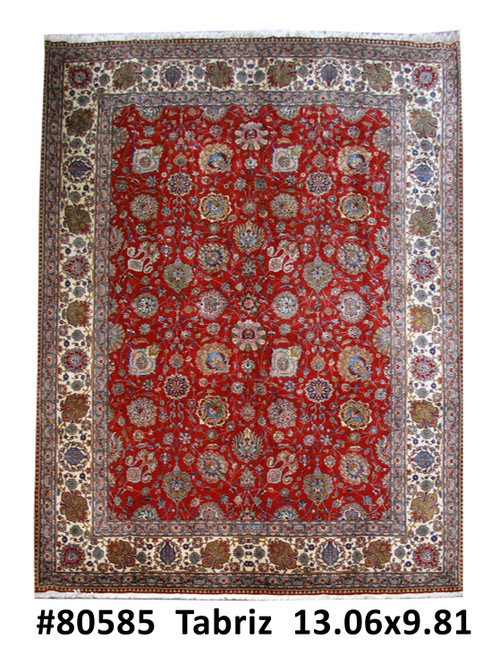
The overhead photograph was shot under bright studio light and reads a little cooler and more cherry red than the rug actually is. The angled full view and the close-up are the honest readings: the field is a warm fire orange with brown undertones. Nothing has been corrected or retouched, and the shift is lighting only, not fade or wear.
Design and Motifs
There is no medallion here. The field carries an all over palmette design, a repeating column of broad winged palmettes flanked by serrated leaves and curling vine tips, each one drawn slightly differently from its neighbor because the weaver worked from memory rather than a cartoon. Small 5 petal rosettes and paired hooked tendrils fill the ground between the palmettes, and the 4 corners are anchored by dark brown leaf forms that read almost black against the orange. The surround is built from 5 distinct bands: an ivory dotted guard stripe repeated twice, a narrow reciprocal stripe, a flowering vine minor border, and a wide main border of rosettes and angular blossoms on a brown ground. The corner photograph shows how cleanly the border turns, which in village weaving is always the detail worth looking at.
A Fire Orange Field With Brown, Ivory and Sage
The field is a fire orange that runs from bright terracotta at the top to a deeper brick tone lower down, a natural abrash that comes from separate dye lots of hand-spun yarn and gives the surface real movement in daylight. Against that ground the palmettes are worked in soft sage green, dove grey, ivory and a warm saffron gold, with a single navy blue palmette sitting off center on the right side like a deliberate signature of the weaver's independence. Dark chocolate brown handles the outlines, the corner leaves and the main border ground, while tiny flecks of turquoise and apricot appear inside the palmette centers, visible in the close-up. Ivory carries the guard stripes and the little border blossoms, keeping the whole scheme legible. It is a warm, autumnal palette that sits easily on wood floors and with leather, brass and walnut.
Kazak Weaving in the Caucasus
Kazak rugs come from the mountain villages of the southern Caucasus, where long cold winters and high pasture produce a fleece with exceptional lanolin content and a natural sheen that survives generations of use. The weave is deliberately coarser than city work, with a tall pile knotted on a wool foundation, and that construction is the whole point: these are tribal rugs built to be walked on for a hundred years. Design knowledge passed from mother to daughter within a village, which is why the palmettes repeat in family resemblance rather than mechanical copies. The wool quality, the dye behavior and the drawing all point to the mid-20th century window given here, and if you want to understand the evidence behind that kind of estimate, our guide on how to date an Oriental rug walks through it. Pieces of this age and this condition, with full pile and uncut ends, are getting harder to find each season.
4'4" x 7' Caucasian Kazak Rug | All Over Palmette Design | Mid-Century, Excellent Condition
Ask about this rug
This piece is the only one of it, so the things worth knowing about it are particular to it. If you want to talk through the size, the colour in your own light, or the weave, speak to someone here first.