


Watch the film
| Size in ft: | Width: 4'5" x Length: 6'7" |
| Size in Inch: | Width: 53" x Length: 79" |
| Size in meters: | Length: 2.01 x Width: 1.35 m |
| Colors: | Orange Red, Blue, Navy, Ivory, Gold, Soft Green |
| Shape: | Rectangular |
| Woven: | 100% Hand-knotted | Handmade |
| Foundation: | Cotton |
| Pile: | |
| Age: | 1970's | Approx. 50 years old |
| Design: | Josheghan | All over diamond lattice | Small center medallion |
| Origin: | Persian Josheghan | Made in Persia |
| Condition: | Perfect | Full even pile |
4'5" x 6'7" Persian Josheghan Rug | All Over Diamond Lattice | 1970s, Perfect Condition
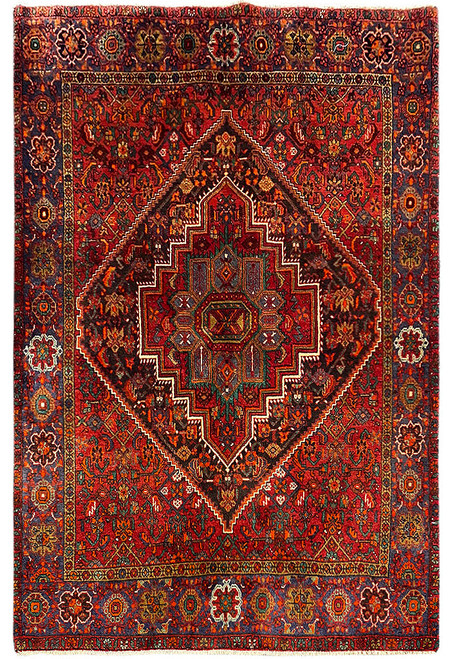
This 4'5" x 6'7" Persian Josheghan was knotted in the 1970s and has come through the last 50 years in perfect shape, with a full, even wool pile and firm, straight sides. It is a small rug carrying a great deal of drawing: the entire orange red field is organized into a diamond grid, and each diamond holds its own flower head, spray or rosette, so the eye keeps finding something new at close range. The weave is wool pile on a cotton foundation, and the back shown in the last photograph gives you an honest look at how tightly and evenly the rows were beaten down. Because the proportions sit between two standard classes, it works where a 4x6 is too short and a full 5x7 Persian rug is too much floor. Every rug we ship carries our certificate of authenticity recording origin, materials, age and size.
Design and Motifs
The Josheghan signature is exactly what you see here: a lattice of small diamonds stacked edge to edge across the whole field, each one filled with a stylized bloom, a cluster of tiny flower heads, a cypress-like sprig or a dotted diaper pattern. It is a true all over design, drawn in straight lines and angles rather than curves, with a single small stepped medallion in navy at the center and ivory corner spandrels that frame the field without interrupting the grid. Scattered through the lattice are 8 petal rosettes, hooked crosses, little vases and bird-like devices, all rendered in the clipped geometric vocabulary of village weaving. The main border runs a line of alternating ivory and red cartouche panels and palmettes over a navy ground, and is held in place by several narrow guard stripes of zigzag and running flower motifs. The repeating structure means the rug reads as calm pattern from standing height and as a catalogue of tiny motifs when you are sitting beside it.
Color Palette
The field is an orange red with a brick, terracotta cast rather than a cherry or blue red, warm enough to sit against oak, walnut and stone and still strong enough to anchor a room. Against it the lattice lines and motifs are picked out in ivory, soft gold, mid blue, a dusty light blue and a muted sage green, with small touches of deep aubergine and rust inside the flower heads. The main border is dark navy, close to indigo black in the shade, and that depth throws the warm field forward and makes the ivory panels read almost white. The center medallion repeats the same navy, which ties the middle of the rug to its frame. There is gentle variation in the red across the field, the natural abrash of a hand-dyed village wool, and it is a virtue rather than a flaw. Buyers working around warm tones will find it sits comfortably with other red and burgundy Persian rugs, and the wool still carries a soft sheen where the light crosses the pile.
Josheghan Origin and Weave
Josheghan is a village in central Persia, northwest of Isfahan, with a weaving record going back to the Safavid period and a design identity so fixed that the diamond lattice is known simply as the Josheghan pattern wherever Persian rugs are sold. The weavers there work in the village tradition, on cotton warps with a firm wool pile, and the quality shows in the discipline of the grid: across more than 6 feet of length the diamonds stay square and the rows stay even, which is harder to achieve on a geometric repeat than on a curved medallion. The wool is local, springy and long staple, which is why a piece from the 1970s can still have this much body and almost no visible wear. For collectors wanting to understand how pieces like this are placed in time, our guide on how to date an Oriental rug explains the clues in the dyes, the back and the finishing of the ends and sides, all of which point to a mid-century Josheghan workshop weave.
4'5" x 6'7" Persian Josheghan Rug | Bold Diamond Lattice | 1970s Vintage
Ask about this rug
This piece is the only one of it, so the things worth knowing about it are particular to it. If you want to talk through the size, the colour in your own light, or the weave, speak to someone here first.
Related rugs
-

-

4'5" x 6'7" 4'5" x 6'7" Persian Qum Rug | Charming Bird Garden | Ivory Fine Kork Wool | 2000's
Was: $7,130.00Now: $6,799.00 -

-
-
