Watch the film
| Size in ft: | Width: 10'1" x Length: 13'6" |
| Size in Inch: | Width: 121" x Length: 162" |
| Size in meters: | Length: 4.11 x Width: 3.07 m |
| Colors: | Rust, Blue, Ivory, Brown |
| Shape: | Rectangular |
| Woven: | 100% Hand-knotted | Handmade |
| Foundation: | Cotton |
| Pile: | |
| Age: | 1970s | Approx. 50 years old |
| Design: | Joshagan | Diamond Lattice | Center Medallion |
| Origin: | Persian Joshagan | Made in Persia |
| Condition: | Excellent | Full even pile |
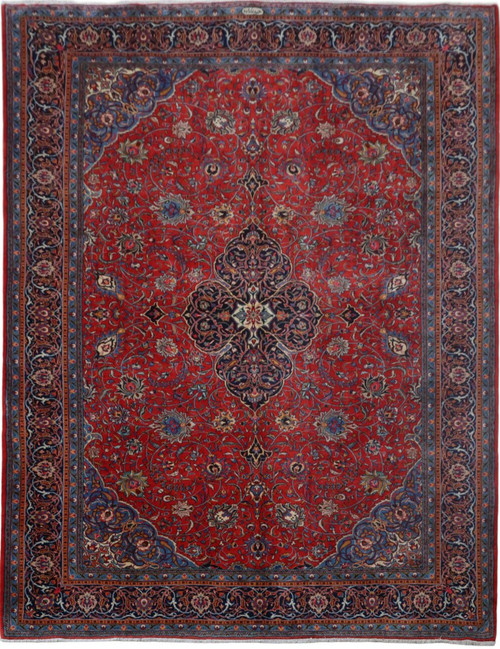
10'1" x 13'6" Persian Joshagan Rug | Rust Lattice Field with Navy Diamond Medallion | 1970s, Excellent Condition
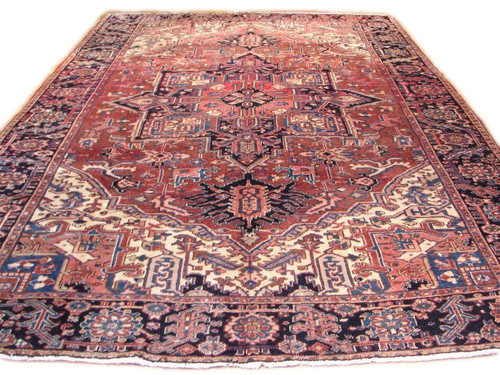
A 1970s village weave from Joshagan in central Persia, this piece carries the design the town has been repeating, with small variations, for centuries: a rust field divided into a diamond lattice, a small stepped medallion holding the center, and deep blue spandrels cut across all 4 corners. The wool pile is full and even end to end, the colors have mellowed into that soft, slightly abrashed terracotta that only real time on a real floor produces, and at 10'1" x 13'6" it lands in the most useful room size there is, sitting alongside our other 10 x 14 Persian rugs. Every rug we ship travels with a certificate of authenticity documenting origin, materials and construction.
Design and Motifs
The field is drawn as a continuous diamond grid, each compartment holding a single stylized element: an 8 petal rosette, a small cross-form floral spray, a serrated leaf cluster or a miniature diamond. Nothing curves. Every line is stepped or angled, which is what puts this squarely among geometric Persian rugs rather than the curvilinear city workshops nearby. At the center sits a compact navy diamond medallion outlined twice in ivory, with a slender blue cartouche inside it and small rust tabs at either side. The 4 corners are filled by large blue spandrels, each planted with red palmettes, brown rosettes and orange botanical sprays, and they are separated from the field by a crisp ivory zigzag line. The main border runs on a dark brown ground with alternating panel cartouches in red, blue and orange, flanked by reciprocal ivory guard stripes and finished with a red outer band.
A Rust Field Against Indigo Corners
The dominant note is a warm brick rust that reads terracotta in daylight and deepens toward brownish red under lamplight, with gentle horizontal abrash across the open areas of the field where the dye lots shifted on the loom. Against it, the spandrels and medallion are a saturated indigo blue that stays clearly blue rather than going black, and the smaller motifs pick up a lighter mid-blue that keeps the lattice from flattening out. Ivory does the structural work here, outlining the medallion, the zigzag field edge and the reciprocal guard bands, so the composition stays legible from across a room. Supporting shades include dark chocolate brown in the main border, olive and khaki green in the leaf forms, soft gold and a bright pumpkin orange used sparingly in the corner sprays, plus small touches of ox blood red and cream in the border panels.
Joshagan: Weaving Between Isfahan and Kashan
Joshagan sits in the mountains of central Persia between Isfahan and Kashan and is one of the oldest continuously weaving towns in the country, with looms documented there since the Safavid era. Unlike its two famous neighbors, Joshagan never chased knot count. Its weavers built a reputation on one instantly recognizable field plan and on hard-wearing local wool, knotted on a cotton foundation at a firm village weight that takes decades of traffic without thinning. This example shows the pile depth, lanolin sheen and squared-up handle you expect from that tradition, and the 1970s production window is consistent with the wool quality and dye palette seen here, a period our guide on dating an Oriental rug covers in detail. Sides and ends are intact, the fringe is original, and the back shows even, consistent knotting across all 13 feet of length.
10'1" x 13'6" Persian Joshagan Rug | Rust Lattice Field with Navy Diamond Medallion | 1970s, Excellent Condition
Ask about this rug
This piece is the only one of it, so the things worth knowing about it are particular to it. If you want to talk through the size, the colour in your own light, or the weave, speak to someone here first.