Watch the film
| Size in ft: | Width: 6'4" x Length: 10'1" |
| Size in Inch: | Width: 76" x Length: 121" |
| Size in meters: | Length: 3.07 x Width: 1.93 m |
| Colors: | Red, Navy Blue, Ivory, Rose Pink, Sage Green, Camel, Dark Brown |
| Shape: | Rectangular |
| Woven: | 100% Hand-knotted | Handmade |
| Foundation: | Cotton |
| Pile: | |
| Design: | Tabriz Floral Medallion | All Over Flowering Vine Field |
| Origin: | Persian Tabriz | Made in Persia |
| Condition: | Excellent | Even pile throughout |
6'4" x 10'1" Persian Tabriz Rug | Red Floral Medallion Field | Excellent Condition
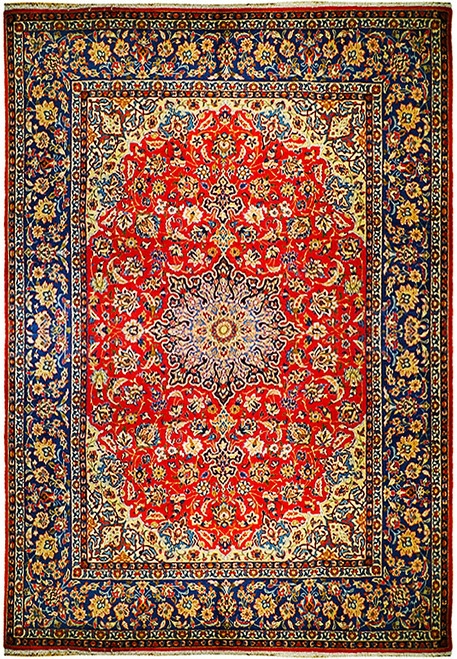
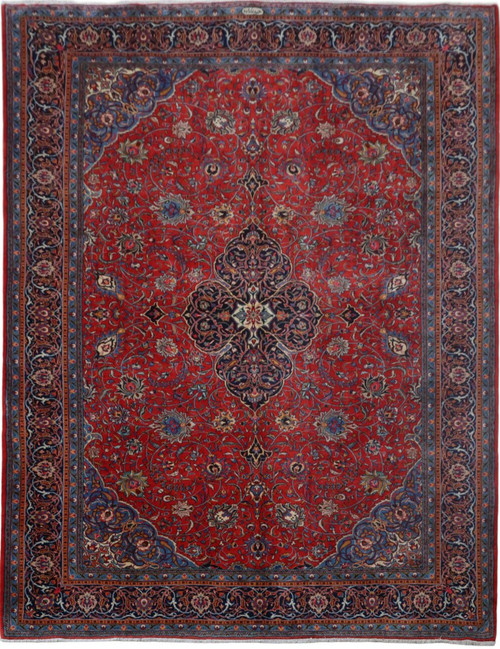
This 6'4" x 10'1" Persian Tabriz is a town-woven piece in the classic northwest Persian formula: a deep red field, a lobed ivory and navy medallion set dead center, and a wide indigo border carrying flowering plants between ivory guard stripes. The wool pile is clipped low and evenly, which is why the fine curved drawing stays legible right down to the smallest blossom, and the cotton foundation gives the rug the flat, obedient lie that makes a 6 by 10 easy to place under furniture. Condition is excellent with full, even pile and clean selvedges, and every rug we sell ships with our certificate of authenticity documenting origin, materials and hand-knotted construction.
Please Note About the Photographs:
The medallion close-up was taken under direct light and reads brighter and pinker than the rug actually is. The true field color is the deeper red shown in the full overhead and angled photographs.
Design and Motifs
The center medallion is built in three layers: a navy outer frame of scrolling cartouches, a pale ivory ring filled with tiny rosettes, and a coral and sage 8 petal rosette at the core. A pendant palmette anchors the medallion at the top and the bottom, and from there the drawing opens into a true all over floral field: flowering vases rising from the lower end, long weeping sprays of leaf and bud, dark brown branches, and large curled cream leaves that sweep diagonally across the upper corners. Small bird figures sit among the vines in the field, a detail Tabriz workshops use to break up open ground. The wide navy border alternates rosettes with upright flowering plants, framed inside and out by ivory guard bands of linked red rosettes, and a narrow pale blue stripe outlines the field itself and keeps the red from running into the border.
A Study in Deep Red, Indigo and Ivory
The field is a saturated cool red with a faint raspberry cast, the kind of tone that turns warmer under lamplight and slightly cooler under daylight. Against it the border reads as a dense indigo navy, almost black where the wool takes the dye hardest, so the rug carries a strong dark frame on all 4 sides. Inside that structure the palette is far richer than a simple two color scheme suggests: buttery ivory and cream in the medallion and the large curled leaves, soft rose pink and dusty mauve in the border blossoms, sage and teal green in the leaf tips, camel and gold in the vine work, and dark coffee brown in the branches. Buyers hunting specifically for red Persian rugs should note how much of the surface is actually drawn in ivory and pink, which keeps this piece from feeling heavy in a smaller room.
Tabriz Weaving in Northwest Persia
Tabriz sits in the far northwest of Persia and has been the commercial and technical capital of Persian weaving for centuries. Its workshops measure fineness in Raj, the number of knots counted across a gereh of about 2.75 in of width, and they built their reputation on curvilinear drawing: medallions that close cleanly, vines that keep their curve, border plants that repeat without drifting. That discipline shows here in the symmetry of the 4 corners and in the way the pendant palmettes line up exactly on the center axis. The reverse, photographed with a ruler for scale, shows tight, regular knot rows on a cotton warp and weft, with the colors reading crisply from the back, the mark of a well beaten, workshop-standard weave rather than loose village work. Hard-twist northwest wool is what gives the surface its slight sheen and its resistance to crushing, and it is the reason a Tabriz of this quality holds its drawing for generations.
6'4" x 10'1" Persian Tabriz Rug | Red Floral Medallion Field | Excellent Condition
Ask about this rug
This piece is the only one of it, so the things worth knowing about it are particular to it. If you want to talk through the size, the colour in your own light, or the weave, speak to someone here first.