Watch the film
| Size in ft: | Width: 10'6" x Length: 13'6" |
| Size in Inch: | Width: 126" x Length: 162" |
| Size in meters: | Length: 4.11 x Width: 3.20 m |
| Colors: | Rust, Blue, Olive, Ivory, Brown |
| Shape: | Rectangular |
| Woven: | 100% Hand-knotted | Handmade |
| Foundation: | Cotton |
| Pile: | |
| Age: | 1980's |
| Design: | Joshagan | Diamond lattice | Stepped diamond medallion |
| Origin: | Persian Mahal | Made in Persia |
| Condition: | Excellent | Full even pile |
10'6" x 13'6" Persian Mahal Rug | Joshagan Diamond Lattice | 1980s Rust & Navy Wool
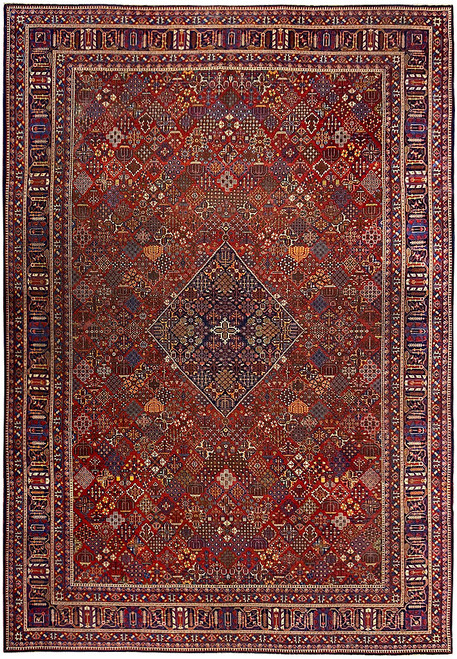
This is a 1980s Persian Mahal woven in the classic Joshagan manner: a rust field carrying a strict diamond lattice, a stepped ivory and indigo medallion at dead center, and four deep blue corner spandrels that box the field in. At 10'6" x 13'6" it is a true room-size piece, wide enough to hold a full seating group or a 10 seat dining table with the chairs pulled out, and it sits comfortably among 10x14 Persian rugs in a great room or open plan space. The wool is dense and the pile is full and even across the whole surface, with no thin spots and clean, original selvages and fringe. Every rug we sell ships with a certificate of authenticity confirming it is hand-knotted, its origin and its materials.
Design and Motifs
The Joshagan drawing works on a grid. The field is divided into hundreds of small diamond cells, and each cell holds one stylized element: an 8 petal rosette, a tiny cypress or shrub, a clustered flower head, a squared star. Nothing repeats mechanically, so the eye keeps finding small changes in color and filler as it moves across the field. At the center sits a stepped diamond medallion on indigo, edged with an ivory sawtooth and a pale olive chain, and inside it a cream quatrefoil cartouche flanked by yellow tendrils and rust rosettes. The four spandrels repeat the same lattice logic on a navy ground, which is what gives an all over design like this its sense of a framed garden rather than a loose field. The main border is a brown and ivory cartouche band of alternating panels, held between rust and navy guard stripes carrying a continuous vine and rosette meander.
A Rust Field Against Indigo and Olive
The ground color is a warm terracotta rust that shifts toward salmon and copper depending on where the light falls, which is exactly what good madder-toned wool does when it is hand spun. Against it the weaver set a deep indigo, almost ink blue, for the medallion, the spandrels and the outer guard, and the contrast between the two is the whole rug. The smaller notes do the fine work: olive green and a soft pale celadon in the medallion chain and the leaf tips, clear yellow gold in the tendrils, ivory and cream in the sawtooth outlines and the border panels, and a dark coffee brown that reads nearly black in the cartouche band. Turquoise flecks appear in the little rosettes scattered through the field. In a room this palette lands warm rather than bright, and it pairs easily with oak, walnut, brass and unbleached linen.
Mahal Weaving and the Joshagan Tradition
Mahal is the name given to the village weaving of the Arak region in west central Persia, an area that has supplied large, heavy, honest room-size rugs to Western houses for well over a century. The looms there are wide, the wool is long staple and oily, and the knotting is deliberately robust rather than fine, which is why a Mahal takes decades of real traffic and only improves in color as it goes. The Joshagan pattern this one carries comes from a small town north of Isfahan whose lattice-and-medallion formula was copied across the region because it scales so well to big rugs. The back, visible in the photographs, shows a tight and regular cotton foundation with the knot rows perfectly straight, the mark of a weaver working an accurate cartoon on a properly tensioned loom. Among geometric Persian rugs of this scale, a 1980s example with full pile and unfaded indigo is getting harder to find each year.
10'6" x 13'6" Persian Mahal Rug | Joshagan Diamond Lattice | 1980s Rust & Navy Wool
Ask about this rug
This piece is the only one of it, so the things worth knowing about it are particular to it. If you want to talk through the size, the colour in your own light, or the weave, speak to someone here first.