| Size in ft: | Width: 4'3" x Length: 6'9" |
| Size in Inch: | Width: 51" x Length: 81" |
| Size in meters: | Length: 2.06 x Width: 1.30 m |
| Colors: | Navy Blue, Red, Ivory, Salmon, Sage Green |
| Shape: | Rectangular |
| Woven: | 100% Hand-knotted | Handmade |
| Foundation: | Cotton |
| Pile: | Wool | Low Pile |
| Age: | 1930's | Antique |
| Design: | Josheghan | Diamond lattice with center medallion |
| Origin: | Persian Kashan | Made in Persia |
| Condition: | Excellent | Low pile with antique patina |
4'3" x 6'9" Antique Persian Kashan Dabir Rug | Josheghan Diamond Lattice | 1930s Low Pile
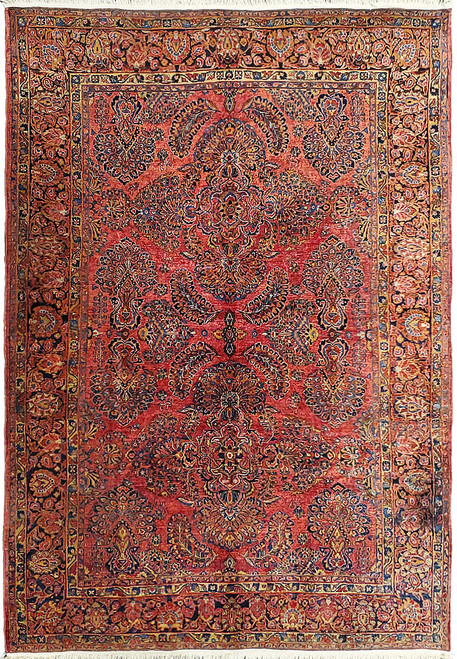
This is a genuine antique from the 1930s, woven in central Persia in the Kashan Dabir manner and drawn in the old Josheghan idiom: a deep indigo field carved into diamond compartments, each one filled with a small flowering shrub or rosette cluster, with a single red stepped medallion holding the center. At 4'3" x 6'9" it is an accent size that carries a full city drawing rather than a simplified village sketch, and nearly 90 years of use have taken the wool down to a low, even, slightly glossy pile that shows the pattern with unusual clarity. The handle is supple, the back is tight and legible (see the folded corner photograph), and the piece lies flat without ripple. Every rug we sell ships with a certificate of authenticity confirming age, origin, materials and hand-knotted construction. Collectors who want to understand how a piece like this is dated can read our guide on how to date an Oriental rug by weave, dye and finishing.
Please Note About the Photographs:
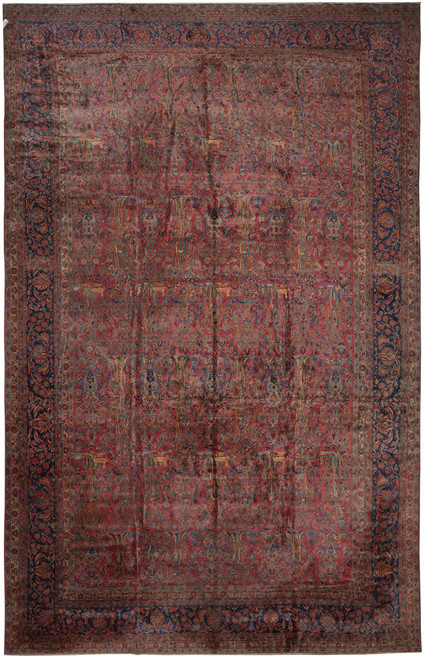
The first image is a flat studio capture and reads darker and more muted than the rug is in person. The floor photographs taken in daylight, and the close-up details, are the truer record of the color: the field is a living indigo with visible abrash, and the reds are warmer and brighter than the studio frame suggests.
Design and Motifs
The field is a classic Josheghan lattice: fine ivory and red diagonal lines cut the indigo ground into repeating diamonds, and every diamond holds its own small motif, alternating between 4 petal rosette clusters, stylized flowering shrubs and slender cypress-like sprays. The rhythm is strict but never mechanical, and the weaver let the motifs shift slightly in scale as the lattice runs toward the ends, which is exactly what you want to see in a hand-drawn antique. At the center sits a stepped red diamond medallion carrying an ivory cartouche with a 4 lobed navy floral rosette, flanked by two small pendants. The 4 corners are resolved with diagonal banded spandrels striped in ivory, gold and sage, a signature treatment of this group. The border is a 7 band system: a wide red main border of hooked palmettes, leaf sprays and small navy rosettes, framed by narrow navy bands and a crisp ivory reciprocal guard stripe that keeps the whole composition tightly contained.
A Deep Indigo Field Against Madder Red
Color is the reason this piece still reads as a serious antique. The ground is a deep indigo navy that photographs almost black in low light and opens into true blue in daylight, with soft horizontal abrash bands where the dye lot changed on the loom. Against it the weaver set two distinct reds: a cool madder brick in the main border and the medallion, and a warmer salmon-coral in the smaller rosettes, so the field never flattens out. Ivory does the structural work, drawing the lattice lines, the reciprocal guard stripe and the medallion cartouche, and it has aged to a warm oatmeal rather than a bright white. Sage green and a dull gold appear in small quantities in the shrub bases, the banded corner spandrels and scattered leaves, and those two colors are the best evidence of natural dyeing here. The overall effect in a room is dark, jewel-toned and quiet, a navy and red palette that anchors light walls and pale wood floors without competing with them.
Kashan Weaving and the Josheghan Tradition
Kashan sits in central Persia, north of Isfahan, and its looms carry the Safavid court workshop tradition forward on soft, lustrous local wool. The Dabir workshops were among the names that kept that standard alive through the first half of the 20th century, and the marks of that work are all here: a cotton foundation with depressed warps, a tight, regular knot count that allows the lattice lines to stay one knot wide over 6'9" of length, and finely drawn small motifs that a coarser loom simply cannot hold. The Josheghan pattern itself comes from a weaving village between Kashan and Isfahan, and city workshops adopted it because the geometry rewards precision. Wool this good takes decades of traffic and responds by polishing rather than shedding, which is why the low pile on this piece looks burnished instead of tired. If you want the full background on the group, our guide to Persian Kashan rugs covers the workshops, the wool and what separates a true Kashan from a copy.
4'3" x 6'9" Antique Persian Kashan Dabir Rug | Josheghan Diamond Lattice | 1930s Low Pile
Ask about this rug
This piece is the only one of it, so the things worth knowing about it are particular to it. If you want to talk through the size, the colour in your own light, or the weave, speak to someone here first.