| Size in ft: | Width: 13'6" x Length: 15'10" |
| Size in Inch: | Width: 162" x Length: 190" |
| Size in meters: | Length: 4.83 x Width: 4.11 m |
| Colors: | Rust, Brown, Sage, Black |
| Shape: | Rectangular |
| Woven: | Hand-Knotted |
| Pile: | Wool - Low Pile |
| Origin: | Persia |
| Design: | Antique Kermanshah |
| Age: | 1930's |
| Condition: | Very Good- Low Worn Pile But String To Last Another 50 Years |
13'6" x 15'10" Antique Persian Kermanshah Rug | Signed 1930s Medallion Design | Low Pile Wool
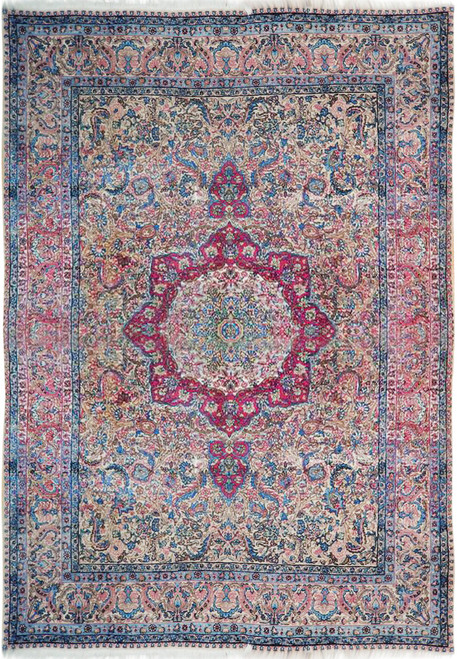
This is a near square antique floor piece from the 1930s, 13'6" x 15'10" of hand-knotted wool that has spent roughly 90 years being walked on and has come out of it beautifully. The field has settled into a soft camel gold, the medallion and its pendants still read clearly in rose and raspberry, and the wide indigo border remains deep and unbroken around all 4 sides. A small woven cartouche sits in the border, the mark of a workshop that put its name on the piece. Among oversize Persian rugs this format is unusually useful, wide enough to hold a full seating group with all legs on the wool. It ships with a certificate of authenticity.
Please Note About the Photographs:
The pile on this rug is low, and the photos show that honestly. In several areas of the field the wool has worn down to a fine even nap, which lightens the drawing and gives the surface its washed, antique look. That is age and patina, not damage. The knots are tight, the foundation is sound, the ends and sides are intact, and the rug is strong enough for decades of continued use. It is professionally washed, steamed and pressed before it leaves us.
Design and Motifs
The drawing is fully curvilinear, the kind of flowing floral work the Kerman weaving district built its name on. A lobed central medallion sits in the middle of the field with stepped pendants running north and south, each one filled with small rosettes, leaf sprays and serrated palmettes outlined in black. Around it the field is covered with an ornate lattice of vases, arched panels, cypress-like leaf forms and open blossoms, arranged in strict mirror symmetry so that the top half answers the bottom half detail for detail. Broad spandrels close off the 4 corners. The border system runs 5 bands deep: a wide indigo main border carrying alternating floral cartouches and paisley boteh figures, flanked by rose and camel guard stripes of small rosettes and reciprocal vine, and finished with a fine black meander at the outer edge. The woven cartouche panel is set directly into that main border, framed in navy and ivory.
A Palette Aged Into Gold and Rose
The ground is a warm camel gold that shifts toward ivory and pale sand where the pile sits lowest, with natural abrash banding visible across the width in the full length photographs. Against it the weaver drew in rust and brick red, deep raspberry and dusty rose, with sage green filling the leaves and small flower centers. Black is used sparingly as an outline color, tracing the medallion, the vases and the cartouche panels so the pattern keeps its definition even where the wool has thinned. Brown tones run through the vine work and the older sections of the field. The main border is the darkest element in the rug, a near black indigo that frames everything and makes the gold field read brighter than it is. The overall effect is soft and faded rather than saturated, which is exactly why antique Kerman weaving works so well with modern furniture, oak floors and neutral walls.
Kermanshah Weaving and the Kerman Tradition
Kermanshah is the trade name that reached the American market for the finest grade of weaving coming out of the Kerman district in southeastern Persia, and it stuck to pieces exactly like this one: fine wool, a high knot count on a cotton foundation, and drawing precise enough to carry a curved line across 15 feet without a break. Kerman workshops worked from full cartoons prepared by a designer, which is why the symmetry here holds so well at this scale, and the pictorial floral border is the region's signature more than any single medallion form. The low, even wear, the cotton warps and the character of the dyes all sit comfortably with a 1930s attribution; if you want to understand how those clues are read, our guide on how to date an Oriental rug walks through the same evidence. Signed antiques in this size rarely surface intact.
13'6" x 15'10" Antique Persian Kermanshah Rug | Signed 1930s Medallion Design | Low Pile Wool
Ask about this rug
This piece is the only one of it, so the things worth knowing about it are particular to it. If you want to talk through the size, the colour in your own light, or the weave, speak to someone here first.