Watch the film
| Size in ft: | Width: 10'4" x Length: 17'3" |
| Size in Inch: | Width: 124" x Length: 207" |
| Size in meters: | Length: 5.26 x Width: 3.15 m |
| Colors: | Blue, Rust, Brown, Burgundy |
| Shape: | Rectangular |
| Woven: | 100% Hand-knotted | Handmade |
| Foundation: | Cotton |
| Pile: | |
| Age: | 1970s | Vintage |
| Design: | Tribal | Repeating Diamond Lattice | All-Over Field |
| Origin: | Persian Tribal | Made in Persia |
| Condition: | Excellent | Ready to use |
10'4" x 17'3" Persian Tribal Rug | Oversize Blue Diamond Lattice | Vintage 1970s
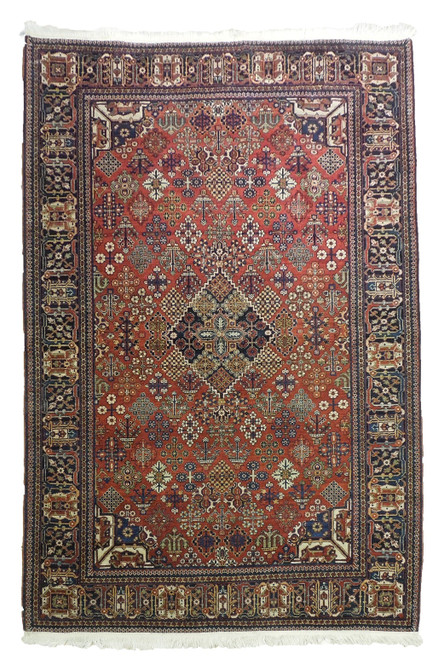
This is a big, confident village weaving from the 1970s, 10'4" x 17'3" of hand-knotted wool laid out as a lattice of burgundy medallions across a deep denim blue ground. Tribal weavers rarely worked at this scale, which is exactly what makes the piece interesting: the drawing stays steady row after row, the wool has the dry, springy handle that only comes from good mountain fleece, and the colors have settled into that slightly uneven, sun-warmed tone that no new rug can fake. It is one of the more usable pieces in our oversize Persian rugs group, heavy enough to hold a full seating plan and forgiving enough to live with. Every rug ships with a certificate of authenticity confirming origin, materials and hand-knotted construction.
Design and Motifs
The field is built from 5 columns of hooked, shield-shaped medallions stacked the length of the rug, each one outlined in golden ivory and joined at the tips so the whole surface reads as a continuous diamond lattice. Inside every medallion sits a small stepped cartouche filled with fine speckled detail and a single rosette at the center, with tiny cruciform flowers and paired hooks scattered through the burgundy ground. Soft camel-brown wedges fill the 4 corners in place of formal spandrels, and along the lower end the weaver added a row of small bird figures in rust and ivory, the sort of personal flourish that separates a genuine tribal piece from a workshop copy. The border system is layered: a main band of rust and red blossoms on navy, flanked by narrow guard stripes carrying a red meander and a repeating hooked vine, each one drawn slightly freehand so the rhythm shifts as your eye travels around the rug.
A Deep Blue Field With Burgundy, Rust and Camel
The dominant color is a deep denim to indigo blue, and it moves: horizontal bands of lighter and darker blue run across the field where the weaver changed dye lots, the natural abrash that collectors look for. Against it the medallions read as a dark burgundy shading toward aubergine in places, edged with a warm golden ivory that does all the work of separating one shape from the next. Rust and terracotta carry the border blossoms and the small bird figures, while camel brown fills the corner wedges and softens the transition into the surround. Look closely at the pile detail and you will find pinpoints of pale blue, brick red and the occasional green inside the medallion cores. The overall effect is rich rather than dark, and the ivory outlining keeps the pattern legible from across a large room.
Persian Tribal Weaving and Build Quality
Tribal and village weavers in Persia worked from memory and from patterns handed down in the family rather than from a cartoon, which is why the medallions here vary a little in width while the overall grid holds true. The back photograph shows tight, even knot rows and a firm hand, and the selvage is wrapped in dark wool the way a working household rug was finished, built to be walked on rather than admired from a distance. A piece of this length would have required a long loom and many months of weaving, so it was almost certainly a commissioned or dowry-scale project. The wool still has its lanolin and the pile stands up cleanly, consistent with a 1970s weaving that saw careful use; if you want to understand the clues that place a piece in a decade, our guide on how to date an Oriental rug walks through the same details we check.
10'4" x 17'3" Persian Tribal Rug | Oversize Blue Diamond Lattice | Vintage 1970s
Ask about this rug
This piece is the only one of it, so the things worth knowing about it are particular to it. If you want to talk through the size, the colour in your own light, or the weave, speak to someone here first.